
24/7 全天候客户支持

免费退货

当日/次日达

品质保障

开启新人专享福利: 全场免邮 | 低至 2 折 | 免费试用 30 天 JoyPlus 会员
下载 Joybuy
A kids play kitchen is more than just a toy; it's a hub for imagination, learning and hours of creative fun. But with so many options on the market, it's easy to feel overwhelmed. Many parents find themselves disappointed when a promising purchase arrives, only to fall short of expectations. As the Joybuy Product Recommendation Officer, my role is to help you navigate the choices and identify the key features that truly matter, ensuring you find a toy kitchen that will be loved for years to come.
Before you add anything to your basket, let's look at a few common pitfalls that can lead to buyer's remorse.
To avoid these issues, focus on a few core parameters. Getting these right is the key to a successful purchase that supports your child's development through role-play.
The first checkpoint is safety and durability. In the UK, all toys must comply with EN71 standards, which cover everything from mechanical and physical properties to the absence of harmful chemicals in paints and materials.
This is arguably the most overlooked yet crucial factor. A kitchen that isn't the right size won't be comfortable or engaging. Before buying, measure the space you have available and compare it to the product's assembled dimensions.
Most importantly, check the countertop height.
Consider whether you want an all-in-one set or prefer to build a collection over time. While some kitchens come with a good starter set of accessories, you can often achieve higher quality and more specific play scenarios by buying them separately. A high-quality pretend food set or a dedicated toy coffee machine can elevate the play experience far more than a dozen flimsy plastic forks.
Based on these practical criteria, here are a few options from our catalogue, matched to different family needs and play styles.
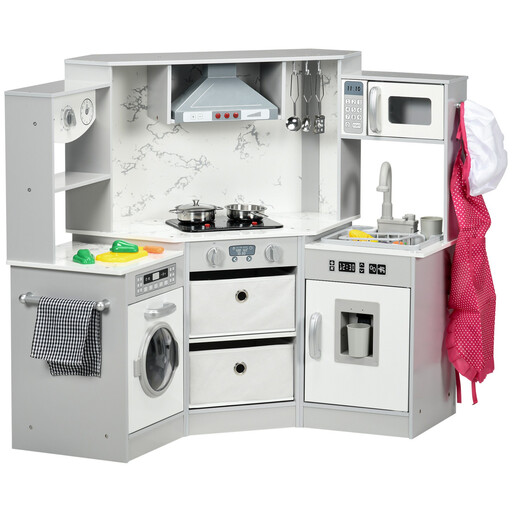
Why This Fits Their Persona: This is for the parent looking for a complete 'wow' gift. It's a large corner unit packed with interactive features, including a microwave, washing machine and a full set of accessories, providing everything needed for immersive play straight out of the box.
It directly counters the "interactive disappointment" pitfall. The sink uses a water circulation system to minimise mess, and the sound and light effects are integrated into multiple appliances (hood, dispenser) for varied play.
The comprehensive feature set, including a functional water sink and included apron/hat, offers a complete role play kitchen experience without needing immediate extra purchases.
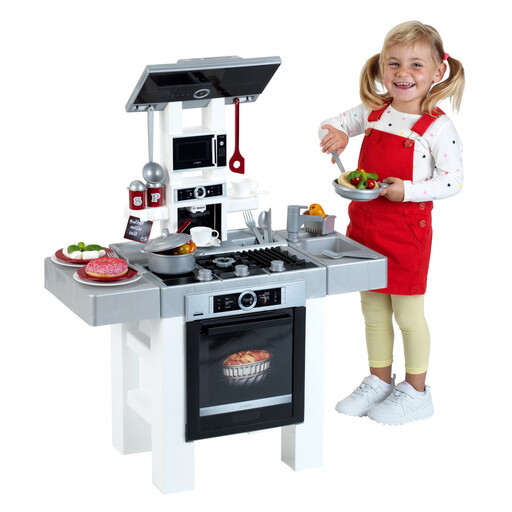
Why This Fits Their Persona: Ideal for families with siblings or for hosting playdates. This kitchen is cleverly designed to be played with from both sides, providing ample space for two or more children to cook together without getting in each other's way.
It solves a problem many parents don't anticipate: sibling squabbles over a single play space. Its robust German design and quality accessories also sidestep the "flimsy extras" trap by providing durable, well-made items like an espresso set and cookware.
The double-sided design is its standout feature, promoting collaborative play and social skills. It also includes a water pump sink and a gas hob with sound and light effects.
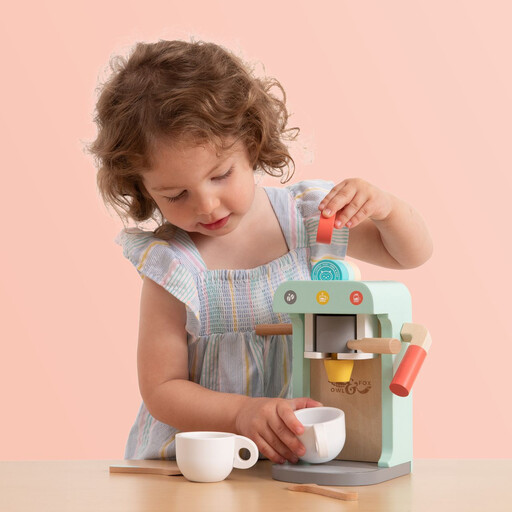
Why This Fits Their Persona: Perfect for parents who prefer to invest in high-quality, sustainable pieces over an all-in-one plastic set. This approach allows you to build a custom play kitchen accessories collection that is durable, aesthetically pleasing and tailored to your child's interests.
This strategy completely bypasses the "flimsy accessories" trap. Instead of getting 20 low-quality items in a bundle, you are purchasing a single, beautifully crafted wooden toy that is built to last and encourages focused, imaginative play.
Crafted from FSC-certified wood, it's an environmentally conscious choice. Its simple, robust design complements other wooden toys and fosters independent, Montessori-style play.
We have compiled a complete, real-time list of products that fully satisfy these strict selection criteria and UK safety regulations.
Most play kitchens are designed for children aged 3 to 6 years. At this stage, children are developing crucial fine motor skills, engaging in imaginative role-play and learning social skills like sharing and cooperation. A toddler kitchen set provides the perfect platform for them to practice these abilities by mimicking everyday activities.
Assembly time can vary significantly. Simpler models might take under an hour, while a large, feature-rich wooden play kitchen could take two hours or more. It's always a good idea to check the product description for assembly information and ensure you have the necessary tools (usually just a screwdriver) before you begin.
They can be, but modern designs have improved. Look for models that specify a "water circulation system" or "closed-loop" pump. This means the water is recycled from the sink back to the tap, greatly reducing the risk of spills. Even with these features, it's wise to place a mat underneath and supervise water play.