Low-sugar recipe experimenters
If you want to vary the chocolate, sweetener or portion size, allow for small trials: the International Dairy Foods Association explains that sugar affects softness, scoopability and body as well as sweetness.


Choose a pre-frozen-tub processor for separate chocolate recipe trials, a freezer-bowl churner for a planned shared batch, or a built-in-compressor machine when you want to make successive batches without pre-freezing a bowl. None can guarantee a scoopable low-sugar result: reducing sugar also changes freezing behaviour and body, so test your chosen recipe before making a larger batch.
If you want to vary the chocolate, sweetener or portion size, allow for small trials: the International Dairy Foods Association explains that sugar affects softness, scoopability and body as well as sweetness.
If you want one larger churned batch and can prepare ahead, a freezer-bowl model may fit. Cuisinart UK specifies a 2 L capacity and a 12-hour bowl pre-freeze for the ICE30BCU.
If you want to make successive recipes without keeping a bowl in the freezer, consider a compressor model. Cuisinart UK states that the 1.5 L ICE150U needs no bowl pre-freezing and supports back-to-back batches.
Choose when: You want to prepare separate chocolate bases and process each portion later.
Allow for: The filled tubs must freeze before processing; Ninja Kitchen UK says to freeze NC300UK ingredients overnight.
Choose when: You prefer to churn a liquid base into a planned, shared batch.
Allow for: The bowl needs freezer space and advance preparation; Cuisinart UK specifies 12 hours for the ICE30BCU.
Choose when: You want to churn successive chocolate batches without pre-freezing a removable bowl.
Allow for: Self-freezing changes the preparation workflow, not how an untested low-sugar recipe freezes.
| Concern | What to check | Who this matters to |
|---|---|---|
| Low-sugar texture | Check whether the machine processes a frozen base or churns liquid, and whether you can trial a small portion. | If I change the sweetener, I want to test whether my chocolate ice cream stays scoopable before making more. Around 36% of consumers put low-sugar texture first. |
| Batch readiness | Check the required pre-freeze time and whether the model supports successive batches. | Making several flavours in one session matters more to me than preparing a bowl or tubs ahead of time. Around 29% of consumers prioritise batch readiness. |
| Space and setup | Check where the bowl or filled tubs will fit in your freezer and the appliance on your counter. | If freezer room is limited, I need a preparation method that fits the space I actually have. Around 21% of consumers put space and setup first. |
| Serving format | Compare included tub sizes with bowl capacity and, where stated, usable working capacity. | I need to decide between separate chocolate trials and one dessert to share. Around 14% of consumers make serving format their primary concern. |
Sugar also affects freezing behaviour and body, according to the International Dairy Foods Association. Changing it can alter firmness and scoopability regardless of the machine.
Start with a recipe designed for your chosen sweetener and trial a small chocolate batch before scaling up.
Cuisinart UK specifies a 12-hour pre-freeze for the ICE30BCU bowl; Magimix UK specifies 10–12 hours for Le Glacier. Neither workflow starts with an unfrozen bowl.
Measure your available freezer space and check the model instructions for how its bowl must be stored.
Magimix UK states a 0.6 L working capacity for Le Glacier despite its 1.1 L total capacity. Ninja’s NC300UK instead uses three separate 473 ml tubs, according to its Joybuy listing.
Choose based on the amount you can make per cycle and whether you want one shared flavour or separate trials.
UK government guidance advises cooling cooked food and refrigerating it within one to two hours; it recommends a fridge temperature of 0–5°C.
For a cooked chocolate base, cool and refrigerate it promptly, keep it chilled until the machine instructions call for processing, and freeze finished portions promptly.
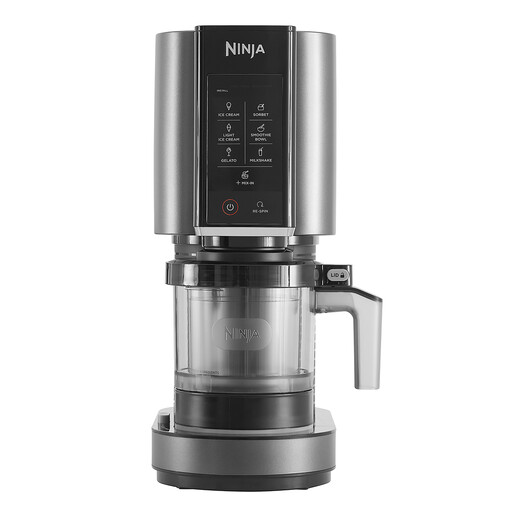
The CREAMi NC300UK takes a frozen-tub approach rather than churning an unfrozen liquid base. Its Joybuy listing identifies three 473 ml tubs.
Cuisinart UK lists two distinct workflows here: the 2 L ICE30BCU uses a pre-frozen bowl, while the 1.5 L ICE150U has a built-in compressor.
Le Glacier is a compact freezer-bowl option for smaller recipe trials, with a 0.6 L working capacity stated by Magimix UK.
This Joybuy choice represents the pre-frozen-tub approach for preparing separate low-sugar chocolate bases ahead of time.
 No image available
Consider it if you want to prepare separate chocolate bases and process them after freezing, rather than churn a liquid base immediately.
The listing identifies three 473 ml tubs and seven programmes. Ninja Kitchen UK says NC300UK ingredients must be frozen overnight; a low-sugar programme or recipe choice does not guarantee the texture of your particular base.
No machine can guarantee that result for every recipe. The International Dairy Foods Association explains that sugar contributes to softness and body as well as sweetness; test a small batch using the cocoa, base and sweetener you intend to serve.
Preparation depends on the model: Cuisinart UK specifies 12 hours of bowl pre-freezing for the ICE30BCU, Magimix UK specifies 10–12 hours for Le Glacier, and Ninja Kitchen UK says to freeze NC300UK ingredients overnight. Check your model instructions for fill limits and preparation steps.
A compressor machine suits making successive batches when you do not want to pre-freeze a removable bowl. Cuisinart UK states that the ICE150U supports back-to-back churning without bowl pre-freezing; you will still need to test how your low-sugar chocolate recipe freezes.
Cool it and refrigerate it promptly before processing. UK government guidance advises refrigerating cooked food within one to two hours and keeping the fridge at 0–5°C; follow your machine instructions for preparing and freezing the base.