
24/7 Customer Support

Free returns

Same-day & Next-day Delivery

Quality Guaranteed

Unlock Your Welcome Offers: FREE Delivery | Up to 80% OFF | Free 30-day JoyPlus trial
Download the APP
As a Joybuy Product Recommendation Officer, my role is to help you navigate the crowded market of tools and equipment. When it comes to selecting a new mechanics tool set, it's easy to be swayed by impressive-looking kits that ultimately fail to deliver. Many are designed to look good on a shelf but fall short in a real-world garage or workshop environment.
This guide cuts through the marketing jargon. We will focus on the critical features that determine a tool set's long-term value and performance, helping you avoid common purchasing mistakes and find a kit that genuinely meets your needs, whether you're a weekend DIY enthusiast or a seasoned automotive technician.
Before looking at what makes a good tool kit, it's crucial to recognise the common pitfalls that lead to buyer's remorse.
professional tool kit if the latter contains the core sockets and spanners you'll actually use.socket set. A basic ratchet with a low tooth count (e.g., 36 teeth) requires a wide-angle swing to engage the next tooth. This makes it nearly impossible to use in the confined spaces of a modern engine bay, turning a simple job into a frustrating ordeal.To ensure you're investing in a tool set that will last, focus on these three non-negotiable specifications.
The industry standard for quality hand tools is Chrome Vanadium (Cr-V) steel. This alloy is specifically engineered for high strength, toughness and resistance to wear and fatigue. When you see a Cr-V tool set, it indicates the tools are built to withstand the force required for automotive and mechanical work.
Equally important is the finish. A fully polished, chrome-plated finish does more than just provide a clean look; it creates a protective barrier against moisture and oil, significantly reducing the risk of rust. For a tool kit that will live in a UK garage, this corrosion resistance is not a luxury—it's a necessity.
The performance of a ratchet is defined by its tooth count. A higher tooth count means a smaller swing arc is needed to turn a nut or bolt.
ratchet spanner set options, ideal for complex jobs where every millimetre of movement counts.Always check the tooth count. A high-count, quick-release ratchet is a hallmark of a quality automotive tool set.
A truly useful kit is defined by its selection of core components, not just the total number. For most UK car and home repair, you'll need:
socket and spanner set will also include deep sockets for accessing recessed nuts and a combination spanner set for when a socket won't fit.Instead of providing a generic list, we've matched specific tool sets to different user needs. This ensures you get the right equipment for your specific projects without overspending on features you won't use.
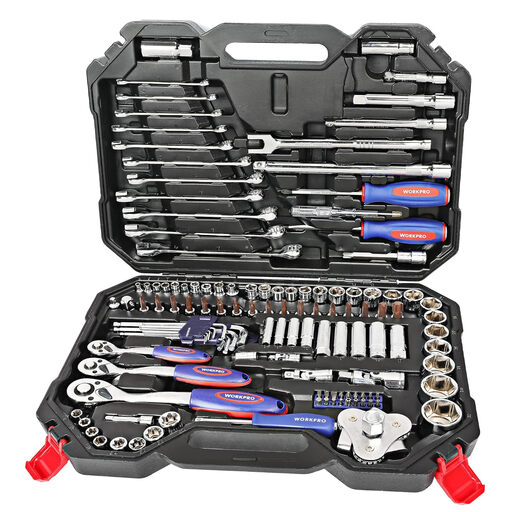
Why This Fits Their Persona: This is an excellent all-in-one DIY tool kit for someone tackling a variety of tasks, from assembling flat-pack furniture to basic car maintenance like changing oil or replacing a battery. It covers the three main drive sizes and includes other essentials like spanners and screwdrivers.
It avoids the piece-count myth by providing a balanced and practical selection of tools rather than hundreds of tiny bits. The tools are made from heat-treated, chrome-plated Cr-V steel, addressing the material quality pitfall.
Includes 1/4", 3/8" and 1/2" drive tools for maximum versatility. Comes in a durable blow-moulded case for organised storage.
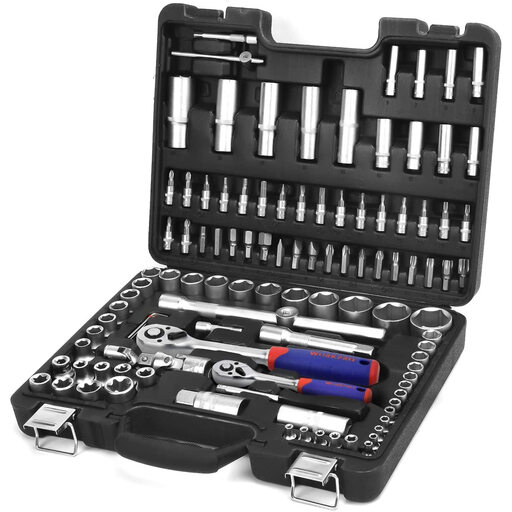
Why This Fits Their Persona: This dedicated car repair tool kit is perfect for the enthusiast who spends weekends working on their vehicle. It focuses on what's needed for mechanical jobs, with a comprehensive range of sockets, extensions and spark plug sockets.
It includes a 72-tooth reversible ratchet, which provides the small 5-degree swing arc needed for tight engine bays. The selection is focused on automotive tasks, avoiding the filler found in generic sets.
Features quick-release ratchets for fast socket changes. The robust plastic case keeps all 108 pieces organised and secure.
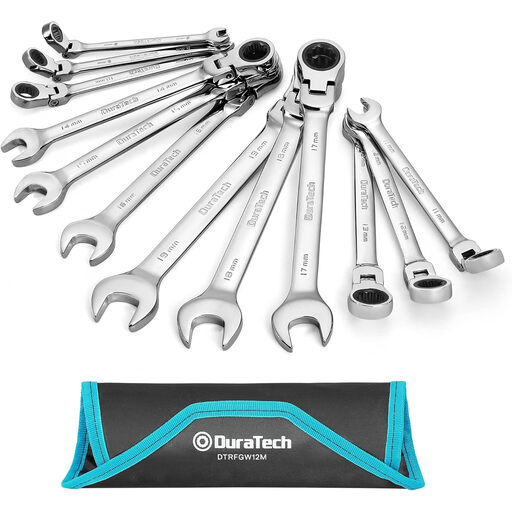
Why This Fits Their Persona: This is not a do-it-all kit, but a specialised ratchet spanner set for professionals or serious hobbyists who frequently work in awkward spaces. The flex-head design is invaluable for reaching bolts around corners or deep within machinery.
This set directly solves the "inefficient ratchet" problem. The 180-degree flexible head combined with a 72-tooth mechanism provides access and precision that standard fixed-head tools simply cannot match.
Made from premium Cr-V steel with a mirror polish finish for durability. Comes in a roll-up pouch for compact and portable organisation.
We have compiled a complete, real-time list of products that fully satisfy these strict selection criteria and UK safety regulations.
Cr-V (Chrome Vanadium) is a steel alloy that is significantly harder and more durable than standard carbon steel. It is heat-treated to increase its strength, making it less likely to bend, break or wear out under high torque. The chrome plating adds a crucial layer of corrosion resistance, which is essential for preventing rust in the UK's climate.
This depends entirely on your needs. For general home and car DIY, a well-chosen set of 100-150 pieces that includes a good range of sockets, spanners and extensions is often more than sufficient. A professional mechanic might opt for a larger, more comprehensive professional tool kit of 400+ pieces, but for most users, quality and component selection are far more important than the total piece count.
mechanics tool set will often include all three drive sizes for maximum flexibility.