Small-desk form builders
If you arrange fields and labels beside a keyboard, you need enough space to move the pointer without letting a small mouse compromise your grip.


For contact-form layout on a small desk, start with a compact mouse that leaves enough room beside the keyboard without feeling cramped in your hand. Choose Bluetooth if your computer supports it and you need the USB port free; consider a receiver model if Bluetooth is unsuitable. If long sessions make hand fit the bigger concern, assess a larger or vertical shape alongside the whole workstation setup.
If you arrange fields and labels beside a keyboard, you need enough space to move the pointer without letting a small mouse compromise your grip.
If you work near other people, repeated clicks may matter as much as the space the mouse occupies. Look at the exact model’s click-noise claim, not just its wireless connection.
If form-layout work fills much of your day, assess hand fit and mouse placement as part of the wider desk arrangement rather than choosing by shape alone.
Check the room beside your keyboard and the fit in your hand first. Then narrow the choice by the connection your computer can use and the controls you need for moving through forms.
| Concern | What to check | Who this matters to |
|---|---|---|
| Desk space | Check the stated size against the space beside your keyboard, then consider whether the shape fits your grip. | With little room to move beside a keyboard, I need a mouse I can place and use without crowding the desk. Around 33% of consumers would put desk space first. |
| Form navigation | Check scroll-wheel behaviour, button placement and compatibility with your computer. | Moving between short fields and longer pages makes controlled pointing and scrolling my priority. For around 27% of consumers, navigation would be the deciding need. |
| Click noise | Look for a quiet-click claim for the exact model, while still checking its shape and connection. | When I work close to others, repeated clicking is the distraction I most want to reduce. Quieter operation would come first for around 20% of consumers. |
| Long-session fit | Check hand-size guidance, handedness and whether the mouse can sit in line with your elbow. | During extended desk sessions, I need a shape and position I can use comfortably rather than the smallest footprint. Around 20% of consumers would prioritise long-session fit. |
A mouse that fits the desk may still feel cramped during longer sessions.
Check hand-size guidance or try the shape where possible. Logitech distinguishes its M650 for small-to-medium hands from the M650 L for large hands.
A receiver uses a USB port, while Bluetooth depends on compatible hardware and software.
Check the exact model’s connection method before ordering. Microsoft specifies Bluetooth 4.0 or later on a Windows 10 or 11 PC for its Bluetooth Mouse.
Depending on the model and your computer, setup may also require a spare USB port or a suitable adapter.
Mouse placement and the rest of the workstation matter as well as grip shape.
The Health and Safety Executive advises keeping the mouse in line with your elbow. Review the keyboard, screen, chair and desk arrangement too; where UK workplace display-screen assessment duties apply, the assessment covers more than the mouse.
A polling-rate figure does not tell you whether a mouse fits your hand or gives you the scrolling control you want for form work.
Check fit, scroll behaviour and connection compatibility first. Consider gaming-focused specifications only if you also have a separate use that calls for them.
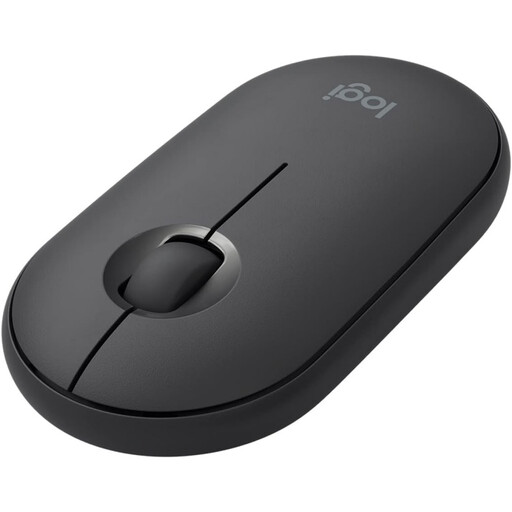
Its relevant ranges include the slim Pebble Mouse 2, hand-size-specific Signature M650 variants and the Lift vertical mouse.
The HP 280 Silent Wireless Mouse is an office-mouse option for buyers considering quieter clicks.
The Microsoft Bluetooth Mouse is a compact option for a compatible Windows computer.
These compact mice are relevant when space beside the keyboard is the main constraint. Check the connection and hand fit of the exact variant before choosing one for longer form-layout sessions.
 No image available
Consider this compact office-mouse variant if desk space is tight and you want to check both Bluetooth and 2.4G connection options.
The product name specifies adjustable multi-level DPI and a 1xAA battery. Confirm the supplied connection equipment, compatibility with your computer and hand fit before buying.
 No image available
Consider this Pebble mouse if a slim shape is your priority beside the keyboard; its quiet-click description may also matter in a shared room.
Confirm whether this exact unit connects by Bluetooth or a USB receiver. Check its hand fit and scroll controls if you will use it for long sessions or frequent page navigation.
Not for routine form-layout work alone. Logitech’s guidance places 50–100 Hz polling rates in standard computing tasks such as browsing and word processing; choose for hand fit, scrolling and computer compatibility before treating a higher polling rate as a priority.
Choose according to your computer’s connections and the ports you need to keep free. Bluetooth requires compatible hardware; a receiver occupies a USB port. For the Microsoft Bluetooth Mouse specifically, Microsoft Support specifies a Windows 10 or 11 PC with Bluetooth 4.0 or later.
A vertical mouse is a fit-dependent option, not a fix for the whole workstation. Check the model’s hand-size guidance and whether its grip suits you, while also reviewing mouse placement and the wider setup. The Health and Safety Executive advises keeping the mouse in line with your elbow.
The Health and Safety Executive says employers must assess workstations for workers who use display screen equipment daily as part of normal work for continuous periods of an hour or more. That assessment concerns the workstation and working conditions, not just which mouse is purchased.