Classrooms printing briefs regularly
Staff issuing frequent black-and-white or colour briefs may prefer refillable ink if someone can take responsibility for refilling the printer.


Choose a multifunction printer around how often the classroom prints briefs and how large its busiest jobs are. Refillable ink may suit frequent printing if staff can manage bottle refills; a cartridge model with a larger paper supply may suit shared batch work. Check the exact model’s two-sided printing, document feeder, network options and compatible ink before ordering.
Staff issuing frequent black-and-white or colour briefs may prefer refillable ink if someone can take responsibility for refilling the printer.
Teachers and support staff printing packs or copying multi-page originals should pay particular attention to paper capacity, automatic two-sided printing and document feeding.
A lighter-use printer may be sufficient for occasional briefs, copies and scans, provided its paper handling and connection options still fit the work.
Start with the expected printing frequency and busiest batch, then check how the printer will be maintained, shared and placed.
| Concern | What to check | Who this matters to |
|---|---|---|
| Ink and upkeep | Check the exact ink supplies and whether staff can manage bottle refills or cartridge changes. | If I issue briefs regularly, I want ink changes to interrupt lessons as little as possible. Around 42% of consumers put supply management first. |
| Batch handling | Check paper capacity, automatic two-sided printing and whether the document feeder handles the originals you copy or scan. | When several staff need packs at once, I want fewer paper reloads and less page-by-page copying; roughly 33% of consumers prioritise shared batch handling. |
| Room and light-use fit | Allow space for paper loading and ink changes; check whether the scanner and approved connection method suit the work. | For occasional briefs in a small room, I need a printer that fits without making simple copying awkward. About 25% of consumers place this fit first. |
A maximum monthly figure is not necessarily a suitable workload for regular printing. HP distinguishes the Smart Tank 7305’s recommended monthly volume from its maximum duty cycle.
Estimate monthly pages and the largest same-day batch, then compare them with the exact printer’s recommended volume and paper capacity.
Copying multi-page originals on a flatbed means placing pages manually. A document feeder can change that workflow, but its capacity and two-sided operation vary by model.
If staff often copy or scan packs, check the exact model’s feeder and whether it handles both sides of an original.
Manufacturer page yields do not establish how long ink will last with a particular mix of text and colour briefs.
Compare the exact compatible supplies against expected black-and-white and colour printing, and decide who will replace or refill them.
A printer’s wireless option does not establish that it fits the school’s connection and device-management rules.
Confirm an approved connection method and update responsibility with IT before ordering. Ask which electrical-equipment recycling route the school uses when the printer is eventually replaced.
Epson’s EcoTank A4 range is relevant when regular classroom printing makes refillable ink worth considering.
Brother’s MFC-J45xx cartridge-inkjet range is relevant to shared printing and multi-page document handling.
HP’s Smart Tank 7305 provides another refillable-ink model to assess for regular A4 document work.
These Joybuy choices cover refillable-ink and cartridge inkjets for classroom briefs, including models to consider for regular batches and lighter use. Match paper handling, ink upkeep, placement and network access to the school’s needs.
 No image available
Consider this model for recurring A4 briefs if staff are comfortable managing refillable ink. Check its paper and document-feeding capacity against peak jobs, and confirm the exact replacement bottles and approved network connection.
 No image available
Consider this A4 print, copy and scan model when staff need to handle multi-page originals as well as regular briefs. Confirm its document-feeding and two-sided functions, the +Ink bundle contents and the footprint before planning its location.
 No image available
Consider this cartridge-inkjet model when shared document handling matters and A3 work may also be needed alongside A4 briefs. Check its room requirements, exact cartridge supplies and standard paper capacity; do not assume an optional lower tray is included.
 No image available
Consider this model for shared A4 printing when staff also expect multi-page copying or scanning. Its A3 capability may be unnecessary for briefs alone, so check placement, paper capacity, compatible cartridges and school-network approval.
 No image available
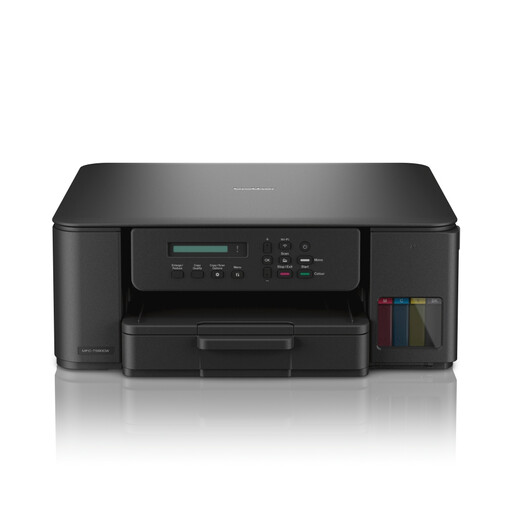
Consider this refillable-ink model for occasional A4 briefs where staff can place originals on a flatbed scanner. For larger batches, check whether its paper capacity and manual scanning workflow are practical; confirm that its wireless connection is permitted, as Ethernet is not available.
Refillable ink is worth considering for frequent brief printing if staff can manage bottle refills; cartridges may suit a team that prefers cartridge replacement and finds a model with the paper handling it needs. Compare the exact compatible supplies and the classroom’s likely black-and-white and colour use.
Automatic two-sided printing is useful when the brief can be read on both sides of the page. Confirm that it works with the intended paper, and check separately whether the document feeder can scan or copy two-sided originals.
Only if the school approves the printer and its proposed connection method. Ask IT about network access, device management and who will handle updates before ordering.
No: a maximum duty cycle should not replace the manufacturer’s recommended ongoing volume. HP, for example, gives the Smart Tank 7305 a recommended monthly range of 400–800 pages and describes its duty cycle as a maximum, not an ongoing target. Compare the recommended volume with expected pages and peak batches.
Use the school’s approved electrical-equipment recycling route or ask the supplier about take-back arrangements. GOV.UK explains that UK WEEE rules aim to reduce electrical and electronic waste sent to landfill or incineration.