Batch paper digitiser
If you regularly scan stacks of loose papers, an ADF saves placing each sheet on a flatbed. For two-sided originals, look specifically for automatic two-sided scanning.


For loose A4 research papers, choose a multifunction printer with an automatic document feeder (ADF), and confirm automatic two-sided scanning if the originals have content on both sides. Consider A3 scanning when larger originals are a regular part of your work; if you also print frequently, assess ink arrangements separately from scanning features.
If you regularly scan stacks of loose papers, an ADF saves placing each sheet on a flatbed. For two-sided originals, look specifically for automatic two-sided scanning.
If A3 diagrams, fold-outs or other larger pages recur in your work, check both the maximum scan size and how those originals must be loaded.
If you mainly handle A4 papers in shorter sessions, focus on the feeder capacity and transfer workflow you will use rather than choosing a larger machine for occasional possibilities.
Start with the largest original you scan regularly, then match the feeder and scanning mode to your paper stacks; consider printing needs separately.
| Concern | What to check | Who this matters to |
|---|---|---|
| Two-sided paper stacks | Check ADF capacity and an explicit automatic two-sided scanning specification for the exact model. | When I scan loose papers printed on both sides, I want to avoid turning every sheet myself. Around 33% of consumers put two-sided batch scanning first. |
| Printing alongside scanning | Compare replacement ink, stated printing yields and any optional ink plan against your expected print volume. | If I print drafts and reading packs often, ongoing ink use matters alongside the scanner. Roughly 25% of consumers make printing costs their primary concern. |
| Larger originals | Confirm the maximum scan size and whether the required size works with the feeder or needs flatbed placement. | With recurring A3 diagrams or fold-outs, I need to capture the original without splitting it into smaller scans. Around 17% of consumers prioritise larger-format handling. |
| Occasional A4 use | Check the ADF, available space and compatibility with your intended wireless or mobile scanning workflow. | For occasional A4 papers at home, I want a setup that fits my space and how I transfer files. Roughly 25% of consumers put straightforward occasional use first. |
These are separate functions: Epson specifies double-sided scanning for the WorkForce Pro WF-4830DTWF, but describes the WF-4820DWF as having double-sided printing and single-sided scanning.
For papers printed on both sides, check the exact model for an explicit automatic two-sided scanning specification.
A3 capability addresses a recurring larger-original requirement, not the ordinary task of scanning A4 papers.
Check the largest original you scan regularly and measure the space available for the machine before choosing an A3 model.
Stated ink yields concern printed pages; they do not establish scan quality, optical character recognition accuracy or feeder performance.
Assess printing needs separately, then check scan size, ADF capacity and two-sided scanning for the documents you handle.
A printer and an optional ink subscription are separate choices when comparing how you will print alongside scanning.
Compare your expected ink use with replacement-ink purchases and any plan you would actually choose; do not assume a subscription is required.
The MAXIFY MegaTank GX7150 is relevant when substantial printing accompanies research-paper scanning.
The MFC-J6955DW is a model to consider when larger research originals make A3 scanning necessary.
WorkForce Pro A4 models offer different scanning arrangements for home-office and small-office workflows.
These models relate to scanning larger originals, handling loose-paper batches or combining A4 scanning with regular printing. Check each model's scan-size and two-sided scanning specifications against your papers before choosing.
 No image available
Consider this model for a workflow involving larger research originals. Confirm the maximum scan size, how those originals are fed and whether automatic two-sided scanning is available; if searchable files matter, check the OCR workflow too.
 No image available
Consider this model if you regularly handle loose, larger-format papers. Check that the required scan size works with your intended loading method, and confirm two-sided scanning if your originals need it.
 No image available
For scanning alongside frequent printing, compare the printing arrangements with your expected use. Confirm feeder capacity and automatic two-sided scanning separately; the GX6150 is not the GX7150 discussed above.
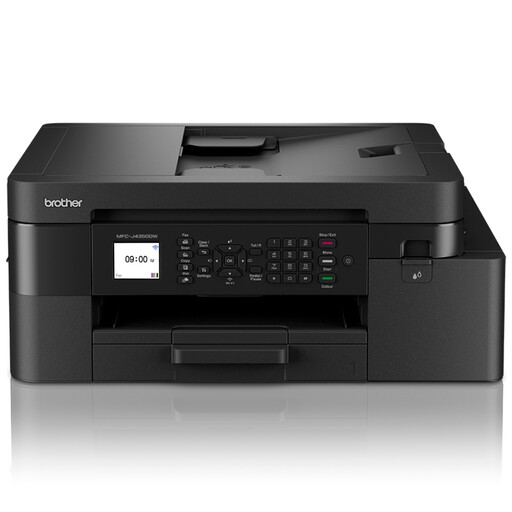 No image available
Consider this model for shorter loose-paper batches and a home-office workflow. Match its feeder capacity to your usual stack, and confirm the maximum scan size and two-sided scanning before buying.
 No image available
Consider this A4 model if you scan papers and also print regularly. Check that its feeder suits your batch size and confirm automatic two-sided scanning if the papers have content on both sides.
No. Epson specifies double-sided scanning for the WorkForce Pro WF-4830DTWF, while its WF-4820DWF has double-sided printing and is described as having single-sided scanning. Check the scanning specification for the exact model.
Choose a capacity that fits the loose-paper batches you usually scan. Epson specifies a 35-page ADF for the WF-4820DWF and a 50-page ADF for the WF-4830DTWF; capacity is a loading limit, not a promise that every paper type will feed successfully.
Only if larger originals are a regular part of your work. Brother specifies A3 scanning for the MFC-J6955DW; if your papers are consistently A4, check an A4 model's feeder and scanning mode before considering a larger machine.
No: scanning does not use ink. Stated ink yields relate to printing, so consider them if you also print drafts or reading packs, and assess scanning features separately.