Loose-record batch archivists
If most service sheets are loose, two-sided A4 pages, a duplex ADF can capture both sides with less page handling. Check that the exact model specifies two-sided scanning, not just two-sided printing.


Choose a multifunction printer with a confirmed flatbed if service records need placing individually; prioritise a duplex automatic document feeder (ADF) if you regularly scan loose, two-sided sheets in batches. Refillable ink tanks are more relevant when you also print regularly, while A3 printing is worth considering only if your work needs the larger format. Check the scan specifications of the exact model: printing on both sides does not establish that it can scan both sides.
If most service sheets are loose, two-sided A4 pages, a duplex ADF can capture both sides with less page handling. Check that the exact model specifies two-sided scanning, not just two-sided printing.
If some originals need careful positioning rather than feeding through a machine, look for a confirmed flatbed or platen and check its maximum scan size. Canon’s GX7050 specifications, for example, distinguish platen scanning from its ADF scan path.
If the hobby-room printer will also produce manuals, checklists or colour documents regularly, consider the ink system and paper handling alongside scanning. Epson’s ET-3950 is an A4 ink-tank multifunction model with a double-sided ADF; Brother’s MFC-J5740DW adds A3 printing but specifies automatic two-sided scanning for A4.
Start with how your originals must be handled: individually on a platen or as loose sheets in an ADF. Then decide how much printing the same machine needs to do and whether larger-format paper handling earns its place in the hobby room.
| Concern | What to check | Who this matters to |
|---|---|---|
| Two-sided batches | Look for an explicit duplex-scan specification; check ADF capacity and supported document sizes. | If I have stacks of loose service sheets with information on both sides, I want to capture them without turning every page myself. Around 36% of consumers put automated two-sided batch scanning first. |
| Mixed originals | Check platen size, ADF size and duplex-scan size separately, especially for non-A4 records. | Some of my records need placing individually, so I need a scan surface that fits them without feeding them through an ADF. For around 29% of consumers, careful handling is the primary concern. |
| Regular printing | Compare the exact ink format and supplied consumables against how often you expect to print. | If I regularly print manuals and checklists as well as scan records, replenishing ink matters more to me than extra scanning capacity. Roughly 21% of consumers put ongoing print supplies first. |
| Room to use the machine | Measure the available space and consider a typical scanning session before choosing larger paper handling or feeder capacity. | When I scan only occasionally, I would rather leave enough room to use the hobby-room worktop than choose capacity for batches I rarely have. Around 14% of consumers make a proportionate setup their first priority. |
A printer can turn paper over for printing without automatically capturing both sides of an original. For two-sided service records, that difference affects how much page handling the archive requires.
Check the exact model’s scanner specification for duplex scanning, two-sided scanning or a single-pass duplex ADF.
Print size, platen size, ADF size and duplex-scan size describe different functions. Brother specifies A3 printing but automatic two-sided A4 scanning for the MFC-J5740DW.
Compare the largest records you need to digitise with each stated scan-size limit, not just the printer’s paper format.
Canon’s MAXIFY GX6150 and GX7150 have different full model numbers. A feature specified for the GX7150, such as its single-pass two-sided ADF, should not be assumed for the GX6150.
Check the full model number, relevant scan functions and current availability on the product page you intend to use.
Scans are less useful if records cannot be retrieved, and records identifying people need appropriate care in storage and transfer. The Information Commissioner’s Office advises appropriate indexing and security for records.
Use consistent file names and organise access to stored scans, particularly when service records contain personal information.
Canon’s MAXIFY MegaTank multifunction range includes models for scanning and regular printing, but scan paths differ by model.
Epson’s EcoTank line is relevant when scanning service records goes alongside regular printing with refillable ink tanks.
Brother offers multifunction printers as well as dedicated document scanners, so its models span different balances of printing and record capture.
These multifunction and inkjet printer models are choices to assess for a hobby-room scanning setup. Match each exact model’s platen, ADF and two-sided scanning specifications to your records before deciding; a similar model name does not establish the same scan functions.
 No image available
Consider the GX6150 if one machine needs to handle record scanning alongside printing. For loose, two-sided batches or individually placed originals, confirm this exact model’s duplex-scanning function, feeder sizes and platen arrangement rather than relying on GX7150 specifications.
 No image available
The A4 ET-5150 +Ink is worth assessing if printing accompanies your scanning work. Confirm whether its scanner handles both sides of loose records automatically, and check its platen and feeder sizes; automatic two-sided printing alone does not answer those questions.
 No image available
If your records combine loose sheets with originals needing individual placement, assess the MFC-J6540DWE’s scanning paths against both tasks. Check platen and ADF scan sizes separately, and confirm duplex scanning before planning a two-sided batch workflow.
 No image available
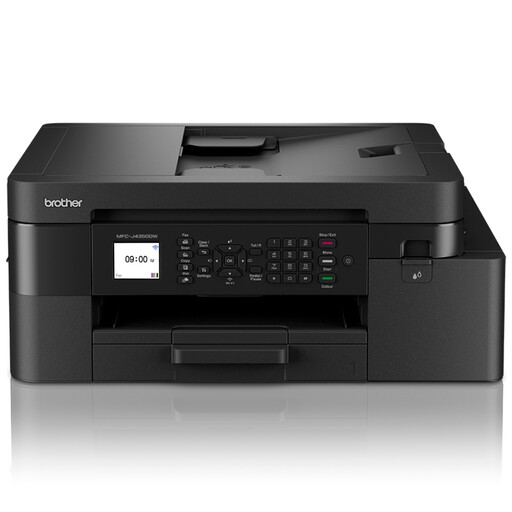
For occasional service-record sessions, compare this all-in-one inkjet printer with the space available and the number of sheets you normally handle. If those sheets are two-sided, check the exact scanner’s duplex capability and supported document sizes before choosing it.
 No image available
If you often digitise loose multi-page records, assess whether this all-in-one printer’s feeder fits your usual batch. Check its scan-size limits and two-sided scanning specification independently, particularly if your collection includes larger originals.
No: two-sided printing and duplex scanning are separate functions. If you regularly archive loose sheets printed on both sides, check that the exact model explicitly specifies two-sided scanning; Canon lists a single-pass two-sided ADF for the GX7150.
A flatbed gives you a way to place an original individually instead of feeding it with a batch. Check both scan paths and their size limits: Canon specifies separate platen and ADF scanning for the MAXIFY GX7050, with an A4/Letter platen.
Not necessarily. Brother specifies A3 printing but automatic two-sided A4 scanning for the MFC-J5740DW, so check platen, ADF and duplex-scan sizes separately for any larger originals.
Yes, records that identify a person call for care when they are stored or transferred electronically. The Information Commissioner’s Office discusses electronically processed personal data and advises appropriate record indexing and security; organise the scans so they can be found and control who can access them.