Small-bench note digitiser
You turn loose workshop notes into digital files but have little permanent desk space. Check both the printer’s closed dimensions and the room needed to load paper, collect output and open the scanner lid.


Start by measuring the space available and looking at the notes you scan most often. A multifunction printer with an automatic document feeder (ADF) makes repeat batches of compatible loose pages easier to handle, but a flatbed matters for originals that should not pass through a feeder. If you also print frequently, compare paper capacity and ink replenishment alongside the space the printer needs while operating.
You turn loose workshop notes into digital files but have little permanent desk space. Check both the printer’s closed dimensions and the room needed to load paper, collect output and open the scanner lid.
You collect enough loose A4 pages that placing each one on the glass interrupts your work. Compare ADF capacity with the size and condition of your usual batches, and check which originals the feeder accepts.
You scan notes and regularly print instructions, records or drafts. Paper capacity and the frequency of ink refills may matter alongside scanning, provided the machine fits your working space.
Check desk fit and how your notes can be handled before deciding whether a larger paper tray or refillable ink would help your printing routine.
| Concern | What to check | Who this matters to |
|---|---|---|
| Desk fit | Measure available width, depth and height. Check the exact model’s closed dimensions and clearance for its lid, paper feed and output. | I have a narrow bench and need to use the scanner without moving the printer each time; roughly 31% of consumers put usable desk fit first. |
| Batch scanning | Compare ADF capacity with your usual stack, and check supported paper and whether you need two-sided scanning. | When loose notes accumulate, I want to scan a compatible batch without placing every page on the glass; around 31% of consumers make batch handling their primary concern. |
| Original handling | Check the manual’s feeder conditions for the size, material and condition of your notes; plan to use the flatbed when feeder suitability is uncertain. | Some of my notes are folded or otherwise awkward to feed, so I need a way to scan them without relying on the ADF; roughly 19% of consumers prioritise original handling. |
| Printing workflow | Consider your printing frequency, paper-tray capacity, ink replenishment, device compatibility and stated security-update support. | I print workshop records as well as scanning notes and want fewer interruptions to replace supplies or reload paper; around 19% of consumers put the ongoing printing workflow first. |
A closed printer can still need extra room for a rear feed, output paper, an open lid or access to ink.
Measure the workstation and compare it with the exact model’s dimensions and operating-clearance instructions.
Feeder capacity applies only to supported originals. Brother UK specifies plain paper for the MFC-J1010DW ADF; it does not establish that other workshop materials are suitable.
Check the exact model manual for paper size and condition, remove staples, and use the flatbed for originals whose feeder suitability is uncertain.
A larger ADF helps with compatible scan batches, while paper capacity and ink replenishment affect a different part of the workshop routine.
Estimate how often you scan and print, then compare the exact model’s feeder, tray and supply options against those tasks.
Brother’s compact home-inkjet range includes the MFC-J1010DW, an A4 print, copy, scan and fax model with wireless connectivity.
Canon’s PIXMA TR7650 is a compact home-office print, copy, scan and fax model with Wi-Fi, cloud functions and front and rear paper feeding.
Epson’s EcoTank ET-5150 combines A4 scanning and printing with refillable ink tanks for a routine that includes frequent document printing.
These multifunction-printer choices cover compact inkjet, refillable-ink and other workshop printing needs. For each model, check desk clearance and whether its scanner accepts your usual notes before deciding.
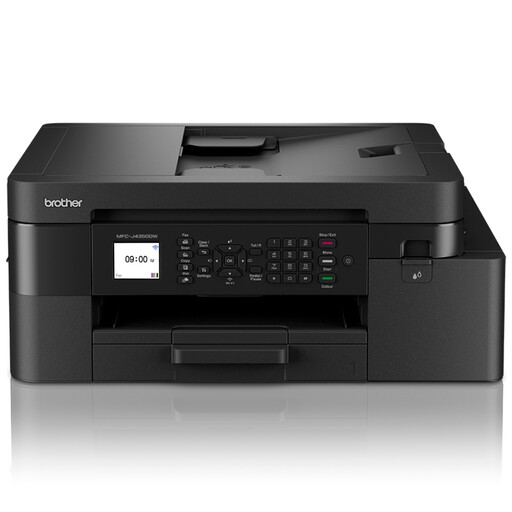 No image available
For a small work area and recurring loose-page scans, check this model’s operating clearance and the ADF media conditions against your notes.
 No image available
Consider this refillable-ink model if frequent printing accompanies your scanning and you have room to operate it. Epson UK specifies a 35-page ADF and 250-sheet front tray; check the manual before feeding your notes.
 No image available
If you need to handle both loose batches and notes that may require a flatbed, confirm this model’s scanner arrangement and supported originals. Measure the bench and the clearance needed for paper access.
 No image available
For a workshop that also needs colour printing, check whether its scanning arrangements suit your originals. Compare its physical size and required operating space with the bench.
 No image available
If larger-format printing is also part of your workshop routine, check this model’s supported paper sizes. Confirm that its dimensions, paper access and scanner arrangements work on your desk.
An ADF is useful when you regularly scan batches of loose pages that the model is specified to accept. Brother UK and Canon UK list 20-sheet ADFs for the MFC-J1010DW and PIXMA TR7650 respectively, while Epson UK lists a 35-page ADF for the ET-5150; use a flatbed for originals whose feeder suitability is uncertain.
It is worth considering when you print workshop documents frequently as well as scanning notes. Compare how often you expect to replenish ink and paper, then check that the exact model’s size and scanner arrangement suit your desk and originals.
Check compatibility with the devices you use and look at the manufacturer’s security-update information for the exact model. Epson UK states a seven-year security-update period from purchase for the ET-5150; do not assume that period applies to other printers.
Follow the maintenance instructions for your exact printer rather than treating the feeder as interchangeable with another model’s. Epson UK advises checking the paper-path guide when ADF scan quality declines but scans made without the ADF remain clear.
Yes. Recycle Your Electricals identifies all-in-one printer-scanner-copiers as recyclable electricals; look for an appropriate electrical-recycling collection route when replacing one.