Choose a multifunction printer with an automatic document feeder (ADF) if the club regularly scans loose, multi-page minutes: feeding suitable sheets is less hands-on than placing each page on a flatbed. If scans are occasional or originals are bound or fragile, a flatbed-led model may suit the work better, but recurring bundles will need page-by-page handling. In either case, check the space needed to open and use the printer, not just its closed dimensions.
Who needs which scanning setup?
Secretary scanning loose meeting packs
If several loose A4 pages need digitising after each meeting, prioritise an ADF to reduce individual page placement. Brother lists a 20-sheet feeder for its MFC-J1010DW, while Epson lists a 30-page feeder for its WorkForce WF-2930DWF; check the paper each feeder accepts.
Club officer sharing a small desk
Allow room to load paper and open the lid or feeder as well as room for the closed machine. Canon lists its MAXIFY GX1050 at approximately 374 × 380 × 186 mm with trays retracted and describes front operation, but those dimensions alone cannot establish whether it will fit your working space.
Volunteer archiving mixed originals
Minutes kept alongside bound, fragile, thick or irregular documents call for a way to scan originals without feeding them through rollers. A flatbed is useful for that work; keep the exact model’s feeder-media limits in mind when handling loose sheets.
What matters when choosing?
Start with the documents the club scans most often, then measure the desk in its working configuration. Treat printing needs as a separate choice: a refillable-ink system does not, by itself, make scanning minute bundles easier.
| Concern |
What to check |
Who this matters to |
| Multi-page scanning |
Check ADF capacity and supported paper. If minutes are double-sided, confirm the scanning mode separately from two-sided printing. |
When a meeting produces a stack of loose minutes, placing every sheet by hand makes archiving cumbersome; around 42% of consumers would put batch scanning first. |
| Desk space |
Compare the model’s dimensions with room to open its lid or feeder and use its trays. |
On a shared desk, I need to use the scanner without moving the printer each time; roughly 33% of consumers would make usable desk space their primary concern. |
| Ongoing printing |
Compare the consumable system with the club’s likely print volume and check whether two-sided printing is available. |
If agendas and notices are printed regularly, I want to understand the continuing ink and paper demands; about 25% of consumers would prioritise ongoing printing needs. |
Mistakes to avoid
-
Choosing a flatbed-only scanner for regular loose-page bundles
Canon specifies a platen scanner for the MAXIFY GX1050. It can handle documents placed on the glass, but scanning a bundle requires placing pages individually.
If loose minutes arrive after most meetings, make an ADF a required feature. Choose a flatbed-led workflow when scans are occasional or originals need to lie flat.
Page-by-page scanning also takes volunteer time.
-
Assuming a compact printer will fit in use
A closed footprint does not show the room needed to load paper or open a scanner lid or feeder.
Measure the desk and compare it with the exact model’s dimensions, allowing access to trays, cables and scanning controls.
-
Putting unsuitable originals through a feeder
ADF limits vary by model. Brother specifies plain-paper ADF use and a 64–90 g/m² ADF media range for the MFC-J1010DW.
Check the manual before feeding originals. Use a suitable flatbed for bound, torn, thick or fragile documents rather than assuming the feeder accepts them.
-
Sharing scanned minutes without considering access
Minutes may contain personal data. The Information Commissioner’s Office highlights the need to protect records in transit as well as in storage.
Before setting up email, cloud or shared-folder scanning, decide who needs the files and apply appropriate account and device controls.
Brands to consider for this task
Brother
Brother’s MFC-J1010DW is an A4 inkjet multifunction example for loose-page scanning alongside club printing and copying.
- Brother specifies a 20-sheet ADF, a 150-sheet enclosed tray and automatic two-sided printing for this model.
- Its ADF is specified for plain paper within a 64–90 g/m² media range; check other originals before feeding them.
Epson
Epson’s WorkForce WF-2930DWF is an A4 multifunction option for clubs that regularly scan suitable loose sheets.
- Epson lists a 30-page ADF, automatic two-sided printing, Wi-Fi and Wi-Fi Direct for this model.
- Check its dimensions and working clearance against the desk; feeder capacity alone does not establish physical fit or duplex-scanning capability.
Canon
Canon’s refillable-ink MAXIFY GX1050 offers a flatbed-led route when scanning is less frequent or originals need to lie flat.
- Canon specifies front operation, a 250-sheet cassette and dimensions of approximately 374 × 380 × 186 mm with trays retracted.
- Canon specifies a platen scanner for this model, so loose multi-page minutes require individual page placement.
Joybuy product choices
These multifunction printer choices are relevant to club administration and loose-page minute scanning. Compare each model’s feeder requirements and working dimensions with the club’s actual documents and desk.
 Image unavailable
Brother MFC-L3740CDWE Colour Wireless LED Printer
For recurring loose-page minutes, compare its feeder with the club’s usual bundle size and paper. This is a colour wireless LED model; confirm working clearance and the scanning mode needed for double-sided originals.
View on Joybuy
 Image unavailable
Brother MFC-J6540DWE Inkjet Printer
Consider this inkjet model for repeated minute bundles if its feeder accepts the club’s originals. Measure the desk and access space before choosing it, and confirm how it scans double-sided sheets.
View on Joybuy
 Image unavailable
Canon MAXIFY GX6150
If the club scans loose minutes and prints regularly, compare this model’s document handling and consumable requirements with both tasks. Check feeder media, access space and whether its scanning modes suit any bound or double-sided originals.
View on Joybuy
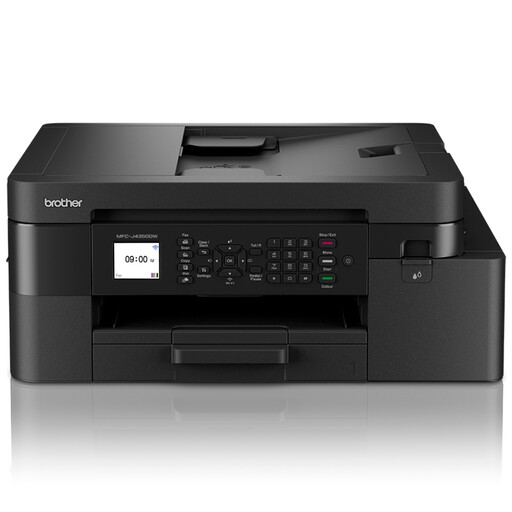 Image unavailable
Brother MFC-J4350DW All-in-One Inkjet Printer
For smaller loose-page packs on a constrained desk, check whether its feeder capacity and supported paper suit the club’s routine. This is an all-in-one inkjet model; allow room to use its scanner and trays.
View on Joybuy
 Image unavailable
Brother MFC-J6760DW All-in-One Inkjet Printer
For recurring loose-page scanning, establish whether this all-in-one inkjet model’s feeder accepts the minutes. Check its full working footprint carefully on a limited desk, along with the scanning mode required for double-sided pages.
View on Joybuy
Frequently asked questions
Should we choose an ADF or a flatbed for club minutes?
Choose an ADF for routine batches of loose sheets that meet the feeder’s media requirements; choose a flatbed when originals are bound, fragile or otherwise unsuitable for feeding. If the club handles both, check that the exact printer provides the scanning methods it needs.
Does two-sided printing mean two-sided scanning?
No. Automatic two-sided printing and automatic two-sided scanning are separate features. If minutes have information on both sides, check the exact model’s scan specification rather than relying on its printing features.
How can we tell whether a printer will fit on the desk?
Compare the desk with the printer’s stated dimensions, then allow room to load paper and open the lid or feeder. Canon’s approximately 374 × 380 × 186 mm figure for the MAXIFY GX1050, for example, is specified with trays retracted, not as a complete measure of working space.
What should we consider before sharing scanned minutes?
If minutes contain personal data, consider who can access the electronic copies and how they are transferred and stored. The Information Commissioner’s Office provides UK guidance for groups and clubs and highlights protecting records in transit; assess the club’s own arrangements rather than assuming a printer’s wireless features provide appropriate safeguards.


