Choose a multifunction printer by the space it needs while printing, not just its stored dimensions: paper feeds, output and scanner access all need room. If your event timetables use colour and you scan multi-page revisions, compare colour inkjets with automatic duplex printing and an automatic document feeder (ADF). If every timetable works in monochrome, a mono laser model is an alternative for repeated text runs, but check its desk fit and consumables before choosing.
Who is this for?
Event organisers with little desk space
You need one device for printing, copying and scanning without losing the space needed for other work. Check clearance for paper loading, output and the scanner lid rather than relying on a compact label; Epson’s published dimensions for the WF-2950 illustrate how stored and printing depth can differ.
Managers of colour-coded timetables
If colour distinguishes rooms, sessions or changes, retain colour printing as a requirement. Automatic duplex printing and an ADF are worth checking when you also produce handouts or scan amended schedules.
Organisers printing frequent black-text revisions
If timetables remain clear without colour, compare mono laser multifunction printers for repeated runs. Brother lists a 250-sheet tray and automatic duplex printing for its DCP-L2620DW, though its fit on your desk still needs checking.
What matters when choosing?
Set a minimum usable desk area first, then decide whether colour carries information that a monochrome timetable would lose.
Colour inkjet multifunction printer
Choose it when: Colour identifies timetable details and you need to copy or scan amended pages.
Trade-off: Compare the exact ink options against your expected number of revisions, as well as the space needed to use the printer.
Mono laser multifunction printer
Choose it when: Every timetable remains readable in black and white and repeated text runs matter more than colour output.
Trade-off: It cannot reproduce colour coding; a larger paper tray does not establish that the device will fit a shallow desk.
| Concern |
What to check |
Who this matters to |
| Working footprint |
Measure usable desk depth and check dimensions with paper loaded and output collected. Epson lists the WF-2950 at 300 mm deep when stored and 577 mm while printing. |
When the printer shares a shallow desk with other work, I need its trays and paper path to stay within the available space. Around 42% of consumers put working clearance first. |
| Timetable workflow |
Check colour output, automatic A4 duplex printing and ADF capacity on the exact model; an ADF alone does not establish two-sided scanning. |
If colours identify sessions and amended pages need copying, I want those tasks to remain practical between print runs. Around 33% of consumers prioritise this workflow. |
| Repeat-print planning |
Compare tray capacity and the stated yield of the exact ink or toner option against your expected volume. |
With frequent timetable revisions, I care about paper refills and when consumables need replacing. For around 25% of consumers, repeat-print planning is the main concern. |
Mistakes to avoid
-
Choosing from stored dimensions alone
Epson lists the WF-2950 at 300 mm deep when stored but 577 mm deep while printing. A printer that fits between jobs may therefore occupy much more of a shallow desk in use.
Measure where paper enters and leaves the printer, and allow access to the scanner lid and cables.
-
Assuming an ADF scans both sides automatically
Canon specifies a 35-sheet ADF for the PIXMA TS7750i, Epson a 30-page ADF for the WF-2950DWF and Brother a 20-sheet ADF for the DCP-J1460DW. Feeder capacity does not, by itself, establish duplex scanning.
If your original schedules are printed on both sides, check the exact model’s scanning instructions before buying.
-
Choosing monochrome before checking the timetable
A mono printer cannot reproduce colour distinctions between rooms, sessions or teams, even if its paper handling suits repeated runs.
Review a representative timetable in greyscale. Keep colour printing as a requirement if the categories become unclear.
-
Comparing consumables without matching the options
Cartridge options and stated yields vary by model. Canon specifies different standard and XL cartridge yields for the PIXMA TS7750i, so a single yield figure cannot describe every replacement option.
Compare the exact cartridges or toner you would use, the stated yield basis and any subscription terms against your likely revision schedule.
Relevant brands to compare
Canon
Canon positions the PIXMA TS7750i as an A4 colour print, copy and scan model for home and home-office use.
- Canon specifies automatic duplex printing, a 35-sheet one-sided ADF and front and rear paper feeds for this model.
- Canon states standard cartridge yields of 180 pages for black and colour A4 documents. Compare the applicable cartridge option with your expected timetable volume.
Brother
Brother has relevant colour inkjet and mono laser models, depending on whether a timetable needs colour.
- Brother specifies automatic duplex printing, a 20-sheet ADF and a 150-sheet tray for the colour DCP-J1460DW.
- Brother’s DCP-L2620DW has a stated 250-sheet tray for repeated monochrome work, but it cannot print colour-coded schedules. Check its operating dimensions against your desk.
Epson
Epson lists the WorkForce WF-2950DWF as an A4 colour multifunction inkjet with copying, scanning and fax.
- Epson specifies automatic duplex printing and a 30-page ADF for the WF-2950DWF.
- Epson’s dimensional information gives a depth of 577 mm while printing, compared with 300 mm when stored. Check that a shallow desk accommodates the working position.
Joybuy printer choices
These colour inkjet models are relevant to event-timetable printing, copying and scanning. Compare their working clearance and the features of each exact model before deciding which belongs on a limited desk.
 No image available
Canon MAXIFY GX6150
Consider this model for colour-coded timetable packs and multi-page source handling. Check its feeder against your usual batch size and allow room for paper loading and output.
View on Joybuy
 No image available
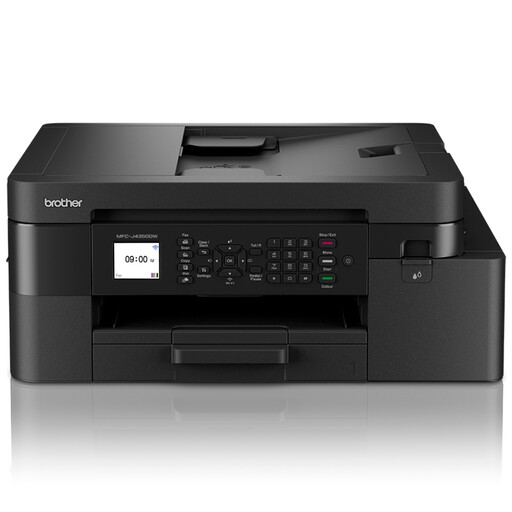
Brother MFC-J4350DW Inkjet Printer
Consider it when colour timetable runs and copying or scanning source pages are both part of the job. Check the space needed for its paper path while printing, not only the space it occupies between runs.
View on Joybuy
 No image available
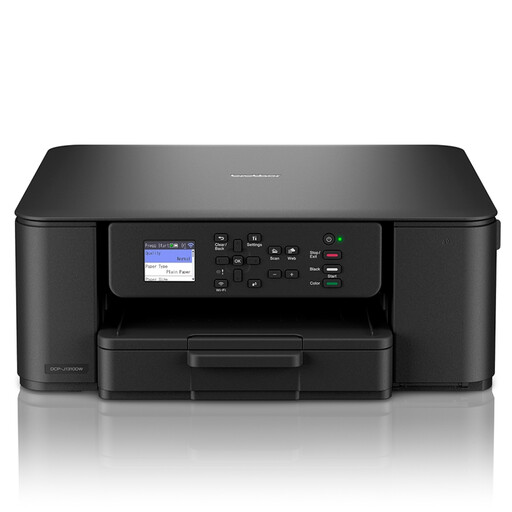
Brother DCP-J1310DW Wireless Inkjet Printer
For timetable revisions that also involve scanning or copying several source pages, check how many sheets its feeder accepts at once. Measure the desk space needed with paper loaded and output collected.
View on Joybuy
 No image available
Brother MFC-J6760DW Inkjet Printer
Consider this model for repeated colour timetable work only if its larger footprint leaves enough usable desk space. Check the paper sizes you need and measure clearance with the printer operating.
View on Joybuy
 No image available
Brother MFC-J6540DWE Inkjet Printer
For colour handouts and multi-page timetable sources, weigh its paper-handling needs against the space available. Measure both the printer’s position and the clearance needed to use it.
View on Joybuy
Common questions
How much desk space should I allow for a multifunction printer?
Allow for the printer in use, including paper loading, output and scanner access. Epson lists the WF-2950 at 300 mm deep when stored and 577 mm while printing; for a different model, check its own operating dimensions rather than applying those measurements to it.
Do event timetables need a colour printer?
Choose colour if it distinguishes information readers need, such as rooms or sessions. If a representative timetable remains clear in greyscale, a mono multifunction model is worth comparing; Brother specifies automatic duplex printing and a 250-sheet tray for the DCP-L2620DW.
What should I compare for ongoing ink or toner use?
Compare the exact consumable option and its stated page yield with the number of timetable revisions you expect to print. Canon states 180-page standard and 300-page XL cartridge yields for the PIXMA TS7750i; actual replacement frequency depends on what and how you print.
What should I do with an old printer in the UK?
Check an appropriate reuse or electrical-equipment recycling route rather than putting the printer in ordinary household waste. GOV.UK identifies the Waste Electrical and Electronic Equipment Regulations 2013, as amended, as the underlying UK framework; your local authority, retailer or manufacturer can provide current collection instructions for your location.


