Consumers printing on card-like stock
If your revision cards use heavier, matte or photo-style paper rather than ordinary copier paper, check the exact printer model, feed path and supported media before comparing speed or ink yield.


Choose a multifunction printer only after checking whether its specified feed path supports the exact paper you intend to use for revision cards. For repeated colour printing, compare refillable ink and cartridge running costs; for lighter use, a compact cartridge printer may suit the desk. Do not assume that automatic two-sided printing works on card stock.
If your revision cards use heavier, matte or photo-style paper rather than ordinary copier paper, check the exact printer model, feed path and supported media before comparing speed or ink yield.
If you regularly reprint colour notes, diagrams or worksheets, consider how often you will replace ink as well as how the printer is refilled. Published page yields need to be read under their stated test conditions.
If several people need to print, scan or copy, check device connections, paper and document-feeder capacity, and the space needed to load paper and collect output.
Start with the revision-card paper: a printer suited to ordinary A4 documents may not accept the same stock or print on both sides of it automatically. Then decide how much repeated colour printing and shared scanning the desk needs.
| Concern | What to check | Who this matters to |
|---|---|---|
| Card-stock compatibility | Match the paper’s type, size and weight to the model’s supported feed path. Check two-sided printing separately. | If my chosen cards cannot feed through the printer, its other features will not solve the main task. Around 42% of consumers put paper compatibility first. |
| Recurring colour-print costs | Compare replacement supplies and stated yields on the same test basis; allow for the coverage of your own designs. | Reprinting colour-coded notes and diagrams makes the supplies I use over time my main concern. For around 33% of consumers, ongoing colour-print costs come first. |
| Shared print, scan and copy workflow | Confirm connections for each device, document-feeder needs and space for paper loading and output. | Several people need access without moving equipment or repeatedly loading worksheets. Convenient shared use is the primary concern for around 25% of consumers. |
Paper support depends on the printer model and the particular media. Canon UK lists different weight conditions for plain paper and supported Canon papers on the MAXIFY GX2051; neither category establishes support for every third-party card.
Check your paper’s finish, size, weight and feed instructions against the printer manual. Try a small pack before buying a large supply.
Canon UK specifies automatic two-sided printing on the MAXIFY GX2051 for A4 or Letter plain paper. That specification does not establish an automatic duplex workflow for card stock.
Check the exact model’s duplex media conditions. If your stock is not supported, plan a one-sided layout or check whether manual sheet reversal is appropriate.
Supplied-ink yields and cartridge yields are stated under manufacturer test conditions; colour-heavy revision materials may use ink differently.
Estimate how often the desk will print colour sets, then compare the relevant replacement supplies and yields rather than treating a published page count as a guaranteed number of cards.
UK government guidance says waste electrical products should not go in household rubbish.
Use an appropriate electrical-waste collection point or household waste recycling centre. When replacing a printer, check the retailer’s like-for-like take-back arrangements.
Brother has A4 all-in-one inkjet models for shared document printing, scanning and copying.
Canon’s MAXIFY MegaTank range includes refillable-ink multifunction models for document-heavy desk use.
Epson’s EcoTank range includes document-focused refillable-ink models and models with feeds for thicker media.
HP’s ENVY 6132e is a wireless home multifunction model to consider for lighter shared use.
These multifunction printers offer different starting points for a shared revision desk, from compact inkjet use to larger-format or colour LED printing. For any of them, confirm that your exact revision-card stock works with the specified feed path before choosing on shared-use features.
 No image available
Consider this model if several people will repeatedly print revision materials and also need everyday document tasks. Check its exact media and feed specifications before choosing it for card stock, and compare the supplies needed for your expected colour use.
 No image available
If index-card-format printing and shared document work are both priorities, check whether your particular stock is supported at its weight and through the intended feed path. Confirm the model’s consumables before comparing ongoing colour-print costs.
 No image available
This colour LED multifunction model is worth checking if shared scanning and copying matter alongside printing. Before using thicker revision-card paper, confirm its supported weight, size and feed path, then compare the relevant toner supplies.
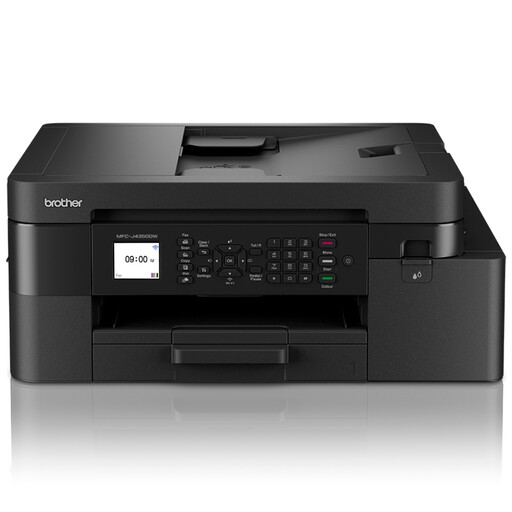 No image available
For lighter shared use, this cartridge model offers print, copy and scan functions. Brother UK lists 5 GHz Wi-Fi, a 150-sheet input tray, a manual feed slot and a 20-sheet automatic document feeder; check card-stock and duplex conditions separately.
 No image available
Consider this model if the desk also needs larger-format documents and shared print, scan or copy tasks. Check the available desk space and confirm the intended revision-card paper’s type, weight and feed path before buying.
Yes, if the exact paper is supported by that printer and its intended feed path. Canon UK, for example, lists plain paper from 64 g/m² to 105 g/m² for the MAXIFY GX2051 and supported Canon papers up to approximately 265 g/m²; that does not establish compatibility with every third-party card stock.
Not necessarily: Canon UK specifies automatic duplex printing on the MAXIFY GX2051 for A4 or Letter plain paper. Check the duplex conditions for your exact printer and stock, and plan a one-sided layout or appropriate manual sheet reversal if automatic duplexing is unsupported.
Check that each person’s device can use the printer’s connection methods, then consider paper capacity, any document feeder and access to the output tray. For example, Brother UK lists 5 GHz Wi-Fi and a 20-sheet automatic document feeder for the MFC-J4350DW; those features do not remove the need to check physical fit and card-stock support.
No. A manufacturer’s page yield reflects its stated test conditions, not a guaranteed number of cards with your chosen colours, images or coverage. Compare yields only when their measurement bases are suitable for the comparison, and consider how you expect to use the printer.
Take it to an appropriate electrical-waste collection point or household waste recycling centre rather than putting it in household rubbish. UK government guidance also says that, when you buy a replacement electrical product, the retailer must accept the old one free of charge on a like-for-like basis.