Racers with limited cockpit space
If the screen, mount and cables must stay clear of the wheelbase and cockpit entry, assess a curved 34-inch 21:9 display first. Check its installed dimensions rather than relying on the diagonal measurement.


A curved 34-inch ultrawide is a sensible starting point when one display must fit a compact oval-racing cockpit. Consider a 49-inch super-ultrawide if the panel, mount and PC can accommodate it; choose triple monitors when physical side-screen placement matters more than space and setup simplicity. Measure the installation and check performance at your intended resolution before deciding.
If the screen, mount and cables must stay clear of the wheelbase and cockpit entry, assess a curved 34-inch 21:9 display first. Check its installed dimensions rather than relying on the diagonal measurement.
A 49-inch 32:9 display offers a continuous image without joining three screens. It calls for substantially more lateral space than a 34-inch display and a PC that can handle its intended resolution and settings.
Three monitors allow side-screen placement, provided the cockpit accommodates the displays and mounts. Plan for suitable graphics-card connections and the additional configuration described by iRacing Support.
Choose the display arrangement that fits your cockpit, then check whether your PC and connections can run the resolution and refresh mode you intend to use.
Consider it: when one curved screen needs to fit a restricted cockpit.
Trade-off: it offers less horizontal screen area than a 49-inch 32:9 panel and lacks the physical side placement of triples.
Consider it: when you have room for a much wider mount and want one continuous panel.
Trade-off: the cited 5120 × 1440 format has more pixels to render than 3440 × 1440, without the physical side-screen placement of triples.
Consider them: when side-screen placement takes priority and your cockpit can accommodate three displays.
Trade-off: three screens require more mounting space, compatible outputs and configuration work.
| Concern | What to check | Who this matters to |
|---|---|---|
| Cockpit fit | Measure usable width, wheelbase clearance and eye-to-screen distance; check the exact display dimensions and mount rating. | If the monitor crowds my wheel or makes the cockpit awkward to enter, a wider view will not help my setup. Around 36% of consumers put physical fit first. |
| Stable motion | Check the refresh rate available through your chosen port and whether your PC sustains a steady frame rate at the intended resolution. | During practice, I would rather have consistent motion than select a refresh setting my PC cannot maintain. For around 29% of consumers, that is the primary need. |
| Horizontal view | Compare the space needed for 21:9, 32:9 and triples; use measured screen geometry when configuring the simulator’s field of view. | If seeing more of the track alongside me matters most, I need to weigh extra screen width against the space it takes. Around 21% of consumers prioritise view coverage. |
| Usable specifications | Compare connection-specific refresh limits and check what response-time metric each manufacturer quotes. | I want the monitor’s advertised modes to match my ports, cables and gaming PC rather than choose by a headline number. That is the first concern for around 14% of consumers. |
A 34-inch screen can still need considerable installation width: BenQ UK specifies the EX3410R at 795.7 mm wide with its stand. Its dimensions do not establish whether another 34-inch model will fit.
Measure the cockpit, wheelbase clearance and viewing position, then check the dimensions and mounting requirements of the exact model.
A display that does not clear the wheelbase may require a different arm or cockpit mount.
The monitor’s stated maximum does not guarantee a steady in-sim frame rate. iRacing Support also notes that resolution scaling can reduce graphics processing demand at the expense of image quality.
Check the mode available through your intended connection and test frame-rate stability at the resolution and settings you plan to use.
Manufacturer figures labelled GtG and MPRT describe different measures, so their numbers should not be treated as directly equivalent.
Check the metric and stated conditions for the exact model; give display format and stable in-sim performance attention as well.
Retailer take-back and home collection are different arrangements. GOV.UK describes take-back responsibilities for qualifying electrical retailers when customers buy equipment of the same type, including online purchases.
Ask the seller how its take-back arrangement works and whether it offers home collection before ordering a replacement.
Samsung UK lists 49-inch 32:9 Odyssey models for buyers considering a single, very wide cockpit display. Check the exact model: the G91F and OLED G9 examples have different stated refresh rates.
LG UK’s 34GS95QE-B is a 34-inch curved 21:9 OLED example for buyers assessing a single-screen ultrawide arrangement.
The BenQ UK EX3410R provides a documented 34-inch curved 3440 × 1440 option with dimensions useful for planning a compact installation.
These single-screen ultrawides relate to the 34-inch route for a compact cockpit. Compare each monitor’s actual installed size and the display mode your PC can use; this selection does not cover the 49-inch or triple-monitor routes.
 No image available
Consider this single-screen option if an OLED ultrawide suits your cockpit and PC setup.
The product title states WQHD and 240 Hz. Check mount capacity, installed clearance and the connection needed for your intended mode. Follow the screen-protection guidance for OLED use.
 No image available
Consider this 34-inch ultrawide if you want one curved screen for oval-racing practice.
The product title states 3440 × 1440, 200 Hz and a VA panel. Check the full installed dimensions and the refresh mode available through your chosen connection; the quoted 1 ms figure uses the MPRT metric.
 No image available
This 3440 × 1440 monitor is an option when a single 34-inch screen fits your cockpit.
Its product title specifies 175 Hz over DisplayPort and 100 Hz over HDMI. Check installed width and depth, and confirm which connection your PC will use.
 No image available
Consider this single 34-inch display if an ultrawide arrangement matches your available cockpit space.
Check its installed dimensions and mounting requirements, then confirm the refresh mode supported by your PC, port and cable.
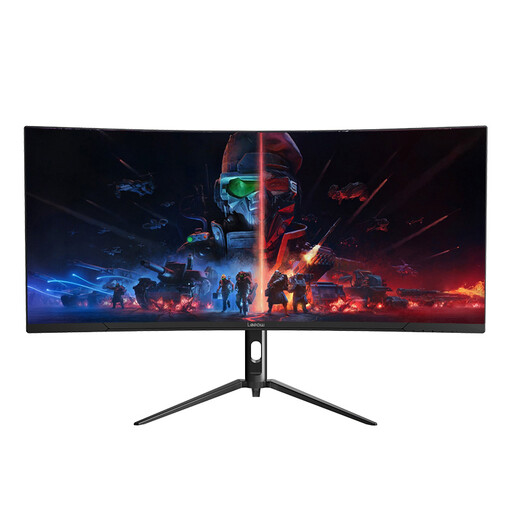 No image available
This single curved display is an option for a cockpit where a 34-inch ultrawide will fit.
The product title states 3440 × 1440 and 165 Hz. Verify installed dimensions and the refresh rate available through your intended port and cable.
Measure from your eyes to the display while seated in your normal racing position, and measure the screen width. iRacing Support says to enter the measurements in Display settings, select one curved screen and use Compute; make subsequent seating-view adjustments from that same position.
They can if the cockpit safely accommodates three displays and mounts, and the graphics card has suitable outputs. iRacing Support documents three-monitor setup methods and strongly recommends screens with the same resolution; measure the screens, bezels, viewing distance and angles before committing to mounts.
No: the chosen connection must offer that display mode, and your PC must sustain suitable in-sim performance. iRacing Support advises limiting frame rate to the monitor’s refresh rate and notes that some users find a cap 2–5 frames per second below it helpful.
It can reduce graphics processing demand by rendering at a lower resolution, but iRacing Support says the trade-off is lower image quality and that CPU load is not reduced. Test the result at the settings you intend to practise with.
Ask the replacement monitor’s retailer about its electrical-equipment take-back arrangement and how to use it. GOV.UK describes qualifying retailers’ responsibility to take back waste equipment of the same type, including for online purchases; check separately whether the seller offers home collection.