
24/7 Customer Support

Free returns

Same-day & Next-day Delivery

Quality Guaranteed

Unlock Your Welcome Offers: FREE Delivery | Up to 80% OFF | Free 30-day JoyPlus trial
Download the APP
A portable tyre inflator can save a journey when a tyre loses pressure, but choosing one based only on a large PSI number can lead to disappointment. UK drivers, electric vehicle owners, motorcyclists and cyclists should look beyond headline claims and check how the pump is powered, how quickly it moves air and whether its valve fittings suit the intended use.
The right model can handle routine pressure top-ups and roadside emergencies. The wrong one may have a short battery runtime, overheat during repeated inflation or lack the cable needed when the battery is flat.
A 150 PSI tyre inflator or 160 PSI model may appear powerful, but maximum pressure is only the upper operating limit. It does not tell you how quickly the pump will inflate a typical car tyre from a low starting pressure.
For practical comparison, check:
A small digital tyre pump can be suitable for maintaining pressure but may take considerably longer when inflating several car tyres.
A cordless tyre inflator is easy to carry and useful away from the vehicle, but its runtime depends on battery capacity, temperature and workload. A rechargeable air pump may need several hours to charge and may not complete multiple car tyres from a very low pressure.
For longer roadside use, a 12V tyre inflator connected to the vehicle can avoid relying solely on the internal battery. However, the vehicle may need to be running to reduce the risk of draining its battery. Always use the power method specified in the product instructions.
A car tyre inflator generally uses a Schrader valve, while many bicycles use Presta valves. An adapter may be required. Inflation needles and tapered nozzles are useful for balls and inflatables, but they do not make every pump suitable for every vehicle.
Also check whether the pressure display uses PSI, bar or kPa, and whether automatic shut-off is included. Automatic stop reduces the need to watch the gauge continuously, but you should still verify pressure with a reliable gauge where appropriate.
Choose a battery-powered electric tyre inflator for portability, or a corded car air compressor for dependable access to vehicle power. A longer cable is useful when the 12V socket is at the front of the cabin and the tyre is at the rear.
For EV owners, confirm that the vehicle has a suitable 12V outlet and check the manufacturer’s guidance before use. Do not assume that a USB charging port can power a high-load compressor.
Battery capacity is measured in mAh, but capacity alone does not guarantee a particular number of inflations. Look for stated runtime and usage examples based on a recognised tyre size.
A 100% duty cycle claim, where provided, indicates the stated ability to operate continuously under specified conditions. Other pumps may need cooling pauses. Follow the manual, particularly after inflating large tyres or using the pump repeatedly.
A digital pressure display, preset function and auto shut-off make routine maintenance more straightforward. Set the target pressure using the vehicle’s tyre placard or handbook rather than the maximum rating printed on the pump.
For a bicycle tyre pump, motorcycle inflator or multi-purpose model, confirm the supplied fittings. Heavy vehicles, trailers, RVs and large trucks may require equipment with a different airflow rating and duty cycle.
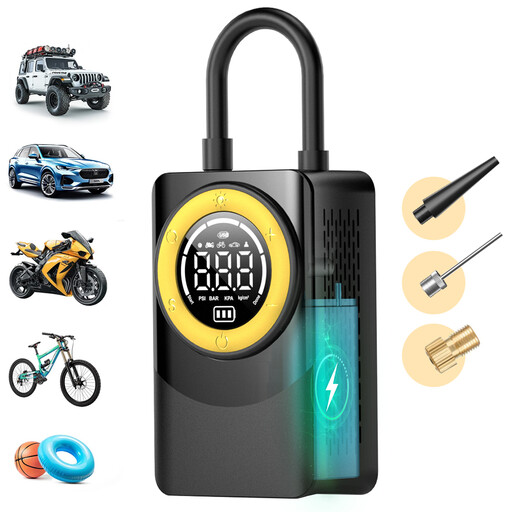
Why This Fits Their Persona: Its built-in battery and cordless design suit drivers who want a compact emergency pump for a car, motorcycle or bicycle without managing a cable.
The digital display helps with target-pressure setting, while the supplied instructions specify charging before wireless use.
Built-in battery, digital pressure display and compatibility with standard cars, motorcycles and bicycles.

Why This Fits Their Persona: A 7,500mAh cordless format and stated 160 PSI maximum suit motorists wanting a more capable pump for repeated top-ups.
The listing gives battery capacity, operating modes and a stated runtime rather than relying only on a maximum PSI figure.
Four preset modes, PSI/bar/kPa display options, LED lighting and USB power-bank output.
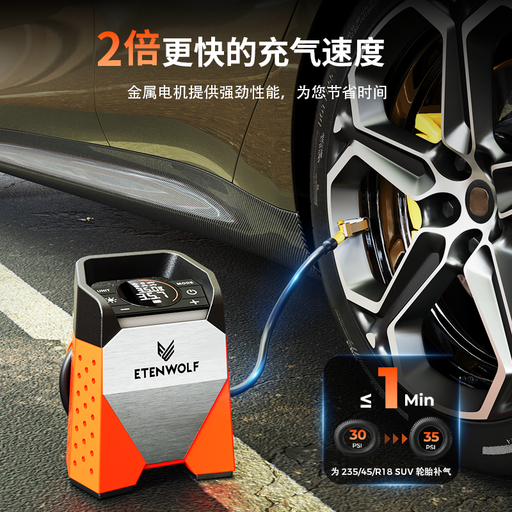
Why This Fits Their Persona: Its stated 1.25 CFM airflow, 160 PSI maximum and 12V specification make it a practical option for cars, SUVs, bikes and light trucks where compatible.
The product information identifies a 100% duty cycle and recommends using the vehicle’s 12V DC socket, reducing dependence on a small internal battery.
Includes a pressure hose, Presta adapter, inflation needle and tapered nozzle; lithium-ion battery included.

Why This Fits Their Persona: Weighing 460g according to the listing, it can fit in a backpack, bike rack or limited boot space for cycling trips and occasional car top-ups.
The stated battery capacity and tyre-use example provide more context than the 150 PSI headline alone. It is explicitly unsuitable for off-road vehicles, RVs, trucks and trailers.
Five inflation modes, automatic shut-off, LED lighting and USB-C input/output.
We have compiled a complete, real-time list of products that fully satisfy these strict selection criteria and UK safety regulations.
A tyre inflator is intended for pressure maintenance, not for repairing punctures or replacing professional inspection. If a tyre repeatedly loses air, arrange an appropriate repair or assessment.
It can be suitable for routine top-ups, provided its specifications cover your vehicle and the battery has sufficient charge. For repeated or very low-pressure inflation, compare airflow, runtime and cooling requirements rather than maximum PSI alone.
A corded 12V model does not depend entirely on an internal battery and can be useful for longer sessions. It does require access to the vehicle’s 12V socket, and the engine may need to run according to the instructions. A cordless model is more flexible away from the car.
Lifespan depends on frequency of use, storage conditions, battery care and whether the pump is operated within its duty cycle. Keep it dry, avoid leaving a rechargeable air pump fully discharged for long periods and allow cooling pauses when required.