
24/7 Customer Support

Free returns

Same-day & Next-day Delivery

Quality Guaranteed

Unlock Your Welcome Offers: FREE Delivery | Up to 80% OFF | Free 30-day JoyPlus trial
Download the APP
A portable tyre inflator can be useful for correcting gradual pressure loss at home, preparing a bicycle before a ride or dealing with an underinflated tyre away from a garage. However, buying by headline pressure alone can lead to the wrong product.
The most common buying mistakes include:
Maximum pressure is only one part of the specification. Airflow, often listed in litres per minute, gives a more useful indication of how quickly a portable air compressor may work.
For occasional bicycle or sports-ball use, a compact rechargeable air pump can be suitable. Car tyres require more air, so look for a stated inflation time, airflow figure or a motor designed for vehicle tyres. Product timing can vary according to tyre size, starting pressure, temperature and battery charge.
Some compact models list airflow of around 32–35 L/min, while others provide a more modest output suited to bicycles and small inflatables. Treat advertised timings as reference figures rather than a guarantee for every vehicle.
A cordless tyre inflator is easy to use at the roadside because it does not depend on a 12V socket. Battery capacity, shown in mAh, helps indicate how much stored energy is available, although motor efficiency and operating conditions also matter.
For occasional top-ups, a smaller rechargeable air pump may be enough. Drivers who want to inflate several car tyres should consider a higher-capacity battery, such as 4,000mAh or 7,500mAh, and check the recommended charging time.
A corded car tyre pump can be a sensible choice for regular vehicle use. It draws power from a 12V DC socket, so the vehicle engine may need to be running according to the manufacturer’s instructions. Allow the pump to cool between extended sessions.
A digital tyre pressure gauge makes it easier to set a target in PSI, bar or kPa. An automatic shut-off tyre inflator stops when the selected pressure is reached, which is helpful when inflating in poor weather or low light.
Before ordering, check:
Remember that a 150 PSI tyre inflator or 160 PSI air compressor does not mean you should inflate a tyre to that pressure. Always use the vehicle, bicycle or equipment manufacturer’s recommended pressure.
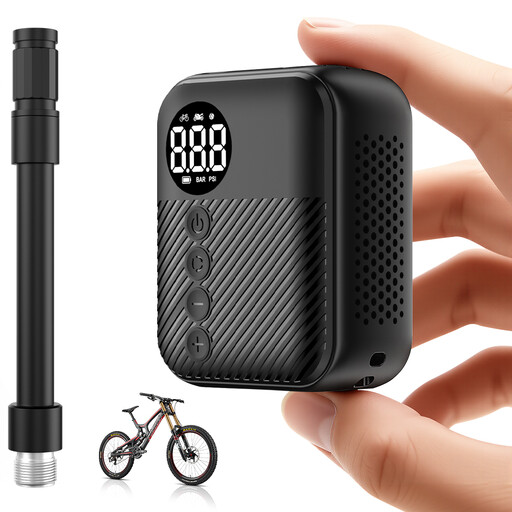
Why This Fits Their Persona: Its pocket-sized design suits cyclists, electric-bike users and motorists who want a compact emergency car accessory for occasional top-ups.
The digital gauge provides a pressure reading, while the rechargeable design avoids dependence on a vehicle socket.
150 PSI maximum pressure; rechargeable battery and digital display; designed for bike, motorbike, car and ball use.
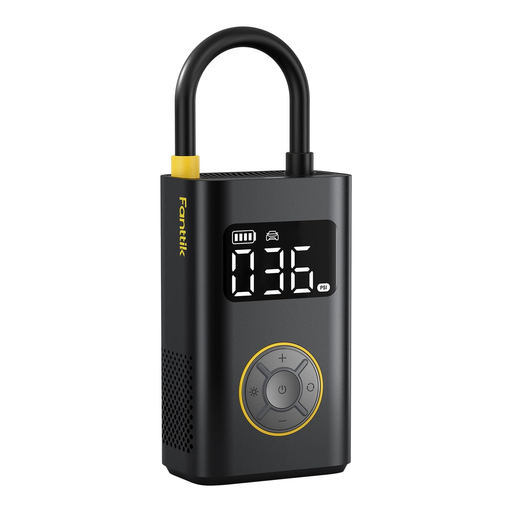
Why This Fits Their Persona: A practical option for UK drivers and riders wanting integrated hose storage, preset modes and a readable digital interface.
The stated 23-minute continuous operating time and automatic shut-off address concerns about monitoring and repeated short uses.
150 PSI maximum pressure; four intelligent modes plus manual mode; integrated hose and accessory storage.

Why This Fits Their Persona: The larger battery and 35 L/min airflow suit drivers, motorcyclists and active households that may need several inflations between charges.
Its 7,500mAh battery reduces reliance on frequent charging, while preset modes help limit incorrect pressure settings.
160 PSI maximum pressure; 7,500mAh rechargeable battery; digital display, LED lighting and automatic shut-off.
We have compiled a complete, real-time list of products that fully satisfy these strict selection criteria and UK safety regulations.
It can be useful for correcting low pressure before visiting a tyre shop or continuing to a safer location. It is an emergency car accessory, not a puncture repair device. Check the tyre for visible damage and seek assistance if pressure drops again.
The electricity used to recharge a small battery is generally modest, but the exact cost depends on battery capacity, charging efficiency and the electricity tariff. A 12V car tyre pump draws power from the vehicle, so avoid prolonged operation with the engine switched off.
Some multi-mode models are designed for all three, but you must check the supplied connectors. Car and many motorcycle tyres use Schrader valves, while bicycles may use Presta valves. A suitable adapter and the correct pressure setting are essential.