Recurring inventory coordinators
Groups preparing regular packs for several households and scanning returned paperwork. They should assess two-sided printing, paper handling and the number of sheets an automatic document feeder (ADF) can take.


Choose around how often volunteers print inventories, whether completed forms need scanning, and whether the records require colour. A refillable ink-tank multifunction printer suits recurring mixed-document batches; a cartridge inkjet offers another route for more modest use; and a mono laser multifunction printer suits mainly black-text packs, but cannot print colour photographs or colour-coded records.
Groups preparing regular packs for several households and scanning returned paperwork. They should assess two-sided printing, paper handling and the number of sheets an automatic document feeder (ADF) can take.
Groups whose volunteers print, copy or scan from different devices. The connection options and document-handling steps need to work for the people who will actually use the printer.
Groups producing smaller batches for meetings or periodic household checks. They can compare the functions they need with the supplies and paper capacity of a machine intended for frequent batches.
Start with the inventory template and expected batch size. Then decide whether volunteers also need to copy or scan completed forms; printing on both sides of a sheet does not, by itself, simplify those tasks.
Consider it when: Mixed-colour inventory packs recur and the group can make use of a large included ink supply.
Trade-off: For occasional short packs, much of that capacity may go unused; manufacturer page-yield figures do not predict the group's output.
Consider it when: The group prints more modest mixed-document batches but still needs duplex printing, copying or scanning.
Trade-off: Check the replacement cartridges and their applicable yields for the exact model as printing volume changes.
Consider it when: Inventory packs are principally black text and prompt batch output matters.
Trade-off: It cannot reproduce colour photographs, highlights or colour-coded condition records.
| Concern | What to check | Who this matters to |
|---|---|---|
| Refill continuity | Estimate black and colour A4 pages per inventory, then check the supplied and replacement ink or toner for the exact model. | If regular packs use many pages, I want to plan supply changes without interrupting a print run; around 36% of consumers put refill continuity first. |
| Shared document handling | Check automatic duplex printing separately from ADF capacity and the way the printer scans completed forms. | When several volunteers handle signed forms, I want fewer manual steps between printing and scanning. Around 29% of consumers primarily need that shared workflow. |
| Black-text batches | Decide whether colour is essential; if comparing speed, use ratings for the same A4 print mode. | If our packs are mainly text, I care about producing them promptly and can do without colour; roughly 21% of consumers make black-text batch output their main concern. |
| Occasional use | Compare the expected batch size with the paper tray, feeder and functions you would actually use. | For periodic, shorter packs, I do not want to choose capacity that will rarely be useful; around 14% of consumers put a proportionate occasional-use setup first. |
A large included ink supply may suit recurring multi-page inventories but be less relevant to occasional short packs.
Count the black and colour pages in a typical inventory and estimate how many packs the group produces before comparing supply options.
Automatic duplex printing handles two-sided output; the ADF determines how many loose pages can be fed for a scanning or copying task.
Check both functions against returned paperwork. Brother UK lists a 20-sheet ADF for the MFC-J4350DW, while Epson and Canon list 35-sheet ADFs for the ET-5170 and i-SENSYS MF275dw II respectively.
A mono printer cannot reproduce colour photographs or colour-coded condition information in the printed pack.
Review a representative form and any supporting photographs; keep colour printing in scope if their colour carries information.
Inventories containing personal information need a controlled printing and records-handling process. The Information Commissioner's Office advises placing printers where unauthorised people cannot access that information.
Choose a controlled location, arrange prompt collection of output and decide who may take records off-site and how they will be disposed of securely.
Epson's EcoTank ET-5170 is a refillable-ink A4 multifunction example for recurring printing, scanning and copying.
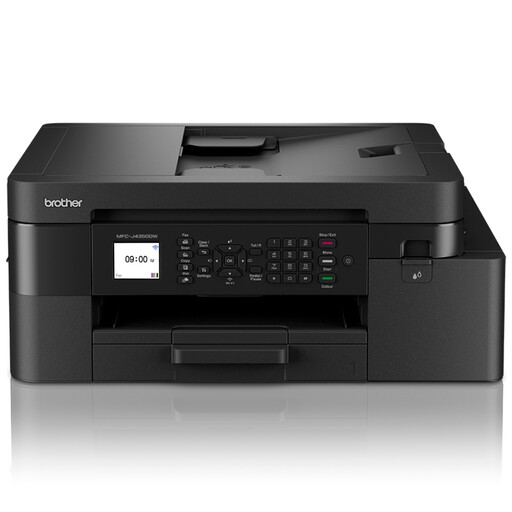
Brother's MFC-J4350DW is a cartridge-inkjet multifunction example for A4 inventories and returned paperwork.
Canon's i-SENSYS MF275dw II is a mono laser multifunction example for inventories that can be printed in black and white.
HP's Smart Tank 7305 is another refillable multifunction example to assess for a shared-document workflow.
These options cover refillable ink, cartridge inkjet and colour LED routes for household inventories. Match each model to the group's A4 forms, scanning tasks and need for colour; a colour LED option is distinct from the mono laser route discussed above.
 No image available
Consider this refillable-ink option for recurring mixed-colour inventory packs and paperwork that volunteers need to copy or scan.
Check the applicable ink-bottle yields against the group's expected print mix.
 No image available
Consider this cartridge-inkjet option for A4 inventory packs that may need colour and for batches of paperwork to scan or copy.
Check which replacement cartridges suit the intended print mix and how their stated yields apply.
 No image available
Consider this inkjet option if colour A4 forms and scanning or copying multi-page paperwork are part of the workflow.
If extra paper capacity matters, confirm which trays are included rather than assuming an optional lower tray comes with the printer.
 No image available
For mixed-document A4 packs, Brother UK lists automatic duplex printing, a 150-sheet input tray and a 20-sheet ADF for this model.
Check that the feeder suits batches of returned forms and compare the cartridge options with the group's expected print volume.
 No image available
Consider this colour LED option when inventory pages use colour-coded information and volunteers also need to scan or copy batches.
Check the included starter toner's yield and the replacement toner options against the expected volume.
Choose according to print frequency, document handling and whether colour is essential. An ink tank is worth considering for recurring mixed-colour packs, a cartridge inkjet for more modest mixed-document use, and a mono laser for principally black-text inventories; the mono route will not print colour evidence.
They solve different tasks: automatic duplex prints on both sides, while an ADF feeds pages for scanning or copying. If volunteers handle returned forms, check both functions and the feeder capacity; Brother UK lists 20 sheets for the MFC-J4350DW, compared with the 35 sheets listed by Epson and Canon for the ET-5170 and i-SENSYS MF275dw II.
Plan secure printing, collection, storage, transfer and disposal alongside the printer choice. The Information Commissioner's Office advises organisations to protect personal data and keep track of records; the group's specific responsibilities depend on its activities and the information it handles.
Avoid leaving inventories containing personal information where others can access them. The Information Commissioner's Office advises locating printers in a secure area; assign someone to collect each batch promptly.
Arrange an appropriate electrical-equipment collection or take-back route rather than putting the printer with ordinary waste. GOV.UK describes the UK WEEE framework as encouraging recovery, reuse and recycling; check which collection options the seller or local authority offers.