Teams scanning document batches
For teams regularly digitising multi-page, double-sided insurance packs, automatic duplex scanning and ADF capacity matter more than an ADF alone. Epson UK and Brother UK list models with both features.


Choose the scanning workflow before the printer format: if insurance packs are routinely double-sided, prioritise automatic duplex scanning and an automatic document feeder (ADF) that accommodates your usual bundle. For a shared studio, weigh network access and available space alongside the way people will store, retrieve and transfer scans containing personal information; the printer cannot establish that process on its own.
For teams regularly digitising multi-page, double-sided insurance packs, automatic duplex scanning and ADF capacity matter more than an ADF alone. Epson UK and Brother UK list models with both features.
Anyone responsible for paperwork containing personal information needs to decide who can use the printer, where scans go and how records are transferred and retrieved. The Information Commissioner’s Office advises risk-appropriate security and records-handling procedures.
Where bundles are modest and mainly single-sided, a compact ADF printer may be easier to accommodate than a larger workgroup machine. Canon UK lists a 35-sheet ADF for the PIXMA TS7550i; check its scanning functions against the documents you actually handle.
Start with whether sheets need scanning on both sides, then match the usual bundle size to the feeder. Check shared access, desk clearance and record handling before settling on a model.
| Concern | What to check | Who this matters to |
|---|---|---|
| Double-sided batches | Confirm automatic duplex scanning for the exact model, then compare ADF capacity with your usual pack. | When forms and supporting papers have information on both sides, I want to avoid turning every sheet by hand; around 36% of consumers put duplex batch handling first. |
| Shared access and space | Measure loading and tray clearance; check the network connection your studio will use. | If several people need the device, I want it accessible without taking over the workspace. Shared-studio fit is the primary concern for around 27% of consumers. |
| Personal-information records | Set access responsibilities and decide where scans are saved, named, retrieved and transferred. | With insurance records passing between people, I need to know who can reach each file and where it goes; around 27% of consumers prioritise control of that workflow. |
| Occasional scanning | Compare feeder capacity with modest bundles and check whether any sheets still need duplex scanning. | For infrequent, mostly single-sided paperwork, I would rather accommodate a smaller device than a larger workgroup machine; simplicity comes first for around 10% of consumers. |
The Information Commissioner’s Office advises appropriate technical and organisational security measures where UK GDPR responsibilities apply. A network connection or cloud destination does not, by itself, determine who can access an insurance scan.
An ADF feeds a stack of sheets, but an ADF or a duplex-print specification does not establish automatic duplex scanning. For two-sided insurance papers, that distinction can mean manually re-feeding pages or overlooking their reverse sides.
Check the scanner specification for the exact model and variant, rather than relying on its printing specification.
A shared scan destination can expose personal-information documents if access and transfers are not controlled. The Information Commissioner’s Office advises security measures appropriate to the processing risk and procedures for managing and transferring records.
Decide who may scan, where files are saved, how they are found later and how they can be sent to others before enabling a shared destination.
A larger workgroup printer may offer useful trays or A3 output, but those features do not resolve a shortage of room around the device.
Measure the intended position with enough clearance to load documents, open trays and retrieve output; decide whether the studio actually needs A3 printing.
Epson UK showed the WorkForce Pro WF-C4810DTWF as out of stock, while the Canon UK Store listed the MAXIFY GX7050 as discontinued in October 2026. Their specifications can still help define what to look for, but those listings do not establish current availability.
Check the exact variant’s current listing and support terms before committing to it.
These model examples illustrate different scanning and printing requirements; a brand’s inclusion does not mean every model has the same features.
The WorkForce Pro WF-C4810DTWF illustrates an A4 office-inkjet route for regular double-sided document batches.
The MFC-J5740DW represents an A3-capable inkjet workgroup route, while the MFC-L3740CDW represents an A4 colour LED route where printing also matters.
The PIXMA TS7550i illustrates a compact ADF option, while the MAXIFY GX7050 illustrates a larger refillable-tank business format.
These inkjet and colour LED multifunction choices cover shared-workgroup and lighter-use setups. For any model you intend to use with double-sided insurance packs, confirm automatic duplex scanning for its exact variant before buying.
 No image available
Consider this workgroup-oriented option if several people need to handle multi-page paperwork. Confirm automatic duplex scanning for the exact model; two-sided printing is not the same function. Check its placement and the access rules for shared scan destinations.
 No image available
For a studio considering a workgroup-oriented inkjet, compare its paper handling and required operating space with the usual workload. Verify automatic duplex scanning separately: duplex printing or copying does not establish it.
 No image available
This colour LED model is worth considering when shared printing matters alongside scanning. If insurance packs have content on both sides, confirm automatic duplex scanning for the MFC-L3740CDWE rather than relying on its duplex-print feature.
 No image available
Consider this multifunction option where the printer must fit a shared studio and handle document bundles. Before choosing it, check the exact scan destinations your team needs, the installation clearance and whether it scans both sides automatically.
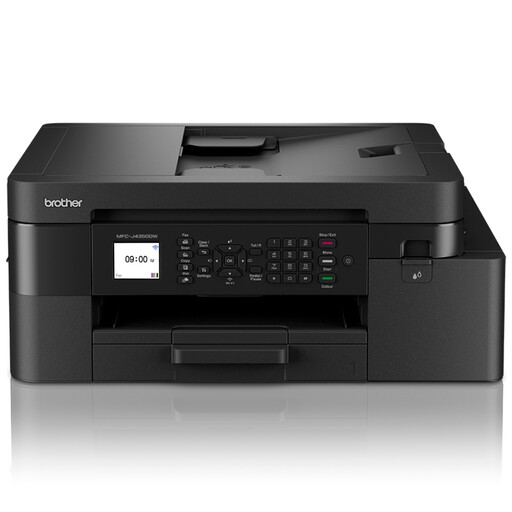 No image available
For occasional, modest document bundles, consider whether this compact-oriented inkjet suits the available space. Check that its feeder accommodates your normal pack and confirm automatic duplex scanning if both sides must be captured.
Prioritise it when forms or supporting documents routinely contain information on both sides. Check that the exact printer specifies two-sided scanning: an ADF and automatic two-sided printing do not establish that capability.
Start with the largest bundle you normally scan, then compare it with the feeder’s stated capacity. Epson UK and Brother UK list 50-sheet or 50-page feeders on some office models, while Canon UK lists a 35-sheet feeder on the PIXMA TS7550i; paper condition and loading instructions also affect what you can feed reliably.
The Information Commissioner’s Office guidance calls for security measures appropriate to the circumstances and risks of processing personal data, rather than prescribing a particular printer model. Where UK GDPR responsibilities apply, assess the device alongside physical access, scan destinations and organisational procedures.
No: a destination alone does not control who can access or transfer a file. Where personal data is involved, decide who may use that destination and apply controls appropriate to the processing risk, in line with the Information Commissioner’s Office guidance.
Set responsibilities for access, storage, retrieval and transfer before people begin scanning insurance records. The Information Commissioner’s Office advises procedures for classifying, titling and indexing records, as well as documented rules for transferring them.