Shared-workflow coordinators
You need several people to print or scan without one person constantly refilling paper or managing the device. Paper handling, two-sided functions, network access and document controls shape that decision.


Choose a monochrome laser multifunction printer if the studio mainly produces frequent A4 text handouts, or an A4 colour multifunction printer if maps, photographs and scans are regular parts of the notes. Make A3 printing a requirement only if larger sheets are a recurring task, and check A3 scanning separately if you need to digitise large originals. For any shared device, match the paper handling, network access and document controls to how the studio actually works.
You need several people to print or scan without one person constantly refilling paper or managing the device. Paper handling, two-sided functions, network access and document controls shape that decision.
Your notes include colour maps, photographs or highlighted extracts, and you also need to copy or scan source pages. Check the colour-printing supplies and scanning functions for the exact model.
You regularly print A3 maps, timelines or display sheets. If you also digitise large originals, confirm the scanner’s supported size rather than relying on the printer’s A3 print specification.
Decide whether the studio’s recurring output is chiefly monochrome text, A4 colour or larger sheets. Then check how the chosen printer will handle shared batches and source documents.
Choose when: Frequent A4 black-text notes and handouts dominate, while colour can be printed elsewhere.
Trade-off: It cannot reproduce the studio’s colour maps or photographs in colour.
Choose when: Colour notes, copies and scans are routine, and a refillable ink system suits the expected printing pattern.
Trade-off: An A4-only model will not handle recurring A3 output; stated ink yields are not guaranteed page counts for your documents.
Choose when: Maps, plans or display sheets regularly need to be printed at A3.
Trade-off: Plan space for the device and paper, and check A3 scanning independently of A3 printing.
Choose when: The studio needs colour A4 documents alongside workgroup paper handling and shared-device controls.
Trade-off: Compare toner supplies against the studio’s black-and-colour page mix; this route does not meet an A3 printing requirement.
| Concern | What to check | Who this matters to |
|---|---|---|
| Shared workflow | Check paper and automatic document feeder capacities, plus the connection method everyone will use. | When several people print or scan batches, I need the device to keep work moving without constant attention; around 33% of consumers put shared access and fewer interruptions first. |
| A4 colour and supplies | Compare compatible colour supplies and their stated yield basis; confirm that the required documents fit A4. | For notes with colour maps and photographs, I want a supply arrangement I can maintain through regular printing. Roughly 27% of consumers prioritise colour output with fewer refill interruptions. |
| A3 material | Confirm the maximum print and scan sizes separately, and measure the space available for the printer and paper. | If maps or display sheets repeatedly need a larger format, reducing them to A4 does not meet my purpose; around 20% of consumers place recurring A3 work first. |
| Monochrome batches | Check typical batch size, paper capacity and whether any regular output genuinely needs colour. | When most handouts are black text, I care more about keeping those batches moving than printing colour in-house. For approximately 20% of consumers, monochrome volume is the primary need. |
Most notes may fit A4 even when the maps or plans used alongside them regularly need A3. Brother UK specifies A3 printing for the MFC-J5740DW, but print size alone does not establish the scanning size you need.
Review recent source material and intended handouts. If A3 is routine, check both the print size and the required scan size; if it is rare, consider how you will handle those exceptions.
Occasional external printing or reducing large originals can add steps to the workflow.
Automatic duplex printing and automatic duplex scanning are different functions. Canon UK specifies duplex printing for the MAXIFY GX6150, while Brother UK specifies duplex scanning on selected multifunction models.
Check the scanner’s two-sided operation, feeder capacity and supported paper sizes separately from the print specification.
Without the required scanning function, multi-page originals may need to be turned over by hand.
Canon UK and Epson United Kingdom publish yields for particular printers and supplies. The studio’s colour coverage and printing pattern will affect how those figures relate to its own use.
Compare compatible supplies using the manufacturer’s yield basis and the studio’s expected mix of black and colour pages.
Notes or scans may be sent to a shared device or left in its output tray. Brother describes security features for its professional range, but the available controls depend on the exact model and setup.
Agree who administers the printer, manages credentials and updates, and checks whether secure release or authentication fits the studio’s workflow.
Brother UK lists shared-workgroup multifunction printers across monochrome, colour and A3-printing routes.
Canon UK’s MAXIFY GX6150 is an A4 refillable colour multifunction model relevant to regular notes, copying and scanning.
Epson United Kingdom lists refillable EcoTank multifunction printers for A4 document and colour workflows.
These printers offer starting points for different local-history-note workflows, from A4 colour documents to models to check for larger-sheet work. Choose against the studio’s actual paper sizes, scanning tasks and shared-access needs rather than treating the list as a single printer type.
 No image available
For a studio considering larger maps alongside everyday notes, check the paper sizes this model prints and scans, and whether its supplied tray arrangement suits shared batches.
 No image available
If the studio wants one inkjet for notes and source-document tasks, confirm the required print and scan sizes, feeder operation and compatible supplies for this model.
 No image available
Consider this refillable colour model when the studio’s printing fits A4 and it also needs routine copying or scanning. Canon UK specifies a 50-sheet document feeder, 350-sheet total paper input, automatic A4 duplex printing, Wi-Fi and Ethernet. Check two-sided scanning separately if it matters to the workflow.
 No image available
For shared colour documents, check whether this model’s paper handling, network settings and replacement toner suit the studio’s workload. Confirm any required document-access controls on the exact device and configuration.
 No image available
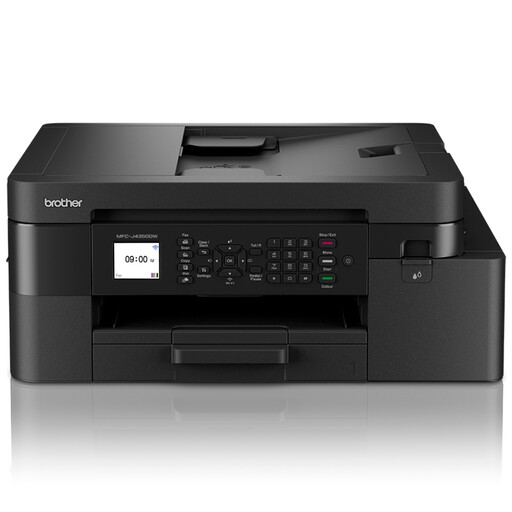
For everyday studio notes, check whether this inkjet’s feeder and paper input can handle the group’s typical batches. If a wired connection is required, confirm Ethernet support; compare compatible cartridge options against the expected colour use.
Choose A4 if notes are normally printed at A4 and larger sheets are exceptional; choose an A3-printing model if maps or display sheets regularly need that size. If the studio must digitise A3 originals too, confirm the scanner’s supported size separately.
Confirm that the exact model supports the studio’s intended connection method and agree who will manage access, credentials and updates. If documents need controlled collection, check whether the model and its configured workflow provide suitable authentication or secure-release features; Brother describes such controls for its professional range, not for every printer.
No: a manufacturer’s stated yield is a comparison input, not a fixed result for the studio’s documents. Check compatible supplies, the stated yield conditions and the expected balance of black and colour printing before working out likely usage.
Use an appropriate electrical-waste route rather than treating the printer as ordinary rubbish. GOV.UK explains that waste electrical and electronic equipment is regulated; check the seller’s applicable take-back arrangement or a local electrical recycling option before disposal.