What should you check?
Start with why you want the snack—protein or the familiar potato-crisp experience—then compare the exact flavour and pack you intend to eat.
| Priority |
What to check |
Your needs |
| Protein |
Compare protein per 100g and per pack. Legislation.gov.uk requires at least 20% of a food’s energy to come from protein for a “high protein” claim; grams of protein alone do not establish that qualification. |
I’m choosing this snack for protein, so I want to know what the portion I’ll eat provides, rather than relying on the product name. |
| Snack type |
Check the main ingredients and whether the product is a conventional potato crisp or a protein-based alternative. Compare portions on the same basis. |
Potato-crisp flavour and texture may matter more to me than protein, or I may be happy to try a different crisp-like snack. |
| Salt and allergens |
Read salt per pack as well as per 100g. Check the exact flavour’s ingredient and allergen statements; Myprotein UK lists soya protein concentrate in its Popped Protein Crisps. |
If I usually finish a whole bag, its per-pack salt figure is the useful comparison. I also need to check whether the ingredients suit me. |
| School setting |
Identify the UK nation, whether the food is school-provided or brought from home, and the current school policy. England’s school-food requirements and its HFSS retail-promotion rules have different scopes. |
If this snack is for school, I need an answer for that particular setting—not a blanket rule about every packet of crisps. |
Brand and product references
These figures describe the named products, not every flavour or pack sold by each brand.
Walkers
Walkers lists both conventional potato crisps and an Oven Baked range.
- Walkers UK lists 5.9g protein per 100g for Oven Baked Sea Salt.
- Its “50% less fat” description compares fat with regular potato crisps; it is not a high-protein claim.
Tyrrells
Tyrrells Lightly Sea Salted is a conventional potato crisp.
- Tyrrells lists 6.9g protein and 0.65g salt per 100g for this flavour.
- Choose it for the potato-crisp format, rather than treating its protein figure alone as a high-protein qualification.
KETTLE Chips
The sampled Lightly Salted product is a potato crisp.
- KETTLE Chips lists 6.5g protein and 0.7g salt per 100g for Lightly Salted.
- Check the nutrition panel for another flavour or pack rather than applying these figures across the range.
Seabrook
Seabrook gives both per-bag and per-100g nutrition for its Sea Salted crisps.
- Seabrook lists 1.9g protein and 0.4g salt per 31.8g bag.
- The same product lists 5.9g protein per 100g; keep the serving basis clear when comparing it with another snack.
Pipers
Pipers Anglesey Sea Salt is a potato-crisp option for shoppers comparing flavours.
- Pipers lists 5.1g protein and 0.94g salt per 100g for this flavour.
- Its protein figure should not be mistaken for a high-protein qualification.
REAL Hand Cooked Crisps
The sampled Jalapeño Pepper product is a conventional potato crisp.
- REAL Hand Cooked Crisps lists 6.9g protein and 0.65g salt per 100g for Jalapeño Pepper.
- Check the label of the flavour you buy; these figures do not describe every REAL crisp.
Joybuy snack option
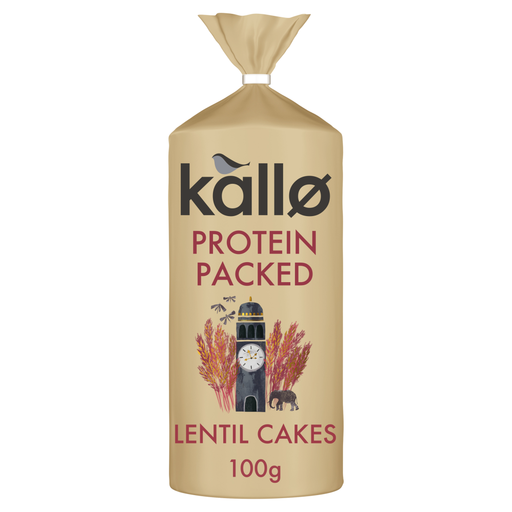
This lentil cake is a savoury alternative to conventional potato crisps for an afternoon snack. Check its pack nutrition if protein is your deciding factor.
 No image available
Kallo Protein Packed Lentil Cakes 100g
Consider this 100g pack if you are open to a lentil cake rather than a potato crisp for your afternoon snack. Compare the pack’s protein per serving, salt and allergen information before choosing it for a specific dietary need.
View on Joybuy
Questions about protein and crisps
Are ordinary potato crisps high in protein?
The sampled conventional crisps from Walkers, Tyrrells, KETTLE Chips, Seabrook, Pipers and REAL are not high-protein options. Their manufacturers list 5.1g to 6.9g protein per 100g; legislation.gov.uk requires at least 20% of a food’s energy to come from protein for a “high protein” claim. Check the exact product rather than assuming every flavour has the same nutrition.
What matters when choosing a protein crisp for an afternoon snack?
Compare protein and salt in the portion you plan to eat, then read the ingredients and allergen statement for the exact product. Myprotein UK lists 11g protein and 1.40g salt per 25g pack for its Popped Protein Crisps, which contain soya protein concentrate.
Does “baked” or “reduced fat” mean high protein?
No: those descriptions address preparation or fat, not the share of energy supplied by protein. Walkers UK describes Oven Baked Sea Salt as having 50% less fat than regular potato crisps and lists 5.9g protein per 100g; assess any high-protein claim separately against the energy-based criterion.
Do the same crisp rules apply to every UK school snack?
No blanket UK conclusion follows from England’s HFSS retail-promotion guidance. The Department for Education says England’s school-food guidance covers food and drink provided in state-funded schools, while Department of Health & Social Care HFSS promotion guidance concerns businesses operating in and selling to England. Check the nation, whether the snack is school-provided or brought from home, and the school’s current policy.


