Occasional organisers with limited space
If you print modest ticket batches alongside home, club or small-office documents, a machine that also scans and copies may suit more of your tasks than a printer chosen solely for batch capacity.


For occasional raffle-ticket batches, a home-office multifunction inkjet may meet your printing, scanning and copying needs without the paper capacity of an office-oriented machine. Check the space it needs while operating and whether its feed supports your chosen ticket stock before deciding; for repeated runs, weigh paper loading and ink changes against the room a higher-capacity machine needs. Finalise the ticket artwork only after identifying which raffle or lottery rules apply.
If you print modest ticket batches alongside home, club or small-office documents, a machine that also scans and copies may suit more of your tasks than a printer chosen solely for batch capacity.
If ticket runs recur, consider how often you will need to refill ink and reload paper. A larger supply may ease that routine, provided the machine still fits your workspace.
If your ticket artwork needs to meet rules for a particular lottery type, establish those requirements before committing to a full print run. The Gambling Commission sets different ticket conditions for different lottery arrangements.
Choose the ticket stock and measure the working space before comparing convenience features. A printer that fits when closed may still need room for paper loading and output.
| Concern | What to check | Who this matters to |
|---|---|---|
| Working footprint | Compare the desk dimensions with the exact printer’s size in use, including access to its paper input and output. | I need to load sheets and collect tickets without moving the printer each time. Around 29% of consumers put usable desk space first. |
| Ticket stock and artwork | Check the chosen sheet’s size, weight and coating against the exact model’s supported feed; establish the applicable ticket requirements before printing. | If I use ticket card, I need a suitable feed and artwork I can approve before the full run. Roughly 29% of consumers prioritise this ticket workflow. |
| Repeat-run interruptions | Consider the size and frequency of your runs, paper-loading arrangement and the conditions behind stated ink yields. | When I print tickets regularly, repeated ink changes or paper reloads would interrupt the job. Around 24% of consumers put run-to-run convenience first. |
| Other document tasks | Confirm the scan, copy or document-feeding functions you will actually use, rather than assuming every all-in-one has the same features. | I also need to copy notices or scan event paperwork, so ticket printing cannot be the machine’s only useful task. About 18% of consumers prioritise everyday multifunction use. |
Paper loading, printed-sheet collection and access to a rear feed can take space beyond the closed printer body.
Measure the desk and compare it with the exact model’s dimensions and paper-path layout in use.
Supported media and feeding methods differ by model. Brother lists a one-sheet manual feed for the MFC-J4340DW, while Epson specifies a rear special-media path for the ET-5850; neither arrangement describes every printer from those brands.
Select the stock first, check the exact model’s media guidance and try a small batch before printing the full run.
Misfeeds or unsuitable stock can waste prepared sheets and ink.
The Gambling Commission specifies ticket information for certain society and local-authority lotteries, while its private-society guidance describes different conditions.
Identify the event’s lottery type and check the applicable official guidance before approving the artwork.
If required information is omitted, the tickets may need to be printed again.
A manufacturer’s page-yield figure does not establish how many pages your particular ticket design will produce. Cartridge restrictions can also affect the ink you can use.
Plan for ticket and ordinary-document printing separately, and check the exact model’s consumable conditions.
These model-specific examples show different paper-handling and ink arrangements; brand names alone do not establish that a printer will accept your ticket stock.
The MFC-J4340DW is a home-office inkjet example for buyers who also need to print, copy and scan documents.
The OfficeJet Pro 8132e is a multifunction colour inkjet with document-feeding features for mixed office and ticket tasks.
Epson’s EcoTank range includes A4 print, copy and scan models as well as office-oriented machines with larger paper supplies.
These multifunction printers span occasional document-and-ticket use and more frequent printing. For every model, check the space needed to operate it and the exact ticket stock you plan to feed before choosing.
 Image unavailable
Consider this model for recurring ticket runs alongside document work if its ink arrangement suits your routine.
Before choosing it, confirm that your ticket stock feeds correctly and that you have room to load paper and collect output.
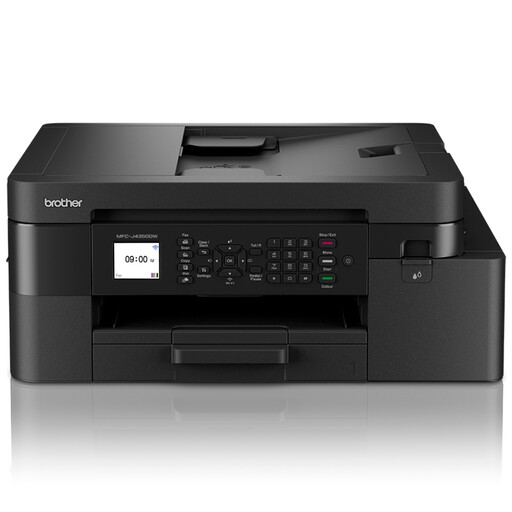 Image unavailable
For occasional tickets alongside everyday paperwork, this all-in-one inkjet is worth considering if it fits your desk in use.
Its one-sheet manual feed may mean frequent loading for a batch on special stock. Confirm the stock’s size, weight and coating against this exact model.
 Image unavailable
For repeat printing alongside office paperwork, consider this A4 model if a refillable ink arrangement suits your routine.
Check the exact ticket media it accepts and leave enough room for paper loading and output. Stated ink yields should not be treated as the yield for your artwork.
 Image unavailable
Consider this office-oriented model for larger runs if its paper-handling arrangement meets your needs and your desk can accommodate it.
Check operating clearance carefully. Even if the stated tray-weight range covers your stock, confirm its sheet size, coating and intended feed path for this model.
 Image unavailable
For larger ticket and document jobs, consider this all-in-one inkjet only if its office-oriented size suits the available space.
Check desk clearance and stable placement, then confirm that the intended ticket stock is supported before planning a full run.
No: check the exact model’s supported sheet sizes, media types, weights and feed path before choosing stock. Brother lists a one-sheet manual feed for the MFC-J4340DW, while Epson specifies a rear special-media path for the ET-5850; those details do not establish compatibility for another model or every kind of card.
That depends on the lottery arrangement. The Gambling Commission specifies ticket information for certain licensed or registered society lotteries and local-authority lotteries; identify your event type and check its full applicable guidance before approving the artwork.
Not under the private-society arrangement described in the Gambling Commission’s guidance: physical tickets must be provided to players. The Commission says that arrangement has no specific requirements for what must be printed on those tickets; check that your event falls within it before applying that guidance.
Start with the expected ticket runs and the ink coverage of your artwork, then read yield figures as conditional manufacturer claims rather than a promised ticket count. Epson states up to 4,500 black and 7,500 colour pages from one ET-2870 ink set under its yield conditions; if considering the HP OfficeJet Pro 8132e, also check HP’s stated restriction on cartridges using a non-HP chip.