Single-screen rally regulars
If you practise stages at one PC monitor, a 27-inch QHD display is a useful starting point for comparing road detail, refresh rate and adaptive-sync support without planning a larger display layout.


For single-screen PC rally practice, start by comparing 27-inch QHD monitors with a high native refresh rate and adaptive-sync support, then check what your PC can deliver at 2560 × 1440. A 34-inch ultrawide offers a wider display but has more pixels to render and needs more space; three screens make more sense as a planned cockpit setup. If you practise with headphones, settle the headset connection before treating monitor speakers as a deciding feature.
If you practise stages at one PC monitor, a 27-inch QHD display is a useful starting point for comparing road detail, refresh rate and adaptive-sync support without planning a larger display layout.
A 34-inch ultrawide may suit you if you have room for its physical width and are willing to check how your PC handles 3440 × 1440. Samsung's 34-inch Odyssey G55T illustrates that format.
If a fixed driving position and three displays are part of your plan, consider screen dimensions, resolution, graphics-card outputs and configuration together. iRacing documents distinct ways to configure a three-monitor setup.
Consider it: when you want one screen and your PC can run your rally game at 2560 × 1440.
Trade-off: its 16:9 display is narrower than an ultrawide or a three-screen arrangement.
Consider it: when a wider view on one screen matters to your driving position.
Trade-off: 3440 × 1440 places more rendering demand on the PC than 2560 × 1440 and requires more physical room.
Consider it: when you are deliberately building a fixed, multi-display cockpit.
Trade-off: mounting, graphics-card connections and game configuration become part of the project; iRacing documents both windowed spanning and combined-display methods.
| Concern | What to check | Who this matters to |
|---|---|---|
| Smooth motion | Check the refresh rate at your intended resolution and whether adaptive sync works with your graphics card and connection. | Fast-moving stages make tearing or uneven motion especially distracting when I am trying to follow the road; roughly 31% of consumers would put smooth motion first. |
| Road detail and PC load | Compare native resolutions and check your rally game's frame rate at 2560 × 1440 on your own PC. | I want enough detail to read the road without choosing a resolution my PC struggles to render; around 31% of consumers would prioritise that balance. |
| Wider driving view | Measure your desk or rig space, then check graphics-card outputs and the game's wide-screen or multi-display setup. | From a fixed driving position, I would value more display area around the cockpit and can accommodate the setup; roughly 23% of consumers would make the wider view their primary concern. |
| Headphones and positioning | Decide where the headset will connect; check the exact monitor's audio port and stand adjustment if you need them. | I practise with headphones and need the screen positioned comfortably, so unused speakers matter less to me; around 15% of consumers would put these practicalities first. |
Samsung describes the G55C's 1ms figure as MPRT, while LG lists 1ms GtG for the 27GS75QN-B. Those are different measurements, so the numbers alone do not establish which screen will show clearer motion in your game.
Compare the stated metric and test conditions rather than choosing solely by the smallest advertised figure.
LG states that the 27GS75QN-B runs at 180Hz normally and needs a DisplayPort 1.4-capable graphics card and DisplayPort 1.4 cable for its 200Hz overclock mode.
Check the graphics-card output, cable and monitor's supported resolution-and-refresh combinations before relying on that mode.
Samsung's 34-inch G55T uses 3440 × 1440, compared with 2560 × 1440 for its 27-inch QHD G55C. The wider panel also needs a suitable physical position; neither specification predicts your game's frame rate.
Measure the space and, where possible, check your rally title's performance at the intended resolution before choosing the wider format.
Integrated speakers, such as those promoted for the BenQ EX2710Q, do not establish how your headphones or microphone will connect.
Decide whether the headset will use the PC, console, controller or monitor. Check for a headphone-out port only if you intend to route audio through the display.
The 27GS75QN-B illustrates a 27-inch QHD IPS route with adaptive-sync support.
The G55C and G55T illustrate different curved-screen choices: 27-inch QHD and 34-inch UWQHD.
The G274QPF E2 is a 27-inch QHD option for buyers checking both display and connection specifications.
The Q27G4XF illustrates a 27-inch QHD Fast IPS route with an adjustable stand.
The EX2710Q is a 27-inch QHD IPS model with integrated audio features.
These models offer single-screen options: 27-inch QHD monitors, a larger 32-inch QHD curved screen and a 34-inch ultrawide. Match the screen size and resolution to your space and PC before comparing their refresh-rate claims.
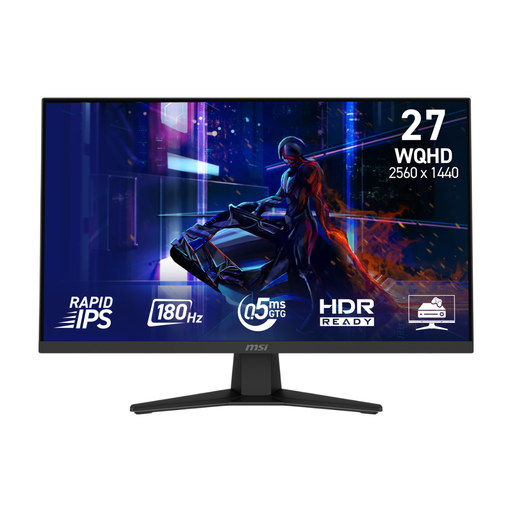 No image available
Consider this for a single-screen QHD setup if its connections suit your PC and headphones.
The product name specifies 180Hz, a Rapid IPS panel and Adaptive Sync. Check the supported refresh rate for the port and cable you intend to use.
 No image available
Consider this larger single-screen QHD format if it fits your desk and viewing position.
The product name specifies 2560 × 1440, 165Hz, Adaptive Sync, HDMI and DisplayPort. Check the refresh rate available through your chosen connection and confirm your intended headphone route.
 No image available
This wider single-screen format suits a setup with room for a 34-inch panel and a PC capable of running the intended game at 3440 × 1440.
The product name specifies a VA panel, two HDMI inputs and two DisplayPort 1.4 inputs. Confirm adaptive-sync compatibility and the refresh rate available through your chosen connection.
 No image available
This is another 27-inch QHD option for a single-screen rally setup; choose a refresh-rate target with your PC's actual game performance in mind.
The product name specifies 240Hz. Check the supported mode for your intended port and cable, as well as how you will connect your headphones.
 No image available
Its 27-inch QHD format fits the conventional single-screen route if your PC can run the rally game at your preferred settings.
The product name specifies 2560 × 1440 and 220Hz. Check port-specific refresh support, stand adjustment and your intended headphone connection before choosing it.
Speakers need not be a priority if headphones are your normal audio route. Decide whether the headset connects to the PC, console, controller or monitor, and check microphone routing separately; MSI lists a headphone-out on the G274QPF E2, but ports vary by model.
It depends on the exact monitor and mode: LG specifies a DisplayPort 1.4-capable graphics card and DisplayPort 1.4 cable for the 27GS75QN-B's 200Hz overclock mode, while its normal rate is 180Hz. Check the resolution-and-refresh limits for the model's HDMI and DisplayPort connections.
You need a compatible monitor, graphics card and connection, with the relevant option enabled in the graphics settings. AMD describes FreeSync for compatible Radeon hardware, while NVIDIA documents G-SYNC and G-SYNC Compatible displays; check the support stated for your exact devices.
You can plan a three-screen setup, but check graphics-card outputs, available space and how your particular game handles multiple displays before buying the additional screens. iRacing documents windowed spanning and combined-display approaches for its simulation; its instructions should not be assumed to apply unchanged to every rally title.