
24/7 Customer Support

Free returns

Same-day & Next-day Delivery

Quality Guaranteed

Unlock Your Welcome Offers: FREE Delivery | Up to 80% OFF | Free 30-day JoyPlus trial
Download the APP
In the world of competitive FPS gaming, every millisecond counts. That crucial moment when you peek a corner in Valorant or counter-strafe in CS2 can be the difference between winning and losing a round. If you've ever felt your equipment was a step behind your reactions, you're likely looking for a performance upgrade. The latest advancement gaining traction is the rapid trigger keyboard, a technology designed to give you that very edge.
This guide is here to help you navigate the features that matter. We'll break down the technology, explain what to look for in a mechanical gaming keyboard and present some of our top recommendations to help you make an informed choice without the marketing jargon.
Choosing the right keyboard involves more than just aesthetics. For competitive play, specific technical features can have a noticeable impact on your in-game performance. Here are a few key considerations.
The heart of any keyboard is its switches. For years, traditional linear switch keyboards have been the go-to for gamers due to their smooth, consistent keystrokes. However, a new contender has emerged: the magnetic switch keyboard.
You may have noticed professional players using smaller keyboards. This is a practical choice. A compact gaming keyboard, such as a 65% or 75% model, omits the number pad (and sometimes the function row) to free up significant desk space. This extra room allows for wider, more comfortable mouse movements, which is critical for players who use low sensitivity settings for precise aiming. A 65% gaming keyboard is a popular choice as it retains the essential arrow keys while being extremely compact.
Polling rate, measured in Hertz (Hz), is how often your keyboard reports its status to your computer. A standard keyboard has a 1000Hz polling rate, reporting 1,000 times per second (every 1ms). An 8000Hz keyboard, however, reports 8,000 times per second, reducing the potential input delay to just 0.125ms. While the difference is marginal, for players seeking the lowest possible latency in an FPS gaming keyboard, this feature can contribute to a more responsive feel.
Here are a few standout options that cater to different needs and preferences for competitive gamers.
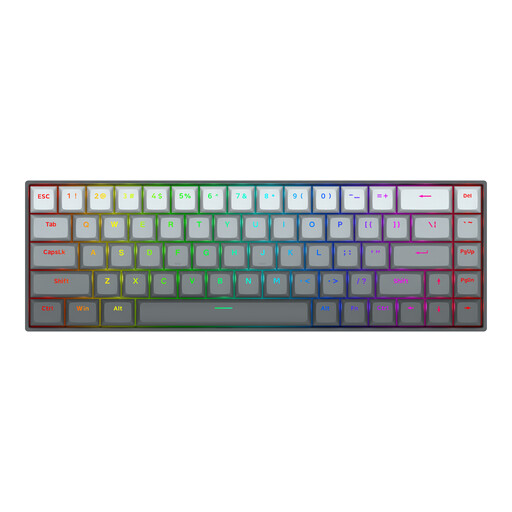
Why It Stands Out: The Redragon M68 packs a suite of high-end performance features into an accessible package. It combines Hall Effect magnetic switches with a blistering 8000Hz polling rate, making it a formidable tool for competitive play. The ability to customise actuation points and leverage Rapid Trigger technology provides a level of control typically found in much pricier models.
Pros:
Who is it for? This is an excellent choice for the serious FPS player who wants to experience the benefits of a magnetic switch keyboard and Rapid Trigger without a significant financial outlay. It's particularly suited for those playing fast-paced titles like Valorant and Apex Legends.
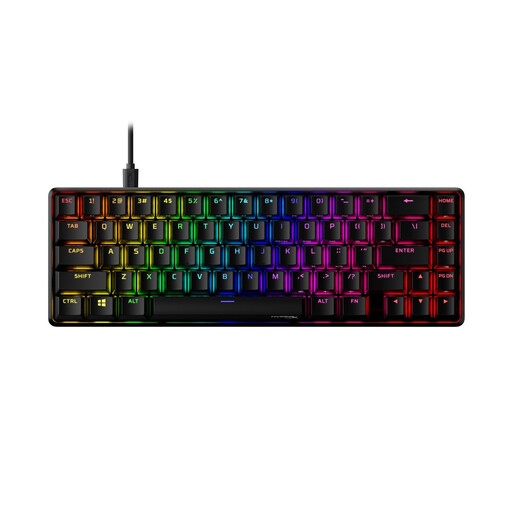
Why It Stands Out: The HyperX Alloy Origins 65 is a testament to refined design and reliability. While it uses traditional mechanical switches, its HyperX Red linear switches are known for their smooth, fast and consistent performance. The keyboard's full aircraft-grade aluminium body provides exceptional stability and a premium feel during intense gaming sessions.
Pros:
Who is it for? Gamers who prioritise build quality, a proven track record and a premium typing feel will appreciate the Alloy Origins 65. It's a reliable wired gaming keyboard for those who prefer the feel of a high-quality traditional linear switch keyboard in a compact form.
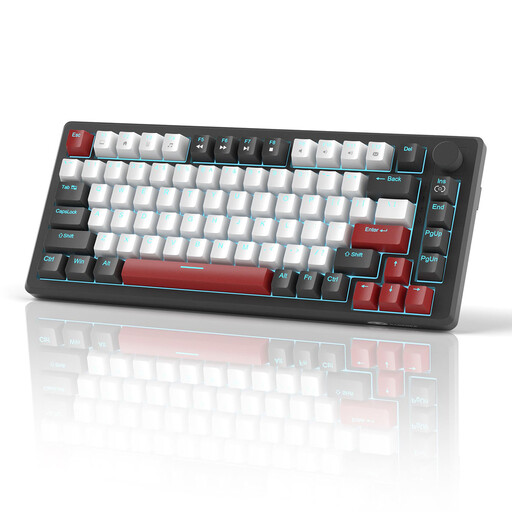
Why It Stands Out: The MageGee STAR75 offers a fantastic entry point into the world of compact mechanical keyboards. Its 75% layout is a great compromise, retaining the function row and dedicated arrow keys while still saving considerable desk space. The inclusion of a multi-functional knob for volume and lighting control adds a layer of convenience not often seen at this price point.
Pros:
Who is it for? This keyboard is ideal for gamers and general users looking for an affordable upgrade. If you want a compact gaming keyboard that doesn't sacrifice function keys and offers useful daily features like a volume knob, the STAR75 is a strong contender.
The keyboards highlighted here represent some of the compelling choices available for gamers in 2026. However, the world of mechanical keyboards is vast. If you're interested in exploring different switch types, layouts or brands, you can browse our broader collection.
? Explore our full range of red mechanical keyboards
Q1: What is a rapid trigger keyboard? A rapid trigger keyboard uses special switches, typically Hall Effect magnetic ones, that allow a key to be reset the moment it begins to travel upwards after being pressed. This is different from standard mechanical keyboards that have a fixed reset point. The result is the ability to perform much faster repeated keystrokes, which is beneficial for precise character movement in games.
Q2: Is a rapid trigger keyboard worth it for Valorant? For a game like Valorant, where precise movement like "counter-strafing" (stopping your movement instantly to fire accurately) is a core mechanic, a rapid trigger keyboard can offer a tangible advantage. The instant key reset allows for cleaner and faster stops and direction changes, potentially improving your movement and aiming consistency.
Q3: What is the difference between a magnetic switch and a linear switch? A traditional linear switch (like a Cherry MX Red) is a type of mechanical switch that provides a smooth press from top to bottom with no tactile bump or audible click. A magnetic switch, often called a Hall Effect switch, is a different technology altogether. It uses a magnet and a sensor to detect the key's position, which allows for features like an adjustable actuation point and rapid trigger. While many magnetic switches are designed to feel linear, their underlying technology is what sets them apart.