
24/7 Customer Support

Free returns

Same-day & Next-day Delivery

Quality Guaranteed

Unlock Your Welcome Offers: FREE Delivery | Up to 80% OFF | Free 30-day JoyPlus trial
Download the APP
Fumbling for a light switch in a dark hallway, struggling to find the right spice in a shadowy cupboard or wishing for a safer way to navigate stairs at night are common household frustrations. Installing new lighting often seems like a costly and complicated job for an electrician. Fortunately, there is a simple, effective and wire-free solution: the rechargeable motion sensor light.
These versatile gadgets provide illumination exactly where and when you need it, without any complex wiring. This guide is designed to help you understand the key features to look for and to present some practical options available for your home in the UK.
Navigating the options can be tricky. To make an informed choice, consider these key factors that will determine how well a light serves your needs.
The brightness of a light is measured in lumens (Lm). A low lumen count (around 50-100 Lm) is suitable for a gentle glow in a bedroom or nursery, while a higher count (300 Lm or more) is better for task-oriented spaces like a kitchen worktop or a garage workshop.
Colour temperature, measured in Kelvin (K), affects the ambiance. A warm white light (around 2700K-3000K) creates a cosy, inviting atmosphere, perfect for living areas and bedrooms. A cool white light (4000K and above) is crisp and clear, making it ideal for kitchens and workspaces. For maximum flexibility, look for a dimmable cabinet light that allows you to adjust both brightness and colour.
One of the main appeals of a battery operated motion sensor light is its simple, tool-free installation. Most models use one of two methods:
stick on lights for cupboards and other smooth, clean surfaces.This wire-free approach is ideal for renters or anyone looking for a quick home improvement without drilling holes.
While motion detection is the core feature, modern lights offer more advanced controls. Standard models use a Passive Infrared (PIR) sensor to detect movement and turn on automatically in low-light conditions. More advanced options may include a gesture control light, allowing you to turn it on, off or dim it with a simple wave of your hand—a particularly useful feature for kitchen under cabinet lighting when your hands are messy.
As the Joybuy Product Recommendation Officer, I've filtered through various options to highlight models that offer practical features and reliable performance for common UK household needs.
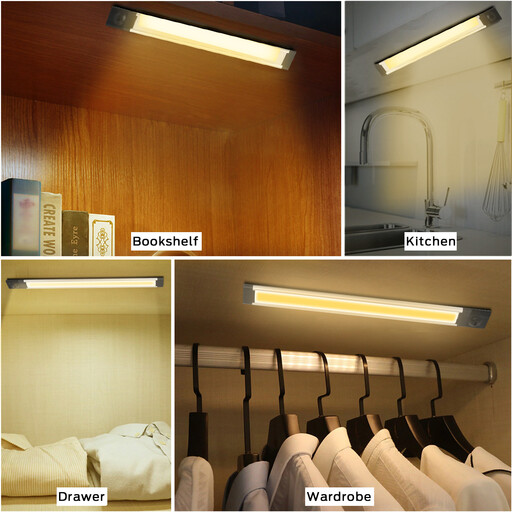
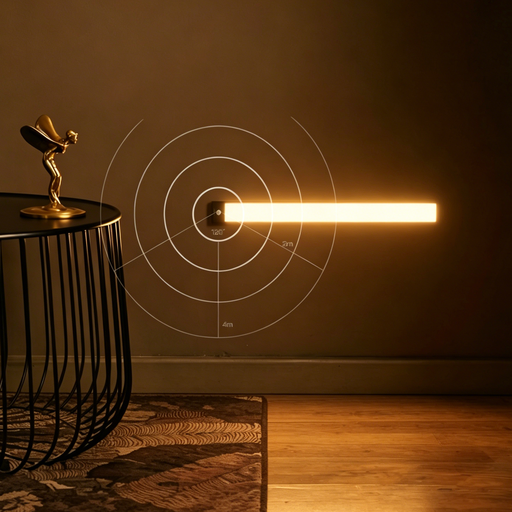
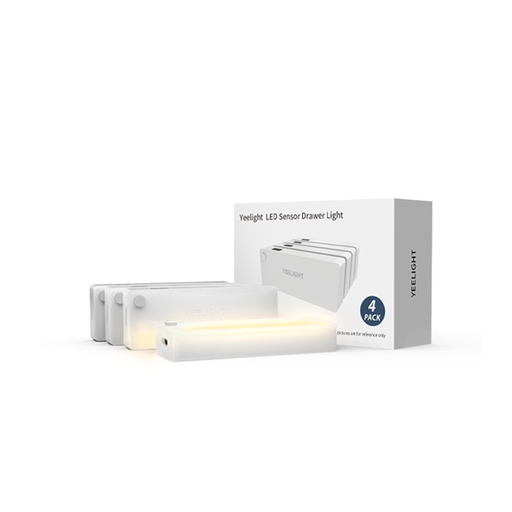
While these recommendations cover a range of common uses, your project might have different requirements for size, brightness or features. If you need something different, you can find a wider variety of solutions to suit your home.
Explore our full collection of motion sensor LED lights to find the perfect match.
1. How long do rechargeable motion sensor lights last on a single charge? Battery life varies depending on the battery capacity, brightness setting and how often the light is activated. On average, most lights can last from several weeks to a couple of months in 'Auto' mode with typical household use. Recharging is simple, usually taking a few hours with a standard USB cable.
2. Can I install a stick-on light on any surface? For the best results, adhesive-backed lights should be applied to smooth, clean and dry surfaces such as finished wood, metal, tile or painted drywall. They may not adhere well to rough, porous or textured surfaces like brick or certain wallpapers. For these situations, a model with a magnetic mount and a screw-in plate (if included) might be a better option.
3. Do motion sensor lights stay on all the time? No, they are designed to be efficient. In 'Auto' mode, the light only activates when it detects motion within its range and when the ambient light is low. It will automatically turn off after a short period of inactivity, typically 15-30 seconds, to conserve power. Many models also include manual 'On' and 'Off' modes for continuous light or to disable the sensor.