Heavy-card revision-card makers
If you want to print directly onto substantial card rather than cut up paper, the exact model’s supported card weight, size and feed path should drive your choice.


Choose the printer around your card stock and printing pattern. For direct printing on heavy card, look for a model with a documented limit for that material and feed path; for batches of black-text cards cut from ordinary A4 paper, a mono laser with automatic two-sided printing is a practical alternative. If colour diagrams are central to your revision, consider a colour inkjet or refillable-tank model, but check its compatibility with the exact card you intend to use.
If you want to print directly onto substantial card rather than cut up paper, the exact model’s supported card weight, size and feed path should drive your choice.
If several people print sets of text, definitions or equations, wireless access, paper capacity and automatic two-sided printing can make repeated A4 runs easier to manage.
If diagrams and colour-coded topics appear throughout your revision materials, weigh colour printing and refill frequency alongside the card stock you plan to use.
Decide whether you will print directly onto card or cut cards from ordinary A4 sheets. Then consider how often the shared desk needs to handle batches and whether colour is essential.
| Concern | What to check | Who this matters to |
|---|---|---|
| Card-stock compatibility | Check the exact model’s supported card type, weight, size and feed path. Try a small pack of your intended stock. | I want to print directly onto sturdy cards without jams or wasted sheets. Around 33% of consumers put compatible card stock first. |
| Shared-desk workflow | Check wireless compatibility, input capacity and the space needed with trays open. | At a shared desk, I want others to print without swapping cables or repeatedly clearing space. Straightforward shared access is the primary concern for around 25% of consumers. |
| Text batches | For A4 sheets you will cut into cards, check mono print speed, tray capacity and whether two-sided printing is automatic. | I print sets of definitions on ordinary paper, so repeated runs need to be manageable. Speed and two-sided printing come first for around 25% of consumers. |
| Colour and refilling | Decide how often you need colour, then compare the stated ink arrangement and media support of the exact models. | Colour-coded diagrams are central to my revision, and I want refilling to fit my printing routine. Around 17% of consumers prioritise colour and refill needs. |
Heavy media can feed poorly or affect print quality when its weight, coating or feed path does not suit the printer. Epson United Kingdom advises checking the exact model’s supported media.
Match your intended card to the model’s media instructions and test a small pack before buying more.
A mono printer cannot reproduce colour-coded topics or coloured diagrams, even if it suits fast text-led batches.
Decide whether colour is essential to your card layout before choosing a mono laser.
Canon UK lists different media categories for the PIXMA TS3750i: 64–105 g/m² for plain paper and up to 275 g/m² for Canon photo paper. The photo-paper figure does not establish support for generic card of the same weight.
Read the material category alongside the weight limit, then check your intended card against the printer’s instructions.
Brother has distinct models worth considering for direct heavy-card printing and for text-led A4 batches; their media capabilities should not be treated as interchangeable.
Epson’s refillable EcoTank route is relevant when colour revision materials are printed frequently.
The PIXMA TS3750i is a colour all-in-one to consider for occasional revision printing on compatible media.
The DeskJet 2820 is a colour all-in-one option when the intended card matches its stated media category.
These colour printer choices relate to revision materials printed at a shared desk. Choose according to your printing routine, and confirm the exact model’s support for your intended card before printing directly onto it.
 No image available
Consider this for frequent colour revision materials when refillable ink and wireless shared access matter.
Before printing directly onto card, check the exact supported media type, weight, size and feed path.
 No image available
Consider this for colour-coded revision sheets and shared printing if its operating space fits the desk.
For direct card printing, match your stock’s material, finish and size to this model’s media and feed instructions.
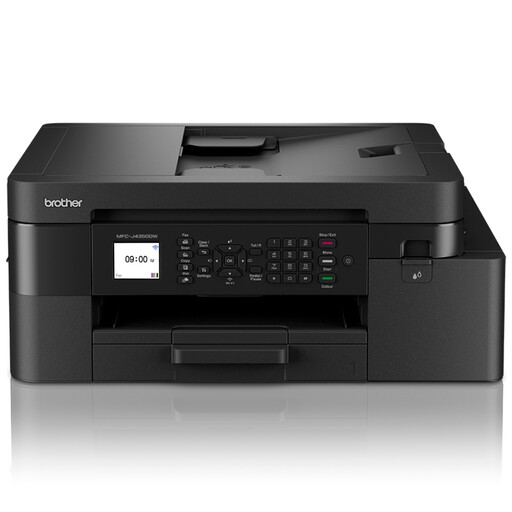 No image available
Consider this when colour revision printing shares a desk with copying and scanning tasks.
Check this model’s supported card weight, finish and size before choosing stock; the MFC-J4340DW’s card rating does not establish support for the MFC-J4350DW.
 No image available
Consider this for colour revision sheets when refillable ink and wireless shared printing suit your routine.
Check card weight, finish, size and feed-path support for the ET-18100, and compare its stated print speed with your expected batch size.
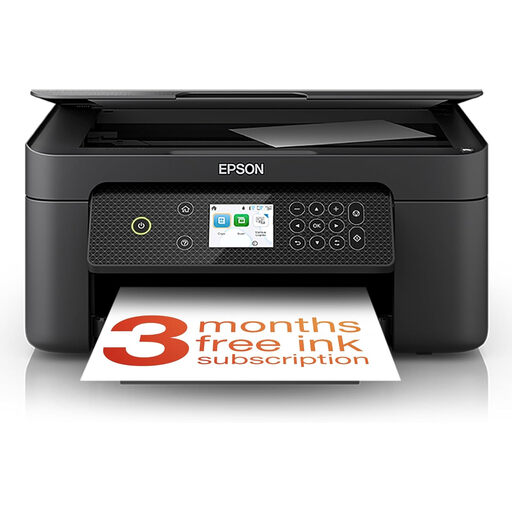 No image available
Consider this for colour revision layouts on A4 sheets when wireless access matters at the shared desk.
The product title lists a resolution of 5760 × 1440 DPI. Check the XP-4200’s card-media guidance before using stock other than your intended supported paper.
No. The card must match the exact printer’s supported material and feed path. Brother UK identifies the MFC-J4340DW for card up to 300 gsm via manual feed; Canon UK’s 275 g/m² figure for the PIXMA TS3750i applies to Canon photo paper, while HP lists HP cards up to 200 g/m² for the DeskJet 2820. These limits are not interchangeable.
Print directly onto card only if your chosen model supports that card’s weight, finish, size and feed path. Otherwise, lay out the cards on supported ordinary A4 paper and cut them out; this also lets you consider automatic two-sided printing for double-sided layouts.
Check that everyone who needs to print can use its wireless connection, then allow room for the printer with its trays open. Paper capacity and automatic two-sided printing also matter for repeated card sets: Brother UK lists a 250-sheet tray and automatic two-sided printing for the HL-L2400DW.
No. A manufacturer’s page-yield figure is not a revision-card count: your layout, colour coverage, number of cards per sheet and test prints affect the result. Use yield information when considering refill frequency, not as a guaranteed output for your card design.