Shared-studio administrator
If you coordinate booking-list updates for several people, consider how much paper must be ready, whether two-sided printing fits your forms, and how users will reach the printer without relying on one person’s computer.


For frequently updated A4 booking lists, choose an inkjet with enough loaded paper for busy periods, automatic duplex printing that supports your paper, and a connection the studio can share. A refillable-tank model may suit regular printing, while A3 handling and larger document feeders matter only if the studio has other paperwork that calls for them.
If you coordinate booking-list updates for several people, consider how much paper must be ready, whether two-sided printing fits your forms, and how users will reach the printer without relying on one person’s computer.
If schedules are reprinted after changes, ink replenishment and the availability of suitable supplies may matter more to you than photo-printing features.
If booking lists sit alongside forms, notices or larger documents, assess scanning, copying, document-feeder capacity and whether you actually need A3 printing.
Start with the busiest booking-list period, then consider how the studio replenishes ink, shares access and handles documents beyond A4 lists.
| Concern | What to check | Who this matters to |
|---|---|---|
| Paper and turnaround | Check loaded-paper capacity for busy periods and whether automatic duplex printing supports your booking-list paper and feed tray. | When schedules change during a busy handover, I need paper ready and two-sided output without stopping to reload; around 31% of consumers put uninterrupted printing first. |
| Ink replenishment | Check the ink system, replacement supplies and the conditions behind any manufacturer page-yield figure. | If I reprint lists often, I want ink supplies I can manage without frequent interruptions; about 31% of consumers prioritise ink replenishment. |
| Shared access | Check whether the studio needs Ethernet or Wi-Fi, and whether its devices and account setup can use the chosen print method. | Several people need to print from their own devices, so I need a connection the studio can manage; around 23% of consumers put shared access first. |
| Other document tasks | Check whether scanning needs a document feeder and whether A3 printing will be used alongside A4 lists. | I also scan forms or produce larger notices, so A4 lists are not my only task; roughly 15% of consumers prioritise wider document handling. |
A booking list’s coverage, colour use and printing pattern can differ from the conditions behind a manufacturer’s page-yield figure.
Use your typical pages to judge how often supplies may need replacing, and check the stated conditions before comparing yields.
Canon specifies automatic duplex printing on the MAXIFY GX4050 for A4 or Letter plain paper from its rear tray or cassette. That does not establish support for card or other feed routes.
Check the exact model’s supported paper size, weight and feed path if your booking sheets differ from ordinary plain paper.
Brother’s MFC-J5740DW offers A3 capability, but a studio printing only A4 schedules may have no use for the larger format.
Decide whether A3 notices or timetables are a recurring task before choosing an A3-capable model.
Canon’s MAXIFY refillable-tank business line is relevant to studios considering A4 administration and a fixed network connection.
Epson’s EcoTank ET-4800 is an A4 refillable-tank all-in-one for studios considering a document feeder and fax alongside booking-list printing.
Brother’s MFC-J5740DW is relevant when A4 booking lists are part of a broader workload that includes A3 documents.
These printers address different shared-studio tasks: regular A4 booking lists, access from several devices, or A4 lists alongside occasional A3 documents. Match the paper and connection requirements to your own workflow before choosing.
 No image available
Consider this model for busy A4 booking-list printing where shared network access and ready paper matter. Check that its automatic-duplex media and feed conditions suit your booking sheets, and assess replacement ink supplies against your expected use.
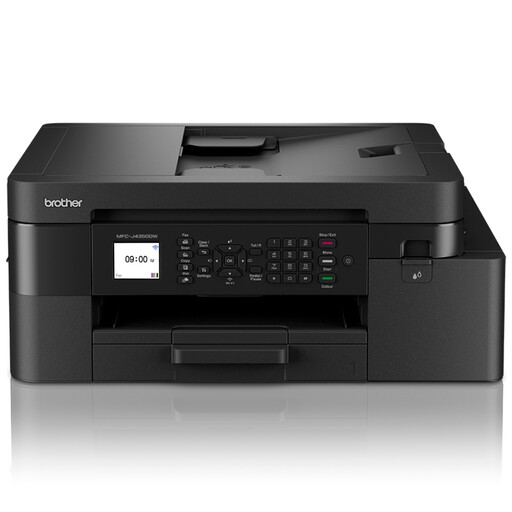 No image available
Consider this all-in-one for regular A4 documents shared over Wi-Fi. Judge whether its listed 150-sheet tray will cover busy periods, and confirm device compatibility and suitable ink supplies before choosing it.
 No image available
Consider this all-in-one if the studio prints A4 booking lists and also needs occasional A3 documents. Allow for its listed 250-sheet paper input, and check duplex-media conditions and ink supplies for your workflow.
 No image available
Consider this model where shared studio paperwork includes A3 documents as well as A4 lists. Its additional lower tray is optional, so confirm the supplied configuration and how any ink subscription would work for the studio.
Not necessarily: Wi-Fi may suit a printer on a stable studio network, while Ethernet suits a fixed position with a wired connection. Canon lists both for the MAXIFY GX4050, and Brother lists wired and wireless connectivity for the MFC-J5740DW; check the studio’s network permissions and each user’s print method.
It depends on the exact model, paper and feed route. For the MAXIFY GX4050, Canon specifies automatic duplex printing on A4 or Letter plain paper from the rear tray or cassette; check the model’s conditions before relying on it for card or other media.
Treat a manufacturer’s page yield as a conditional comparison figure, not a prediction of how many booking lists your studio will print. Check the stated test conditions, your usual colour use and the availability of the correct replacement ink.
Plan an appropriate electrical-equipment collection or recycling route and confirm the arrangements that apply to the studio’s business waste. GOV.UK describes waste electrical and electronic equipment rules as supporting recovery, reuse and recycling; ask your waste provider what handling and documentation are needed for this collection.