
24/7 Customer Support

Free returns

Same-day & Next-day Delivery

Quality Guaranteed

Unlock Your Welcome Offers: FREE Delivery | Up to 80% OFF | Free 30-day JoyPlus trial
Download the APP
A cluttered hallway is more than just an eyesore; it’s the first impression your home makes. Tripping over a mountain of shoes is a frustrating start and end to any day. A well-chosen shoe cabinet promises a simple solution, but the path to a tidy entryway is littered with pitfalls. Many find themselves with a cabinet that’s flimsy, doesn't fit their shoes or obstructs their hallway.
As a Joybuy Product Recommendation Officer, my role is to help you see past the marketing gloss and focus on what truly matters. Before you buy, be aware of these three common traps that lead to buyer's remorse.
To find a reliable and practical shoe storage cabinet, you need to look beyond the promotional photos. Focus on these core parameters to ensure your purchase is a lasting solution, not a temporary fix.
The most critical step is to measure your space and your shoes. Don't just rely on the overall product dimensions (Height x Width x Depth).
The construction of a shoe cabinet dictates its longevity and daily usability.
Based on these practical criteria, here are a few options from our catalogue, matched to different household needs and styles.
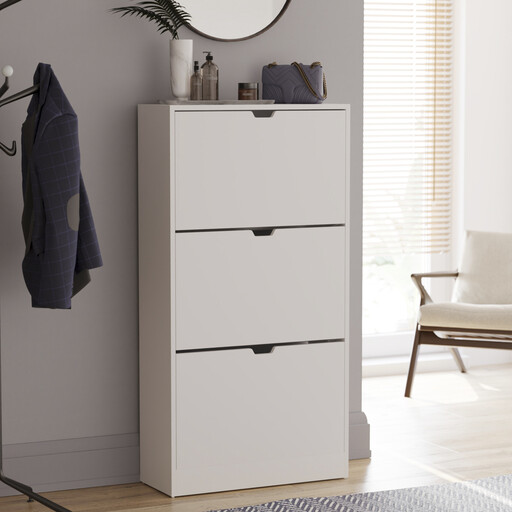
Why This Fits Their Persona: Living in a modern flat or a home with a narrow hallway requires furniture that works hard without taking up space. This cabinet's clean lines and handle-free design offer a minimalist aesthetic that won't overwhelm the room.
Its 24cm depth is specifically designed for tight spaces, providing effective hallway shoe storage without causing an obstruction. The pull-down mechanism is a proven, space-efficient design.
The three separate compartments help organise shoes by type or by person. It's made from FSC-certified wood, ensuring responsible sourcing.
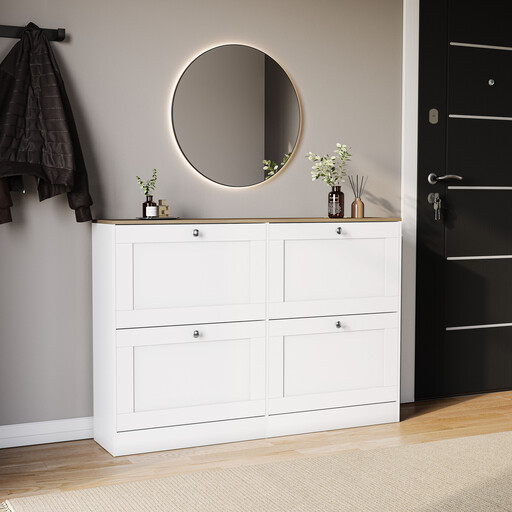
Why This Fits Their Persona: For those who see furniture as an extension of their home's style, a purely functional box won't do. This cabinet blends storage with design, acting as an attractive console table for the entryway.
Unlike basic units, this model is built from sturdy MDF with a durable melamine finish and includes a wall fixing recommendation for stability. It feels like a substantial piece of furniture, not a flimsy box.
The oak-effect top provides a warm, stylish contrast and a practical surface for keys, post or a decorative lamp. The panelled door fronts and stainless steel handles add a touch of classic elegance.
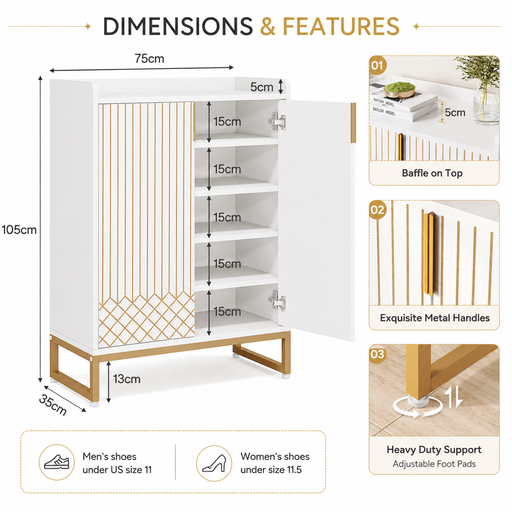
Why This Fits Their Persona: For families or individuals with an extensive shoe collection, capacity is the top priority. This cabinet is designed to handle volume, keeping a large number of shoes organised and protected from dust behind closed doors.
It directly tackles the "misleading capacity" trap by offering five tiers of conventional shelving, which is more accommodating for varied shoe types and sizes than pull-down drawers. It holds a stated 22-25 pairs.
The combination of concealed shelves and an open bottom shelf is highly practical for storing everyday shoes and guest footwear. The sturdy wooden structure with metal legs ensures stability for a fully loaded cabinet.
We have compiled a complete, real-time list of products that fully satisfy these strict selection criteria and UK safety regulations.
The most effective method is to use the anti-tip kit that should be included with your purchase. This usually consists of a strap or bracket that secures the top of the cabinet to the wall. It is a simple but essential safety measure, especially for taller, more narrow units. Always ensure the cabinet is placed on a flat, level surface.
This depends on the cabinet's internal depth. Many slimline models with a 24cm depth can be a tight fit for shoes larger than a UK size 10. It is crucial to check the product's internal compartment dimensions before buying. Some users find they can fit larger shoes by storing them at a slight angle. For guaranteed fit, consider a cabinet with a depth of 30cm or more.
Both are engineered wood products commonly used in furniture. MDF (Medium-Density Fibreboard) is made from fine wood fibres bonded with resin, making it denser, stronger and smoother than particleboard. Particleboard is made from larger wood chips and is generally a more economical option. For a shoe cabinet that will see daily use, MDF often provides better long-term durability, but a well-constructed particleboard unit with a protective finish is also a perfectly suitable choice.