Single-screen space-sim pilots
A 34-inch 21:9 layout is worth considering if you want more horizontal room for a cockpit view. Check your game’s aspect-ratio support and HUD placement before treating that extra width as a docking advantage.


For docking a virtual spacecraft on one monitor, consider a 34-inch 3440 × 1440 ultrawide if you want a wider cockpit layout and your game supports 21:9. Choose a 32-inch 4K display instead if instrument and desktop detail matter more than horizontal width. Whichever format you prefer, check that your graphics card, connection and game settings can sustain the resolution and refresh rate you intend to use.
A 34-inch 21:9 layout is worth considering if you want more horizontal room for a cockpit view. Check your game’s aspect-ratio support and HUD placement before treating that extra width as a docking advantage.
A 32-inch 4K display is relevant if reading instruments, working with a dense interface and using the monitor for other desktop tasks matter more to you than a wider screen shape. Check that your PC can run the intended display mode.
If your space sim already strains your PC, decide on a workable resolution and graphics settings before choosing a headline refresh rate. Roberts Space Industries notes that Star Citizen’s estimated video-memory use changes with resolution and graphics settings.
The main format choice is between horizontal room and 4K detail; within either route, your game and PC determine which display modes are useful.
Choose it when: You want a wider single-screen cockpit layout and your game makes useful use of 21:9.
Accept that: A 3440 × 1440 display still needs suitable GPU performance, and the wider panel cannot fix a game’s restricted field of view or HUD layout.
Choose it when: Instrument, interface and desktop detail take priority over extra horizontal width.
Accept that: The higher pixel count can increase graphics and video-memory demands; the LG 32GR93U-B also needs a suitable DisplayPort 1.4 connection with DSC or HDMI 2.1 to enable 144Hz, according to LG.
| Concern | What to check | Who this matters to |
|---|---|---|
| Wider cockpit view | Check the game’s 21:9 mode and HUD behaviour, then make sure the screen and stand fit your desk. | I want room to see the approach on one screen, but only if the game uses that width well. Around 36% of consumers would put a wider single-screen view first. |
| GPU and video-memory fit | Assess performance at your intended resolution and settings; check video-memory headroom where the game exposes it. | If my PC already struggles during manoeuvres, a display mode I can sustain matters more than a headline specification. Around 29% of consumers would prioritise GPU and video-memory fit. |
| Instrument and desktop detail | Compare 32-inch 4K with 34-inch 3440 × 1440 at your usual viewing distance. | Small cockpit labels and desktop text matter more to me than the shape of a wider view. For around 21% of consumers, detail would be the primary need. |
| Motion and connections | Check refresh modes by input, your graphics card’s output, the cable path and variable-refresh-rate compatibility. | I care most about steady-looking motion and want the advertised mode to work with my PC. Around 14% of consumers would make motion and connection fit their first concern. |
A monitor’s maximum refresh rate does not tell you which mode your graphics output and game can deliver. Roberts Space Industries also warns that running out of video memory can substantially reduce Star Citizen performance.
Check the exact monitor’s port modes, your graphics card’s outputs and your intended game settings before setting a resolution and refresh-rate target.
A wider physical screen does not guarantee a wider usable docking view. The game’s aspect-ratio handling, field of view, menus and HUD placement all affect the result.
Check how your chosen space sim currently handles ultrawide output before selecting a 21:9 panel for that purpose.
ASUS says its PG34WCDM cooling design reduces burn-in risk; risk reduction is not a promise that persistent cockpit or desktop elements cannot cause problems.
Read the exact model’s care guidance and warranty terms, particularly if you expect long sessions with static HUD elements.
An online listing’s country-facing description alone does not establish which power connection and documentation will arrive with a monitor.
Confirm the supplied plug or cable arrangement and English documentation with the seller if the listing is unclear.
Dell lists the 34-inch, 3440 × 1440 AW3425DW QD-OLED and AW3426DWM VA as distinct ultrawide models.
LG lists both the 34-inch 21:9 OLED 34GS95QE-W and the 32-inch 4K IPS 32GR93U-B, covering the two main format choices.
Samsung lists the 34-inch Odyssey OLED G8 G85SD as an Ultra WQHD QD-OLED option with a 175Hz specification.
BenQ specifies the EX3410R as a 34-inch 3440 × 1440 curved VA monitor with a 1000R curve.
ASUS lists the PG34WCDM as a 34-inch 3440 × 1440 curved OLED with 240Hz, a Smart KVM and USB-C charging stated at 90W.
These monitors represent the ultrawide route for a single-screen docking setup, rather than the 32-inch 4K alternative. Compare their screen sizes and stated refresh specifications against your desk, game and PC before choosing.
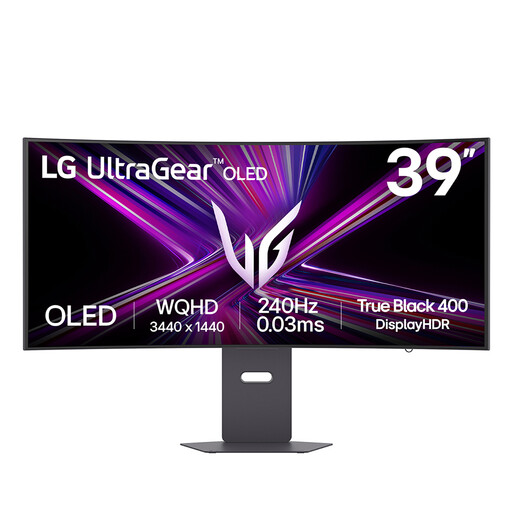 No image available
Consider this larger screen if you have space for a 39-inch monitor and want a single-display cockpit setup.
The product name specifies an OLED panel and 240Hz refresh rate. Check desk fit, game display behaviour and whether your PC can sustain the mode you plan to use.
 No image available
This 34-inch option is relevant if you want an ultrawide-style single-screen setup without moving to a 39-inch display.
The product name specifies OLED and 240Hz. Allow for OLED care in prolonged sessions with static cockpit elements, and confirm the game and PC suit your intended display mode.
 No image available
Consider this VA option if a 34-inch curved ultrawide suits your desk and you want to assess a stated high-refresh mode.
The product name specifies 3440 × 1440, a VA panel, 200Hz and 1ms MPRT. Check the refresh mode for the input you intend to use; MPRT is not the same response-time measure as GtG.
 No image available
This 34-inch UWQHD model is relevant if you are comparing single-screen ultrawide layouts.
Before choosing a refresh-rate target, confirm the model’s supported mode through your intended input and cable, along with your PC’s performance in the game.
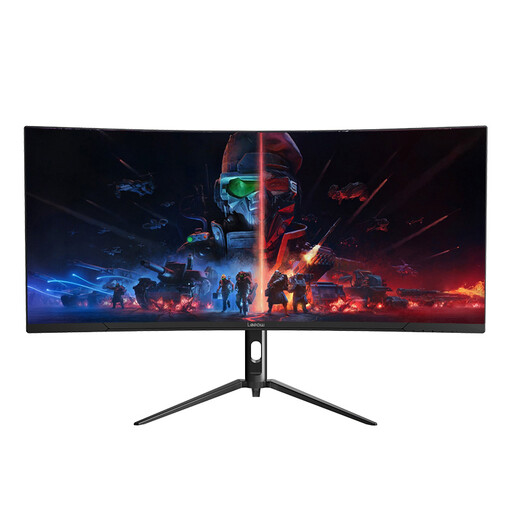 No image available
Consider this model if a 34-inch curved ultrawide fits your single-monitor setup and you can check its connection modes against your PC.
The product name specifies 3440 × 1440 and 165Hz. If variable refresh rate matters to you, confirm support for the exact model before buying.
No. A 34-inch 21:9 monitor is worth considering for a wider single-screen layout, but its practical value depends on the game’s aspect-ratio and HUD behaviour and on your PC sustaining the chosen resolution. LG describes its 34-inch 21:9 display as 34% wider than standard 16:9; that physical format does not establish how much usable view a particular game provides.
Check the requirements for the exact monitor, graphics card and connection path. For the LG 32GR93U-B specifically, LG says enabling 144Hz requires a graphics card supporting DisplayPort 1.4 with DSC or HDMI 2.1. You must also assess whether your game runs satisfactorily at your chosen settings.
No. Read the measurement type and conditions for each exact model rather than treating a single figure as a complete motion assessment. Samsung says the Odyssey OLED G8 G85SD’s quoted 0.03ms GtG result is based on internal test conditions and can vary with content, settings and input-source performance.
Not necessarily. GOV.UK guidance says Great Britain continues to recognise CE marking alongside or in place of UKCA marking where the relevant rules allow it. That guidance concerns England, Scotland and Wales; if you are buying for Northern Ireland, check the applicable Northern Ireland requirements rather than assuming the Great Britain process applies.