Shared-studio production coordinators
If several contributors send jobs to one printer, network access, paper capacity and a clear way to keep ordinary documents off programme stock matter as much as the printed page itself.


Choose around the sheets you need to print, not just the finished programme size. Brother specifies automatic two-sided A3 printing for the MFC-J6955DW when larger duplex sheets are required; for A4 sheets folded into smaller programmes, Canon’s MAXIFY GX7050 offers a higher-capacity paper arrangement, but its specified automatic duplex printing is limited to A4 or Letter plain paper. Epson’s six-colour ET-8550 is an option to investigate for image-led A3+ artwork, provided its media handling and the studio’s separate booklet-finishing process fit the job.
If several contributors send jobs to one printer, network access, paper capacity and a clear way to keep ordinary documents off programme stock matter as much as the printed page itself.
If the layout calls for A3 sheets or two-sided A3 spreads, check that duplex printing applies to that size and the intended stock. An A5 finished booklet alone does not establish a need for an A3 printer.
If photographs, colour artwork or A3+ covers drive the choice, consider the image-printing and feed arrangement alongside the more routine programme-page workflow. A printer for artwork still needs a workable plan for folding and stapling.
Choose when: The programme layout regularly needs A3 sheets or two-sided A3 spreads. Brother specifies automatic two-sided A3 printing for the MFC-J6955DW.
Allow for: This office-oriented all-in-one prints sheets; folding and saddle-stitching need a separate process.
Choose when: Pages are prepared on A4 sheets and finished separately. Canon specifies a 600-sheet total plain-paper input arrangement for the MAXIFY GX7050.
Check before use: Canon limits that model’s specified automatic duplex printing to A4 or Letter plain paper.
Choose when: A3+ colour artwork or covers take priority. Epson specifies A3+ output and a six-colour ink system for the EcoTank ET-8550.
Check before use: Confirm the planned paper-feed and duplex workflow rather than treating A3+ output as proof of automatic two-sided A3 printing.
| Concern | What to check | Who this matters to |
|---|---|---|
| Shared access and interruptions | Check how studio devices will connect and whether the available trays can keep ordinary jobs separate from programme stock. | I need several contributors to print without repeatedly changing paper or waiting for one computer. Around 33% of consumers put continuity of shared printing first. |
| Programme size and duplex printing | Set the finished size and sheet layout, then check automatic duplex support for that sheet size and paper type. | If my layout needs two-sided A3 sheets, an A4 duplex specification will not settle the question. Roughly 27% of consumers prioritise getting the programme format and two-sided workflow right. |
| Paper and cover presentation | Match the chosen stock’s weight, finish and coating to the relevant feed path; proof the actual artwork on that stock. | I want the programme to look right on its intended paper without discovering that the stock cannot go through the planned feed or duplex path. Around 27% of consumers put paper and colour presentation first. |
| Occasional A3+ artwork | Decide whether A3+ sheets are a regular requirement and whether rear-feed loading suits the production schedule. | My programme pages are the routine job, but I also need occasional larger artwork or covers. About 13% of consumers make that A3+ capability their primary concern. |
Canon specifies automatic two-sided printing for the MAXIFY GX7050 on A4 or Letter plain paper. That does not establish automatic duplex printing on A3 sheets or heavier programme stock.
Check the exact duplex conditions for the planned sheet and paper, then proof the complete two-sided file before ordering the production stock.
If the intended stock needs manual turning, allow for the handling and alignment work in the production schedule.
Paper limits can differ by tray and paper type. A weight accepted for a specified photo paper does not establish that every coated or uncoated stock of the same weight will feed correctly.
Get the stock’s weight, finish and coating from the supplier, match them to the printer’s relevant feed instructions and test the finished layout.
Print Booklets describes specialist equipment that prints, staples and machine-folds theatre programmes. A desktop printer does not, by itself, complete those finishing steps.
Plan who will check the PDF, collate, fold, staple and inspect the programmes—or arrange a separate finishing service.
In-house finishing needs equipment or hands-on time beyond the print run.
The MFC-J6955DW is a reference point for a shared studio that needs automatic two-sided A3 printing.
The MAXIFY GX7050 is a reference point for A4 programme sheets that will be folded and finished separately.
The EcoTank ET-8550 and ET-15000 are reference points for studios considering A3+ artwork or covers.
These printer choices are relevant to printing programme sheets in a shared studio, with folding and stapling planned separately. Decide on A4 or A3 sheets and the intended paper before checking which model fits the job.
 No image available
Consider this inkjet printer if the programme layout calls for larger sheets and the studio needs a shared printing arrangement. Confirm automatic duplex support for the intended size and stock, and whether a second tray is included with this variant.
 No image available
Consider this model for programme pages prepared on A4 sheets and finished separately. Check its maximum paper size and the exact sizes and paper types permitted for automatic duplex printing; do not apply the GX7050’s specifications to the GX6150.
 No image available
Consider this all-in-one inkjet printer if larger programme layouts are part of the studio’s plan. Check whether automatic two-sided printing covers the required sheet size and stock, and whether its paper input suits the planned run.
 No image available
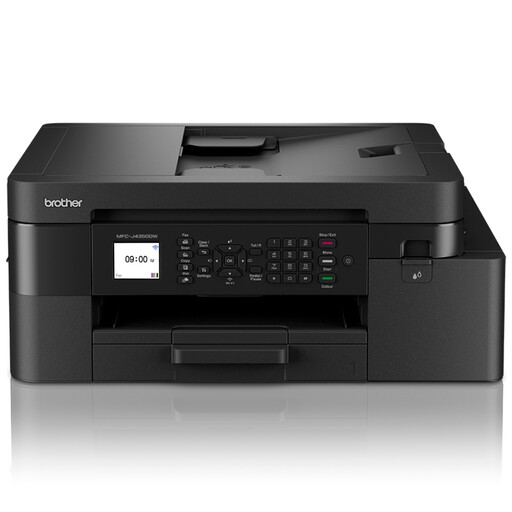
Consider this all-in-one inkjet printer for routine programme-sheet printing in a shared workspace. Before choosing it for an A3 layout, confirm its maximum paper size; also check duplex conditions for the intended stock and whether its paper input will require reloads during the run.
Not necessarily: A4 sheets can be folded into a smaller finished programme. Choose A3 capability when the sheet layout or artwork actually requires it, and confirm the finished size, pagination and separate finishing process before selecting a printer.
No; automatic duplex support depends on the printer’s stated sheet-size and paper conditions. Canon specifies it for A4 or Letter plain paper on the MAXIFY GX7050, while Brother specifies automatic two-sided A3 printing for the MFC-J6955DW. Check the exact model and intended stock rather than extending either specification to a different paper or printer.
A desktop printer produces the printed sheets, but the studio must arrange folding, collation and stapling separately unless it has suitable finishing equipment. Print Booklets describes using specialist machines to print, staple and machine-fold theatre programmes, illustrating the extra steps an in-house workflow must cover.
Check the applicable business electrical-waste arrangements rather than placing a studio printer in ordinary waste. GOV.UK identifies the Waste Electrical and Electronic Equipment Regulations 2013, as amended, as the UK’s underpinning WEEE legislation; for a business in Scotland, the Scottish Environment Protection Agency advises using a registered waste carrier and keeping a waste transfer note when the equipment leaves the site.