For PC touring-car sims, a 34-inch curved 21:9 monitor is a sensible starting point if you want a wider driving view without the physical scale of a 49-inch 32:9 display. Choose a larger screen only if your space, graphics hardware and games suit it; weigh OLED's static-HUD risk against its picture characteristics. If PS5 is your main platform, prioritise a compatible 16:9 display rather than expecting native ultrawide output.
Who this choice is for
PC racers seeking a wider cockpit view
If horizontal track and cockpit visibility matters more to you than choosing a standard 16:9 screen, compare 21:9 and 32:9 options against your available space and the aspect ratios your games support. RTINGS notes that ultrawide games can show more of the surroundings than on a standard 16:9 monitor.
Drivers focused on smooth motion
If fast cornering makes changing frame rates distracting, look beyond the headline refresh rate. Check the monitor's variable refresh rate (VRR) compatibility with your graphics hardware and the mode available through your chosen connection.
PS5 or mixed-platform racers
If the same monitor must serve a PS5 and a PC, establish the console's 16:9 output modes before choosing an ultrawide for PC driving. PlayStation provides a PS5 test for supported 1440p, 120 Hz and VRR output.
What matters when choosing
34-inch 21:9 for PC
Choose when: You want more horizontal game context than 16:9 and your PC game supports ultrawide output.
Trade-off: A 3440 × 1440 display places greater demands on graphics hardware than a 2560 × 1440 display.
49-inch 32:9 for PC
Choose when: A very wide PC driving setup is the priority and your rig has room for the screen.
Trade-off: The larger format needs more physical space; check mounting and GPU capability for the exact model.
16:9 for PS5
Choose when: PS5 is your main racing platform and predictable console output matters more than a PC ultrawide view.
Trade-off: Confirm the particular display's 1440p or 4K, 120 Hz and VRR modes rather than relying on its gaming label.
For touring-car driving with headphones, settle the display format and source device first; then compare the motion, connection and panel characteristics that affect your sessions.
| Concern |
What to check |
Who this matters to |
| Driving view |
Check the aspect ratio, desk or rig space, and whether your PC game supports it. |
If I want to see more track and cockpit context, I need a wider view that fits my driving position. Around 27% of consumers put that PC-view need first. |
| Motion |
Check native-resolution refresh modes and VRR compatibility with your graphics hardware and connection. |
Through fast corners, I care most about how motion looks when my game's frame rate changes; for around 33% of consumers, smooth motion is the primary concern. |
| Platform fit |
Check the monitor's input modes; for PS5, test the supported 1440p, 120 Hz and VRR output. |
If I switch between PC and PS5, I want to know which display mode each can actually use. That compatibility need comes first for around 20% of consumers. |
| Panel choice |
Compare OLED panel-care and warranty terms with the exact VA or other LCD alternative. |
With a racing HUD on screen for repeated sessions, I need to decide whether OLED's picture characteristics justify its static-content trade-off. Around 20% of consumers place that decision first. |
Buying pitfalls
-
Buying an ultrawide mainly for PS5 racing
RTINGS notes that consoles do not support ultrawide aspect ratios, so a 21:9 or 32:9 panel will not give you the native PS5 view you may expect.
If PS5 is your main source, assess its supported 16:9 modes first. Consider an ultrawide for its PC use instead.
-
Equating maximum refresh rate with game frame rate
A monitor's advertised refresh rate does not establish what your source, connection and racing game can deliver together. NVIDIA describes VRR as matching display refresh to the graphics card's changing frame rate, not creating additional game frames.
Compare achievable in-game performance with the exact monitor's native-resolution modes and VRR compatibility.
-
Overlooking fixed HUD elements on OLED
RTINGS warns that constant exposure to static elements can increase OLED burn-in risk. Repeated speedometer, timing or menu layouts make that relevant to touring-car play.
Review the exact model's panel-care features and warranty, and consider an LCD alternative if long sessions with a fixed interface are your usual pattern.
-
Assuming every input offers the same display mode
The available resolution and refresh-rate combination can differ by input, source and cable, even on the same monitor.
Check the exact model's port-mode table, then confirm the active signal in your PC settings or the PS5 Video Output screen.
Relevant monitor brands for reference
ASUS ROG
ASUS lists the ROG Swift OLED PG34WCDN as a 34-inch, 1800R curved OLED model with a 360 Hz refresh rate.
- ASUS specifies DisplayPort 2.1, USB-C 90 W power delivery and OLED Care Pro for this model.
- Check whether your PC can use the desired display mode and whether OLED panel care suits your repeated HUD use.
LG UltraGear
LG lists the 34GS95QE-B as a 34-inch, 3440 × 1440 curved OLED monitor with a 240 Hz refresh rate.
- LG specifies AdaptiveSync, G-SYNC Compatible and FreeSync Premium Pro support for this exact model.
- OLED's static-content trade-off still matters when a racing HUD remains in place for long sessions.
Samsung Odyssey
Samsung lists the Odyssey OLED G9 G95SC as a 49-inch, 5120 × 1440, 32:9 curved OLED monitor with a 240 Hz refresh rate.
- Its stated 32:9 format gives PC racers a super-ultrawide option to assess for a large rig.
- Allow for the screen's physical size, and do not choose it expecting native PS5 ultrawide output.
AOC
AOC lists the CU34G2XPD/BK as a 34-inch curved VA monitor with 3440 × 1440 resolution and a 180 Hz refresh rate.
- AOC specifies FreeSync Premium for this non-OLED ultrawide model.
- Assess its exact input modes and motion behaviour rather than treating refresh rate alone as a full comparison with OLED models.
Joybuy monitor options
These monitors cover 34-inch curved ultrawides and a 49-inch super-ultrawide for PC-focused driving setups. Choose by the view your games support, the space available and the display mode your hardware can deliver; headphones do not make built-in speakers a deciding feature.
 No image available
LG UltraGear 34GX900A-B 34-inch OLED monitor
Consider this 34-inch OLED option for PC racing if a curved ultrawide view is your priority. The product name specifies WQHD and 240 Hz; check the usable mode with your graphics hardware and review panel-care and warranty terms for repeated static-HUD use.
View on Joybuy
 No image available
Dahua 34-inch 3440 × 1440 curved VA monitor
This is a curved ultrawide option for a PC touring-car setup. Its product name specifies 200 Hz, 1 ms MPRT, two HDMI inputs and two DisplayPort 1.4 inputs; MPRT should not be compared directly with GtG figures. Confirm the resolution and refresh mode available through the input you intend to use, as well as VRR compatibility if you need it.
View on Joybuy
 No image available
Lenovo R34w-30 34-inch UWQHD gaming monitor
Consider this 34-inch UWQHD model if you want a wider PC racing display. Check the exact input modes and your game's ultrawide support before deciding whether it meets your preferred refresh-rate target.
View on Joybuy
 No image available
CRUA 49-inch 5120 × 1440 curved VA monitor
This 32:9 option suits a PC rig where a very wide display is the main aim. Its product name specifies 165 Hz, a 1500R curve and AMD FreeSync; check your game's 32:9 support, the available input mode and whether your desk or mount can accommodate a 49-inch screen.
View on Joybuy
 No image available
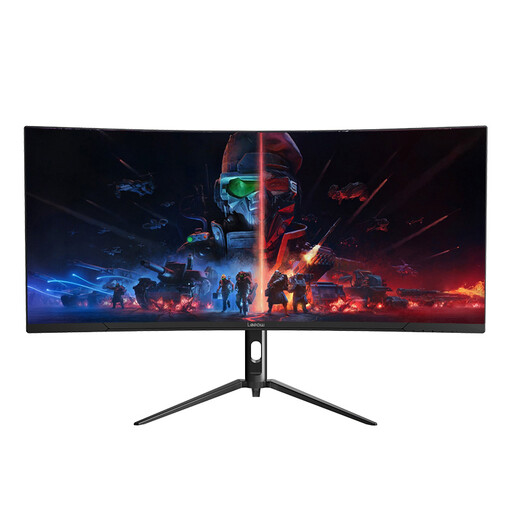
Lepow HC-SJ34MZ5 34-inch curved ultrawide monitor
Consider this model for a 34-inch curved PC racing view. Its product name specifies 3440 × 1440 and 165 Hz; confirm the refresh mode your chosen input supports and check VRR compatibility if changing frame rates are a priority.
View on Joybuy
Frequently asked questions
Should I buy an ultrawide mainly for PS5 touring-car games?
Not for a native ultrawide PS5 view. RTINGS states that consoles do not support ultrawide aspect ratios; if PS5 is your main source, check a monitor's supported 16:9 modes first. An ultrawide may still make sense if you also want its wider PC gaming view.
How do I check PS5 1440p, 120 Hz and VRR support?
Use the PS5's video-output settings to test the connected monitor and inspect the active signal. PlayStation says the console can test 1440p SDR/HDR output at 60 Hz or 120 Hz and VRR when the display supports those modes; the game and connection must also support the mode you want to use.
Do built-in monitor speakers matter if I race with headphones?
They need not be a deciding feature if your headphones use another connection in your PC or console setup. Before choosing the monitor, establish where the headphones will connect and check microphone support separately if you use voice chat.
Will VRR make a racing game run at the monitor's maximum refresh rate?
No. NVIDIA describes VRR as matching monitor refresh to the graphics card's changing frame rate; it does not make the game render more frames. Check the monitor's VRR compatibility, connection and the performance your system can achieve in the game.


