What matters when choosing?
Start by comparing the script-and-call layout at your preferred text size, then check whether the screen can be positioned at your standing desk. Treat connections and device switching as separate decisions: they help only when your equipment and working pattern call for them.
34-inch, 3440 × 1440 ultrawide
Consider it when: Two adjacent windows give your script enough room and you want the more compact of these screen formats.
Trade-off: Its 1440 vertical pixels leave less document space than a 5120 × 2160 display, so test the layout at a text size you can read.
39.7- or 40-inch, 5120 × 2160 ultrawide
Consider it when: Keeping more of a long script visible beside the call is worth prioritising; Dell U4025QW and LG 40U990A-W illustrate this resolution.
Trade-off: Check the display’s dimensions, usable desk depth and your computer’s supported video output before committing to the larger format.
| Concern |
What to check |
Who this matters to |
| Readable script space |
Compare native resolution and the space your script and calling apps occupy at your preferred text size. |
If my script needs to stay readable without hiding the call, window layout comes first; around 39% of consumers put readable workspace first. |
| Standing-desk positioning |
Check the stand’s adjustment range or compatible mount, along with usable desk depth. The Health and Safety Executive advises a central screen with its top at eye level, about an arm’s length away. |
When I change desk height, I need to place the screen comfortably in both positions; around 38% of consumers make positioning their primary concern. |
| Laptop and device workflow |
Confirm your laptop’s video output and charging requirements against the exact ports. For two computers, check the monitor’s KVM connections. |
I want fewer connection changes during calls, especially if I switch computers; around 23% of consumers prioritise connection and switching workflow. |
Joybuy ultrawide monitors
These 34-inch ultrawides are options to assess for a script beside a call. Compare each screen at your preferred text size, then check stand positioning and connections against your standing desk and laptop; these products do not represent the larger 5120 × 2160 route discussed above.
 No image available
LG UltraGear 34GX900A-B 34-inch OLED WQHD monitor
Consider this 34-inch ultrawide if you want to try a script and call in adjacent windows. Its title specifies an OLED panel and 240 Hz refresh rate; check whether the script remains readable at your preferred text size, and confirm the stand range and laptop connections for your setup.
View on Joybuy
 No image available
Philips Evnia 6000 34M2C6500 34-inch monitor
Its 3440 × 1440 screen is an option for arranging a script beside a call within the 34-inch format. The title lists DisplayPort at 175 Hz, HDMI at 100 Hz, two HDMI inputs and stand height, swivel and tilt adjustment; check the adjustment range and desk fit before choosing it for standing work.
View on Joybuy
 No image available
Dahua 34-inch UWQHD 200 Hz curved monitor
The 3440 × 1440 format gives you a screen on which to assess adjacent script and call windows. Its title specifies a VA panel, two HDMI inputs and two DisplayPort 1.4 inputs; check the complete stand range and desk footprint against your standing position.
View on Joybuy
 No image available
Lenovo R34w-30 34-inch UWQHD monitor
This 34-inch UWQHD monitor is another option for checking whether your script and calling app fit comfortably side by side. Confirm its physical dimensions, stand adjustment range and laptop connections before using it in a sit-stand arrangement.
View on Joybuy
 No image available
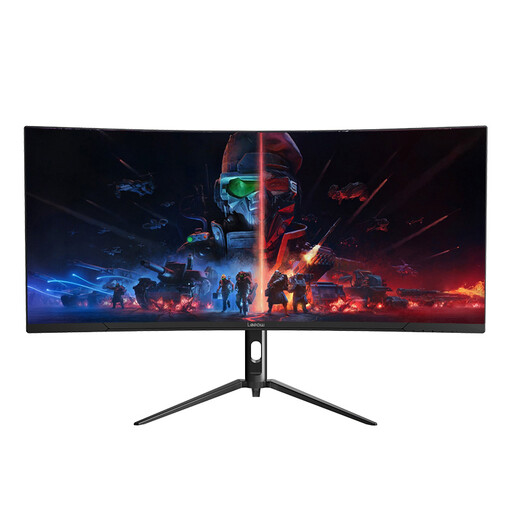
Lepow HC-SJ34MZ5 34-inch curved ultrawide monitor
Its 3440 × 1440 screen is suited to assessing a script-and-call layout in the 34-inch format. The title specifies a 165 Hz refresh rate; for a standing desk, check whether the stand or a compatible mount can place the screen at the height and distance you need.
View on Joybuy
Frequently asked questions
How should I position an ultrawide at a standing desk?
Place the top of the screen level with your eyes and the display about an arm’s length away, in line with Health and Safety Executive guidance. Keep the screen and keyboard central, then check their positions again when you change desk height.
Will USB-C automatically send video and charge my laptop?
No: a USB-C connector alone does not establish which video, data and charging functions a laptop and monitor can use together. Check the laptop’s supported display output and power requirement against the monitor’s exact port rating; Dell also cautions that some M-series chips may not support certain features of its Thunderbolt monitors.
Would a built-in KVM help with script reading and calls?
A built-in KVM helps when you use two computers and want to share one keyboard and mouse; it does not make the script larger. Samsung describes that two-source control on its ViewFinity S65UC, so check the input connections if switching computers is part of your routine.
When does a display-screen workstation need an assessment?
In the UK, the Health and Safety Executive says employers must assess a workstation when a worker uses display screen equipment daily as part of normal work, continuously for an hour or more. That requirement concerns the workstation as a whole, not just the monitor you choose.


