Detail-focused map reviewers
If you regularly inspect labels, boundaries or colour-coded layers, compare native resolution and whether a flat or curved viewing plane suits the way you examine map edges.


A 34-inch, 3440 × 1440 ultrawide is a starting point if you want a map beside notes on one screen. Consider a flat model if you prefer a flat viewing plane for inspecting lines and edges; consider a larger 5120 × 2160 screen if the extra pixel detail justifies its desk footprint and your computer can drive it. For long sessions, check reflections, screen position and connections alongside resolution.
If you regularly inspect labels, boundaries or colour-coded layers, compare native resolution and whether a flat or curved viewing plane suits the way you examine map edges.
If you keep a map beside notes, research or documents, a 21:9 ultrawide gives you a single screen on which to arrange those windows. Check that the physical screen fits your desk.
If you want fewer desk cables, compare the monitor’s video inputs and charging capability with your laptop’s display output and power needs. Apple Support advises Mac users to check external-display support and the cables or adapters required.
Choose the screen format around the map detail and window layout you need, then check whether its shape, stand and connections work in your study.
Consider it when: you want a map beside reference material on a 3440 × 1440 screen.
Trade-off: if you prefer a flat plane for checking straight lines, assess the curve before buying.
Consider it when: a flat viewing plane matters to you when inspecting map lines, boundaries and edges.
Trade-off: a 3440 × 1440 flat model does not provide the pixel canvas of a 5120 × 2160 display.
Consider it when: dense map content or multiple large panes make the extra pixels useful.
Trade-off: check desk space and whether your computer and cable support the intended display mode.
| Concern | What to check | Who this matters to |
|---|---|---|
| Map detail | Compare native resolution, including 3440 × 1440 and 5120 × 2160, and decide whether you prefer a flat or curved panel. | If I examine fine labels and boundaries for long stretches, I want enough detail to read them without giving up room for my reference material. Around 40% of consumers put map detail first. |
| Long-session setup | Check stand adjustment, screen placement and whether the surface and room lighting produce distracting reflections. | When I review maps for extended periods, I need a screen I can position comfortably in my study. Long-session setup comes first for around 30% of consumers. |
| Laptop connection | Match the laptop’s video output and supported display mode to the monitor input; check charging requirements and the cable. | I use a laptop at this desk and want the monitor connection to handle the display reliably, with charging if my setup allows it. Around 20% of consumers prioritise that connection. |
| Desk fit | Measure available width and depth, including the stand, before choosing a larger screen. | My study desk has limited room, so a larger display needs to earn the space it takes up. Desk fit is the primary concern for around 10% of consumers. |
A 34-inch 3440 × 1440 monitor and a roughly 40-inch 5120 × 2160 monitor differ in both pixel canvas and physical footprint, as the BenQ PD3420Q and Dell U4025QW specifications illustrate.
Compare native resolution, screen dimensions and stand depth against the maps and supporting windows you actually use.
A USB-C connector alone does not establish that your laptop can send the intended video mode and receive enough power through a particular monitor and cable.
Check the laptop’s display output, the monitor’s input and power-delivery rating, and which cable is supplied.
A different cable or adapter, or a separate charger, may be needed if the connection does not meet both requirements.
The UK Health and Safety Executive notes that poorly designed display-screen workstations and environments can contribute to discomfort. A monitor feature does not settle questions of placement or lighting.
Set the screen at a workable height, manage reflections and change activity or take breaks during long sessions.
Curvature is a viewing preference, not a reason to assume that straight boundaries or edge details will look better to you.
If those details drive your choice, compare a flat panel with a curved one where possible.
LG’s 34WQ75C-B is an example of a 34-inch ultrawide for a single-screen workspace.
BenQ’s PD3420Q is a flat-panel option to examine if map lines and edges make the viewing plane important to you.
Dell’s UltraSharp range provides examples at both 34-inch ultrawide and larger 5K2K sizes.
These monitors offer different ways to keep maps and reference windows on one screen, from 34-inch ultrawides to a much wider 49-inch format. Check panel shape and desk fit carefully: the 49-inch model is not the 5120 × 2160 route discussed above, and prolonged static maps warrant particular care with the OLED model.
 No image available
Consider this 3440 × 1440 screen if you want a map beside notes on one display. Its listed VA panel is curved rather than flat, so compare the viewing plane if straight map lines matter to you.
The product title specifies 200 Hz, two HDMI inputs and two DisplayPort 1.4 inputs; the refresh rate is not, by itself, a reason to choose it for static maps. If a near-silent study is essential, check operating noise before ordering.
 No image available
This 34-inch ultrawide is a candidate if you want map content and study material on a single screen. It has a curved VA panel, so it is not the flat-screen route for inspecting straight lines.
Check that its stand adjustment suits your viewing position, and ask about operating noise if quiet-room acoustics are important.
 No image available
This 34-inch ultrawide can accommodate a wide map workspace, but its OLED screen requires particular consideration for prolonged static map display: the product information warns of burn-in with extended static images.
The title specifies 240 Hz, which does not address that static-image risk. If you plan to connect a laptop, confirm the required display mode, cable and charging arrangement.
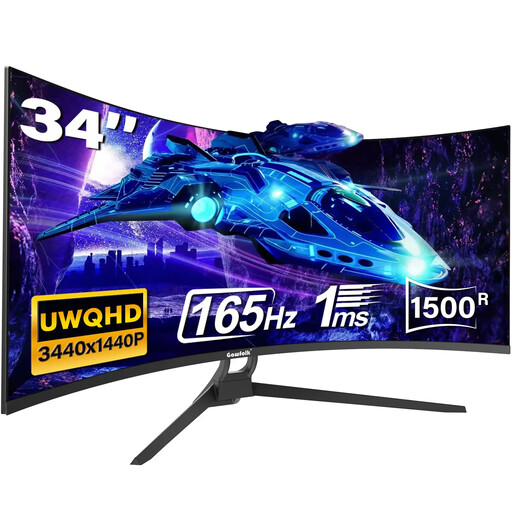 No image available
The 34-inch, 21:9 format is worth considering if you want a map alongside other windows. Its stated 1500R curve may not suit you if a flat presentation of map boundaries is a priority.
The title names HDMI 2.1, DisplayPort 1.4 and Type-C, while the technical port list names only HDMI and DisplayPort; confirm the actual ports before planning a laptop connection. Check stand-height adjustment and operating noise if either matters to your study.
 No image available
Consider this 49-inch, 32:9 screen only if your map workflow needs a very wide canvas and your desk can accommodate it. Its stated 5120 × 1440 resolution is not the 5120 × 2160 format discussed for greater vertical map detail.
The title specifies an 1800R curve and HDMI, DisplayPort and USB-C connections. Check the dimensions with its stand, your computer’s intended display mode and operating noise before choosing it for a quiet study.
It is a starting point if you mainly need a map beside notes or reference material. LG Electronics UK and BenQ UK list that resolution on 34-inch models; if dense labels or several large panes drive your choice, compare the space you can use on screen with a 5120 × 2160 model.
Choose the panel shape according to how you prefer to inspect lines and edges, rather than assuming either shape works better for everyone. If a flat viewing plane is important to you, compare a flat model such as BenQ’s PD3420Q with a curved screen where possible.
It will work for your intended setup only if the laptop, monitor input and cable support the display connection you need. Check the laptop’s supported external-display resolution and refresh rate, then check charging separately; Apple Support also advises Mac users to identify the necessary ports, cables and adapters.
Check whether you can position the screen comfortably and control reflections in your study. The UK Health and Safety Executive links poorly designed display-screen workstations and environments with discomfort; stand adjustment, lighting and breaks matter alongside monitor features.