A 34-inch-class, 21:9 WQHD monitor is a starting specification for keeping a calendar beside email. At a shared desk, check whether each user can reposition the screen and whether the monitor and stand fit the space. USB-C docking and a built-in KVM matter chiefly when the connected laptops need charging or two computers must share a keyboard and mouse.
Who this setup suits
Calendar-and-email multitaskers
If you keep a calendar visible while working in email, documents or a browser, a 21:9 WQHD screen gives you horizontal space to arrange those windows. Check the window sizes you find readable rather than relying on the screen diagonal alone.
Hot-desk and shared-workstation users
When different people use the same desk, the screen may need repositioning between sessions. The Health and Safety Executive includes workstation setup in its display screen equipment guidance; an adjustable stand is one part of setting up the desk for its current user.
Two-computer desk sharers
If two computers need to use one display, keyboard and mouse, a built-in KVM may be useful. Check that both computers can connect through the monitor’s supported inputs before choosing one for that feature.
What to check before buying
Start with room for the two windows you use most, then check screen positioning and desk fit. Consider docking and computer switching only if the connected devices call for them.
| Concern |
What to check |
Who this matters to |
| Side-by-side workspace |
Compare a 21:9 panel with native 3440 × 1440 resolution, then check that calendar and email remain readable at your preferred window sizes. |
I want to see appointments while replying to email without continually changing windows. Around 42% of consumers put that side-by-side workspace first. |
| Changing users |
Check height, tilt and swivel adjustment, plus the monitor’s width and stand footprint against the desk. |
When someone else takes over the desk, I need to move the screen into a suitable position for them. For roughly 33% of consumers, repositioning is the primary concern. |
| Two-computer switching |
Check KVM and multi-source modes if needed; match the monitor’s inputs and USB-C power delivery to both computers. |
If two computers share the desk, I would rather use one keyboard and mouse than rearrange the connections each time. About 25% of consumers place that switching need first. |
Buying pitfalls
-
Choosing by screen size alone
A 34-inch label does not establish the resolution, stand adjustment or connections needed for this desk.
Compare the exact model’s native resolution, physical dimensions, stand range and inputs. Check docking or KVM separately if you need either feature.
-
Choosing docking features for a single-computer desk
Keeping calendar and email open from one computer does not itself require KVM, Ethernet or USB-C laptop charging.
Decide whether the desk will actually switch between computers. If it will not, concentrate on readable window space, adjustment and physical fit.
-
Relying on the stand to settle workstation setup
An adjustable monitor still needs to be positioned for the person using it. The Health and Safety Executive says employers should assess display screen equipment workstations and reduce risks, including ensuring breaks from display screen work.
Reset the workstation for its current user and follow the employer’s assessment process where the screen is used for work.
-
Assuming every USB-C connection does the same job
A monitor’s USB-C charging rating does not establish what a particular laptop can send as video or needs for charging.
Check the laptop’s video-output and charging requirements against the exact monitor’s ports, power-delivery rating and required cable.
Brands to consider
Dell
Dell’s Pro 34 Plus USB-C Hub Monitor P3425WE is a business-oriented ultrawide to examine when the shared desk also needs laptop connections.
- Dell UK specifies a 34.1-inch WQHD screen, USB-C power delivery of up to 90W and RJ45 Ethernet for the P3425WE. Its model information also lists KVM and height, tilt and swivel adjustment.
- Check the laptop’s charging and connection requirements and the P3425WE’s physical fit; these features should not be assumed for other Dell ultrawides.
LG
LG’s 34BA75QE-B combines a 34-inch WQHD ultrawide layout with features aimed at a desk used by more than one computer.
- LG UK lists a 3440 × 1440 curved IPS panel, USB-C power delivery of up to 90W, RJ45, stand adjustment, Picture-by-Picture and built-in KVM for this model.
- LG describes side-by-side work as a use case, not an independent productivity comparison. Check the precise model and connected computers before relying on its docking features.
Samsung
Samsung’s 34-inch ViewFinity S6 S65UC is relevant when viewing two sources or sharing peripherals is part of the desk setup.
- Samsung Business UK lists USB-C, LAN, built-in KVM and multi-source viewing options for the ViewFinity S6 S65UC.
- Confirm the exact model suffix, stand adjustment and USB-C charging output for the unit you are considering.
Joybuy products for this setup
These ultrawide monitors offer different starting points for a calendar-and-email workspace, from 34-inch models to a wider 49-inch option. Check stand movement, desk fit and the connections your computers need for the particular model.
 No image available
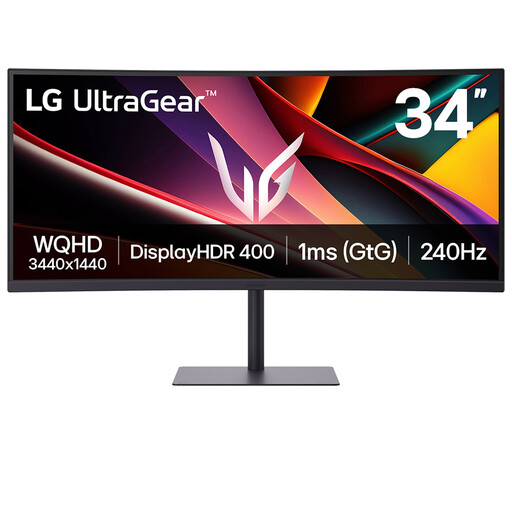
LG UltraGear 34G630A-B 34-inch VA WQHD monitor
Consider this 34-inch model if keeping calendar and email on one screen is your main need; check how its position can be adjusted for each desk user.
The product name specifies a VA panel and 240Hz refresh rate. If two computers must share a keyboard and mouse, confirm the required switching arrangement before buying.
View on Joybuy
 No image available
Acer X Predator X49X 49-inch QD-OLED monitor
This wider format may interest someone arranging several windows or connecting two computers, but first check whether the display and stand fit the shared desk.
The product name specifies a curved 32:9 QD-OLED display with Double Quad HD resolution, a 1800R curve, 240Hz refresh rate, HDMI, DisplayPort and USB-C. Confirm the connection and peripheral-switching arrangements required by both computers.
View on Joybuy
 No image available
Philips Evnia 6000 34M2C6500 34-inch WQHD monitor
Its stated stand adjustments make this a model to examine when the screen position changes between users; measure the space available for the stand as well as the screen.
The product name specifies 3440 × 1440 resolution, height, swivel and tilt adjustment, two HDMI inputs and DisplayPort. It lists refresh rates of 175Hz over DisplayPort and 100Hz over HDMI. Check docking and peripheral-switching requirements separately.
View on Joybuy
 No image available
Dahua 34-inch UWQHD curved monitor
Consider its 34-inch ultrawide format for placing calendar and email together, while checking the full stand footprint before assigning it a shared desk.
The product name specifies 3440 × 1440 resolution, a VA panel, 200Hz refresh rate, two HDMI inputs and two DisplayPort 1.4 inputs. Confirm the adjustment and connection features your users need for this exact model.
View on Joybuy
 No image available
LG UltraGear 34GX900A-B 34-inch OLED WQHD monitor
This is another 34-inch option for side-by-side windows, but its OLED panel warrants particular thought if calendar and email will remain in fixed positions for long periods.
The product name specifies OLED and a 240Hz refresh rate. The product description warns that prolonged static images can risk OLED burn-in; check the manufacturer’s usage guidance for a persistent desktop layout.
View on Joybuy
Common questions
Is a 34-inch WQHD ultrawide enough for calendar and email?
A 34-inch, 21:9 WQHD screen is a starting point for showing the two windows side by side. Check your preferred text scaling and window sizes, then measure the desk’s depth and width before settling on a model.
What matters most when different people use the desk?
Choose a screen position that can be reset for each user, checking the stand’s height, tilt and swivel range as well as its footprint. For a workplace desk, the Health and Safety Executive’s display screen equipment guidance also calls for workstation risks to be assessed; adjustment alone does not settle the whole setup.
Do I need a built-in KVM switch?
A built-in KVM is useful when two computers must share one keyboard and mouse through the monitor; it is not needed simply to place calendar beside email from one computer. LG and Samsung list built-in KVM on the particular business models discussed above, but you should check the exact model’s inputs against both computers.


