What matters when choosing?
Start with the space needed for the dashboard and report. Then decide whether this particular desk also needs laptop docking, two-computer control or an integrated camera; check screen positioning regardless of those extras.
| Concern |
What to check |
Who this matters to |
| Side-by-side workspace |
Check for 3440 × 1440 resolution and test text scaling and window sizes on the intended laptop. |
If I keep a dashboard open while reading or editing a report, I need both windows to remain legible. Roughly 36% of consumers put usable side-by-side workspace first. |
| Laptop docking |
Confirm USB-C video compatibility and compare the monitor’s stated power delivery with the laptop’s charging requirement; check for Ethernet if needed. |
When I move my laptop between shared desks, I want a connection that handles the display and suitable charging without repeatedly rebuilding my setup. For around 29% of consumers, docking is the primary concern. |
| Two-computer use |
Check for a built-in KVM and the required USB connections; check Picture-by-Picture if both inputs must appear simultaneously. |
If I alternate between a work laptop and another computer, I would rather share peripherals than reconnect them each time. Two-computer use comes first for roughly 21% of consumers. |
| Calls and workstation fit |
Decide whether a built-in webcam is useful, and check stand adjustment, screen position and reflections at the desk. |
When different people use the desk for regular work or video calls, I need a screen I can position appropriately and a camera arrangement that suits the office. Around 14% of consumers prioritise these needs. |
Joybuy products for this setup
These ultrawides offer screen formats to consider for a dashboard beside a report, from 34-inch 3440 × 1440 models to a wider 49-inch 32:9 option. Check each model’s connections and fit for the shared desk rather than treating the screens as interchangeable docking setups.
 No image available
Acer X Predator X49X 49-inch 32:9 QD-OLED monitor
Consider its wider format if the shared desk can accommodate it and the dashboard and report need extensive horizontal room.
The product name specifies a 49-inch, 32:9 QD-OLED screen with an 1800R curve, HDMI, DisplayPort and USB-C. Check desk width, viewing position, laptop charging requirements and the intended two-computer workflow before choosing this format over a 34-inch screen.
Joybuy
 No image available
LG UltraGear 34GX900A-B 34-inch OLED WQHD monitor
Its 34-inch WQHD format is relevant to keeping a dashboard beside a report.
The product name specifies an OLED panel and 240 Hz refresh rate. Its product warning advises against extended static images because of burn-in risk, an important consideration if a dashboard stays on screen for long periods. Check USB-C video and charging compatibility with the intended laptop.
Joybuy
 No image available
Dahua 34-inch UWQHD curved VA monitor
Its stated 3440 × 1440 resolution gives the dashboard and report a 34-inch ultrawide canvas.
The product name lists a VA panel, 200 Hz refresh rate, two HDMI inputs and two DisplayPort 1.4 inputs. If the desk needs single-cable laptop docking or shared keyboard-and-mouse control, check those requirements separately.
Joybuy
 No image available
Philips Evnia 6000 34M2C6500 34-inch WQHD monitor
Its 3440 × 1440 resolution suits the proposed side-by-side window layout, while the listed stand adjustments matter when users share a desk.
The product name lists height, swivel and tilt adjustment, two HDMI inputs and DisplayPort. Check whether the intended laptops and peripherals need docking or switching connections beyond those listed inputs.
Joybuy
 No image available
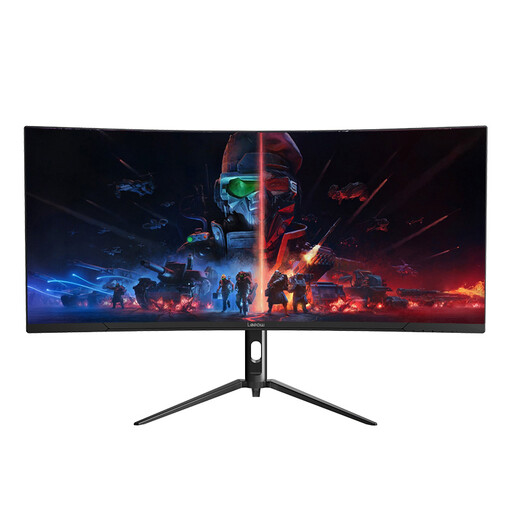
Lepow HC-SJ34MZ5 34-inch curved ultrawide monitor
Its stated 3440 × 1440 resolution provides a starting point for arranging a dashboard and report side by side.
The product name specifies a 34-inch curved screen and 165 Hz refresh rate. Check the stand’s adjustment range and the connections needed at the shared desk before selecting it for regular office use.
Joybuy
Frequently asked questions
Is a 34-inch ultrawide suitable for a dashboard beside a report?
A 34-inch 3440 × 1440 ultrawide is a practical starting point for that layout. It retains 1440 vertical pixels while providing room to arrange windows horizontally; check text scaling and the actual window sizes with the laptops and people who will use the desk.
When do I need KVM rather than two video inputs?
Choose a KVM-equipped monitor when two computers need to share one keyboard and mouse. Multiple video inputs connect the displays but do not, by themselves, provide that peripheral control; choose Picture-by-Picture as well if both computers must be visible at once.
Can one USB-C cable run the display and charge my laptop?
It can if the laptop supports compatible USB-C video and charging and the monitor supplies enough power for it. LG UK lists up to 65 W for the 34WR55QK-B, while Dell UK lists 90 W for the P3425WE; compare the chosen model’s rating with the intended laptop’s requirements.
Does changing to an ultrawide call for a workstation assessment?
For workers who use display screen equipment daily for continuous periods of an hour or more, the UK Health and Safety Executive says employers must assess the workstation. HSE also calls for an assessment when an existing workstation or the way it is used changes; the desk, chair, lighting and working arrangements matter alongside the monitor.
Do screen comfort features replace adjustments to the shared desk?
No. An adjustable stand or anti-glare surface does not replace checking each regular user’s screen position, reflections and wider workstation arrangement. HSE’s display screen equipment guidance addresses risks across the workstation and working environment, not just the screen.


