Standing-desk recipe indexers
People who keep browser research, recipe fields and reference images in view while needing to reposition the screen as the desk height changes.


Start with a 34-inch, 3440 × 1440 ultrawide that you can position comfortably at both seated and standing desk heights: its width suits recipe fields beside browser references, although long pages will still need scrolling. Prioritise USB-C video and adequate charging for a compatible laptop, a built-in KVM switch if you use two computers, or stated colour specifications if the index includes image work. Check the stand or arm alongside the desk setup rather than choosing on screen size alone.
People who keep browser research, recipe fields and reference images in view while needing to reposition the screen as the desk height changes.
People who use one laptop for indexing and want fewer desk connections, provided its USB-C port supports monitor video and the monitor meets its charging needs.
People who catalogue food photography or cookbook scans and need to consider panel and colour specifications as well as space for their indexing tools.
For a standing-desk recipe index, establish where the screen needs to sit before deciding which connections and image-related features serve your workflow.
| Concern | What to check | Who this matters to |
|---|---|---|
| Screen placement | Check stand height adjustment at both desk heights. For an arm, match the VESA pattern, monitor weight and desk mounting limits. | If I alternate between sitting and standing, I need the screen in a comfortable position at each height. Roughly 36% of consumers may put screen placement first. |
| Laptop connection | Confirm USB-C video support on the laptop and compare its charging requirement with the monitor’s power-delivery rating. | With one laptop handling my recipes and references, I want fewer connections to manage when I move the desk. Around 29% of consumers may prioritise the laptop connection. |
| Two-computer work | Check the exact model’s KVM and multi-view modes, then confirm the inputs needed by both computers. | If recipe files and reference material live on different computers, I want to control or view both without repeatedly swapping devices. Approximately 21% of consumers may make two-computer work their main concern. |
| Images and scans | Check panel type and stated colour coverage, and consider how the software and source images are colour-managed. | When I edit food photographs or compare cookbook scans, the appearance of those images matters more to me than extra office connections. About 14% of consumers may put image work first. |
A supplied stand may not place the screen suitably at both desk heights. The Health and Safety Executive advises positioning the top of a display at eye level and viewing it from about an arm’s length away.
Check the screen position while seated and standing. If you need an arm, match its capacity and mounting requirements to the monitor and desk before ordering.
An arm also takes mounting space and may require a different desk-mounting arrangement.
USB-C describes the connector, not every function it supports. Dell Support states that USB-C monitor video requires DisplayPort Alt Mode or a Thunderbolt port.
Check the laptop port specification, the monitor’s display and data connections, and whether its power delivery meets the laptop’s charging requirement.
An unsuitable port or insufficient charging may leave you using a separate connection or charger.
A built-in KVM switch is for controlling connected computers with one keyboard and mouse; it does not create additional workspace for applications running on a single computer.
If you index everything on one device, focus instead on screen positioning and the connections that device actually needs.
A page can remain visible when an exact model is unavailable. Similar-looking 34-inch monitors can also differ in stand adjustment and connections.
Check the full model designation, availability, seller and warranty terms before ordering, and compare specifications again if you change models.
The LG 34BA75QE-B is an example of an ultrawide aimed at a laptop-based standing-desk setup.
The Dell P3424WE illustrates a curved USB-C hub monitor for a laptop, wired network and desk peripherals.
The Samsung ViewFinity S65VC is relevant when a recipe-index workstation regularly uses two computers.
The BenQ PD3420Q is a flat IPS option to examine when the index includes food photography or scans.
These Joybuy ultrawides provide width for recipe fields beside references. Compare their stated features with the screen position, connections and image work your desk setup requires.
 No image available
Its 34-inch, 3440 × 1440 screen is suited to keeping recipe fields beside browser references. The product name specifies a VA panel, 200 Hz refresh rate, two HDMI inputs and two DP 1.4 inputs.
Check the screen position at both desk heights and confirm monitor, arm and desk compatibility if you intend to mount it.
 No image available
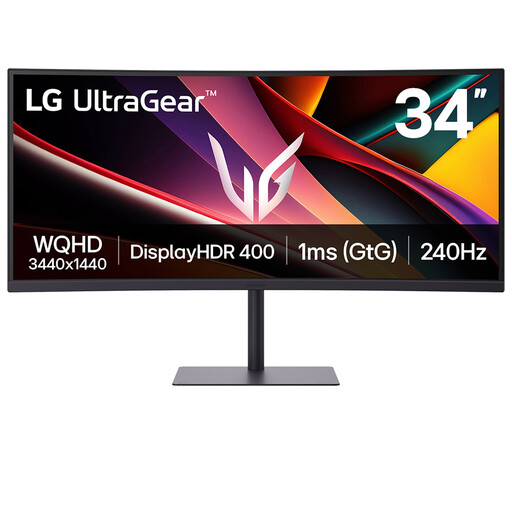
This 34-inch ultrawide is an option for arranging recipe and reference windows side by side. Its product name specifies a VA panel, WQHD resolution and 240 Hz refresh rate.
Check whether its stand reaches the screen positions you need. If connecting a laptop by USB-C, check video compatibility and charging requirements before relying on a single cable.
 No image available
Its 34-inch ultrawide format gives recipe fields and references room to sit alongside one another. The product name specifies an OLED panel, WQHD resolution and 240 Hz refresh rate.
The listing warns about OLED burn-in and recommends screen-protection settings, which matter if index fields stay on screen for long periods. Confirm laptop connections and arm compatibility before building the desk setup around it.
 No image available
This 34-inch UWQHD ultrawide is relevant if you want recipe-entry tools and references visible together. Before choosing it for a standing desk, confirm that the stand’s adjustment reaches your seated and standing screen positions.
If you plan to use an arm, check the exact VESA pattern, monitor weight and desk mounting limits.
 No image available
Its 34-inch, 3440 × 1440 format suits a recipe index with reference windows alongside it. The product name specifies two HDMI inputs, DisplayPort, and height, swivel and tilt adjustment; it lists up to 175 Hz via DisplayPort and 100 Hz via HDMI.
Check the adjustment against both desk heights. If you also edit food images or scans, confirm the exact model’s colour specifications for that work.
No particular ultrawide size or resolution is specified in the cited Health and Safety Executive guidance. For UK workers who use display screen equipment daily as part of normal work, continuously for an hour or more, the HSE says employers must assess the workstation, work and individual requirements. Its posture advice focuses on screen position and viewing distance.
Not if the supplied stand lets you position the screen appropriately while seated and standing. If you need an arm for more positioning range or desk depth, check the monitor’s VESA fit, weight and depth against the arm’s capacity and the desk’s mounting limits.
No: the laptop port must support video output through DisplayPort Alt Mode or Thunderbolt, according to Dell Support. Also compare the monitor’s power-delivery rating with the laptop’s charging requirement before expecting one cable to handle both display and charging.
A built-in KVM is useful if you regularly control two connected computers with one keyboard and mouse. If the recipe index and its references all run on one computer, focus on screen placement and the connections that computer needs instead.