What matters when choosing
Decide what kind of colour judgement the work requires, then check whether the screen and stand fit the room. Treat laptop docking as a separate compatibility decision rather than a substitute for either check.
| Concern |
What to check |
Who this matters to |
| Colour decisions |
Match named colour modes to your intended output; check calibration documentation and use an accurate ICC profile in a colour-managed application. |
If I am choosing between colour edits for a portfolio or video project, I need the display and editing workflow to give me dependable feedback. Around 33% of consumers put reliable colour comparison first. |
| Desk fit |
Compare the assembled width and stand depth with your usable desk space; check mounting options if the stand will not fit. |
I want room for my edit and reference windows, but I cannot give the monitor more desk space than my room allows. For around 27% of consumers, a usable workspace that physically fits is the primary concern. |
| Laptop docking |
Confirm video-capable USB-C or Thunderbolt output, the monitor’s power-delivery rating and the cable needed for its hub functions. |
If my laptop moves between study spaces, reconnecting the display, charger and peripherals should be straightforward. One-cable use comes first for around 20% of consumers. |
| Web-first work |
Check stated sRGB coverage and any factory-calibration claim for the exact model; decide whether your work needs additional colour modes. |
For coursework and edits mainly viewed online, I would rather assess a straightforward sRGB option than assume I need every creator-display feature. Around 20% of consumers prioritise this simpler web-first route. |
Brands to consider
These model lines illustrate different features to examine; a brand name alone does not establish colour accuracy or laptop compatibility.
BenQ
The PD3420Q is relevant when documented colour modes and calibration information matter more than adding general-purpose workspace alone.
- BenQ lists a 3440 × 1440 IPS panel, 100% sRGB, 100% Rec.709, 98% P3, a calibration report and average Delta E ≤3 for the PD3420Q.
- Those are manufacturer specifications for this model, not an independent measurement of every unit or a replacement for an accurate profile in your editing workflow.
Dell
The UltraSharp U3425WE is worth examining for a laptop-centred desk where a hub and stand adjustments matter.
- Dell lists a 34.1-inch, 3440 × 1440 IPS Black display, an integrated USB hub, height, swivel and tilt adjustments, and 120 Hz operation.
- Those workspace features do not, by themselves, establish that the U3425WE meets a particular colour-grading requirement; check the colour modes and workflow you need.
LG
LG’s individual UltraWide models offer different reasons to investigate them for study and editing, so compare model numbers rather than treating the range as one specification.
- LG lists sRGB 99% (typ.) and factory colour calibration for the 34U650A-B. It lists USB-C, RJ45 and up to 90 W power delivery for the separate 34WQ75C-B.
- The charging and calibration claims belong to different models. Confirm the colour modes, connections and assembled dimensions of the one you intend to buy.
Joybuy ultrawides for the workspace
These 34-inch-class ultrawides offer screen space to consider for editing alongside reference material. Their panel types and listed features differ, so check colour modes, calibration needs, desk fit and laptop connections for the particular model rather than treating screen width as a colour-workflow recommendation.
 No image available
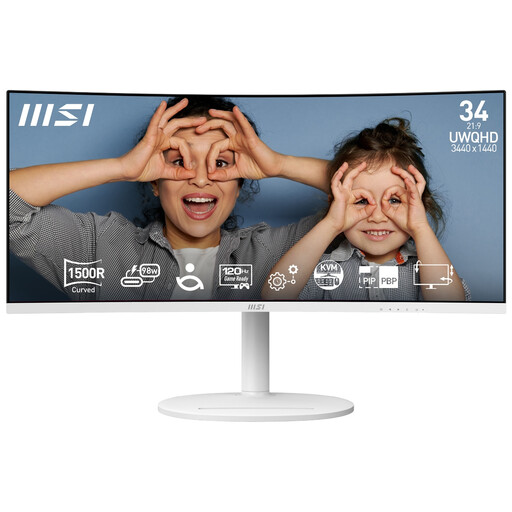
Modern MD342CQPW 34-inch curved monitor, white
Consider this model if an ultrawide editing layout and laptop-desk connections are priorities; confirm video output and charging compatibility with your laptop before planning around one cable.
The product name specifies 3440 × 1440 UWQHD, 120 Hz and a 1500R curve. For colour-sensitive decisions, check its available colour modes and calibration documentation rather than relying on screen size or gamut claims alone.
View on Joybuy
 No image available
LG UltraGear 34GX900A-B 34-inch OLED monitor
This is an ultrawide option to assess if you also want the model’s gaming-oriented features, but check its colour modes and your ICC-managed workflow before using it to judge edits.
The product name specifies WQHD and 240 Hz. The listing warns of OLED burn-in risk with static images, so check its screen-protection settings against the time you spend with stationary editing panels. Confirm USB-C video support and whether its stated 65 W power delivery meets your laptop’s needs.
View on Joybuy
 No image available
Lenovo R34w-30 34-inch UWQHD monitor
Consider its ultrawide workspace for keeping an edit and references visible together, while checking whether its colour controls suit the decisions you need to make.
The product name specifies a 34-inch UWQHD monitor. Check the exact assembled width and stand depth against your desk, and confirm the model’s colour modes and calibration documentation if colour-critical comparisons are part of your work.
View on Joybuy
 No image available
Dahua 34-inch curved UWQHD VA monitor, 200 Hz
This model offers an ultrawide layout to consider for editing and reference windows, but its gaming-oriented specifications should not be taken as evidence of calibrated colour performance.
The product name states 3440 × 1440, a VA panel, 85% DCI-P3 and two HDMI plus two DisplayPort 1.4 connections. Check its sRGB mode and calibration documentation for your intended output, and obtain the assembled stand footprint before deciding whether it fits your desk.
View on Joybuy
Common questions
Is a wide colour gamut enough for comparing edits?
No. Use a mode suited to the colour space in which you deliver the work, alongside an accurate monitor profile and colour-managed software. Adobe says accurate ICC-compliant profiles are essential for reliable colour management.
Should I choose 3440 × 1440 for an editing ultrawide?
3440 × 1440 gives more pixels for an edit, panels and references than 2560 × 1080, making it a useful workspace criterion. Resolution does not establish colour accuracy; assess the model’s colour-space information and your editing workflow separately.
Will any USB-C laptop work with a USB-C ultrawide?
No. Confirm that the laptop port supports video output, compare its charging requirement with the monitor’s power-delivery rating, and check the required cable. LG, for example, specifies up to 90 W power delivery for the 34WQ75C-B, but that does not establish compatibility with every laptop.
Does a monitor warranty replace my rights if it arrives faulty?
No. GOV.UK says a seller must offer a full refund if an item is faulty, not as described or does not do what it is supposed to. Keep your order details and the listing, and distinguish those rights from a seller’s separate change-of-mind policy or voluntary warranty.
What should I do with an old monitor?
Use an applicable electrical-equipment recycling or take-back route rather than putting the monitor in general waste. GOV.UK describes waste electrical and electronic equipment rules as a way to reduce electrical waste; check which collection or retailer take-back option is available to you.


