Reference-heavy digital artists
If you keep a canvas, visual references and notes open together, screen layout matters. When you make colour decisions, compare the exact monitor’s stated colour spaces and calibration documentation too.


A 34-inch, 3440 × 1440 ultrawide is a useful starting point for keeping a drawing canvas and reference windows on one screen, provided it fits your desk and your computer can output that resolution. Prioritise documented colour specifications when colour decisions matter; choose USB-C charging, Ethernet or a keyboard, video and mouse (KVM) switch when those features serve your laptop or two-computer setup.
If you keep a canvas, visual references and notes open together, screen layout matters. When you make colour decisions, compare the exact monitor’s stated colour spaces and calibration documentation too.
If you draw from a laptop, a suitable USB-C monitor may carry the display signal and charge the laptop through one cable. Check the laptop’s video-output support and power requirement before planning the desk around it.
If you move between two computers, an integrated KVM may let you use one keyboard and mouse with both. Check the monitor’s inputs and switching arrangement against the devices you actually use.
Start with the space needed for your canvas and references, then decide how much colour documentation your work requires. Check connections and desk fit before relying on the monitor to simplify your setup.
| Concern | What to check | Who this matters to |
|---|---|---|
| Canvas and reference space | Check for a 3440 × 1440, 21:9 display and confirm that your computer can output its resolution. Measure the monitor and available desk space. | When I draw with several references open, I want to see them beside my canvas instead of continually changing windows; around 40% of consumers put workspace layout first. |
| Colour confidence | Compare the exact model’s stated colour spaces and calibration documentation with your drawing and output workflow. | For colour-sensitive artwork, I need more than a wide screen or an HDR label to judge the display; roughly 30% of consumers put colour confidence first. |
| Connections and desk comfort | Check USB-C video support and charging needs, or KVM inputs for two computers. Confirm the stand’s adjustment range and the desk’s depth. | If I work from a laptop or switch between computers, I want a less cluttered desk while still being able to position the screen comfortably; around 30% of consumers put connections and desk comfort first. |
Screen size and HDR support do not establish how a monitor will handle the colour decisions in your artwork.
Compare the exact model’s stated gamut, colour modes and calibration documentation, then consider how your software and final output handle colour. BenQ lists a factory calibration report for the PD3420Q; that does not, by itself, guarantee a match to every output.
A USB-C connection does not establish that your laptop sends video through that port or that the monitor supplies enough power for it.
Check the laptop’s DisplayPort Alt Mode or Thunderbolt support and its charging requirement. BenQ lists 65W USB-C power delivery for the PD3420Q, while LG lists up to 90W for the 34WQ75C-B and Dell lists up to 90W for the P3425WE.
An adjustable stand cannot make every screen position comfortable on every desk. The Health and Safety Executive advises employers to assess workstations and reduce risks for workers who regularly use display screen equipment.
Measure the desk, check the stand or a compatible monitor arm, and adjust the workstation if the screen position causes discomfort. If the monitor is used for work, follow your employer’s workstation-assessment process.
The PD3420Q is a flat, 34-inch creative ultrawide to consider when documented colour specifications are central to the choice.
The 34WQ75C-B illustrates an IPS ultrawide with display, charging and wired-network connections for a laptop-centred desk.
The P3425WE and UltraSharp U3425WE show two Dell hub-monitor configurations for a desk that uses a laptop or multiple devices.
The S65UC is a curved, 34-inch ultrawide aimed at a desk that switches between source devices.
These ultrawide monitors are options for placing drawing software beside reference material. Compare their stated display characteristics with your colour needs, and check physical fit and quiet-room suitability separately.
 No image available
Consider this ultrawide if your main aim is to keep drawing software and references visible together. Its name specifies a 34-inch UWQHD gaming monitor; check colour-calibration documentation if your artwork requires it.
 No image available
This ultrawide is relevant if you want drawing and reference windows on one screen. Its name specifies OLED and 240Hz, but that refresh rate does not establish a colour-work benefit. For drawing software with persistent toolbars, consider the listing’s warning about OLED burn-in and review its screen-protection guidance.
 No image available
Consider this model for a wide canvas-and-reference layout where stand positioning matters. Its name specifies 3440 × 1440 resolution and height, swivel and tilt adjustment; it gives different refresh rates for DisplayPort (175Hz) and HDMI (100Hz). Check the colour specifications needed for your artwork.
 No image available
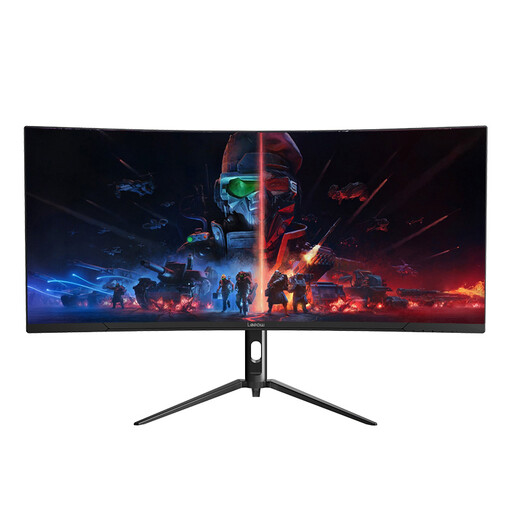
Its 3440 × 1440 resolution makes this a model to assess for side-by-side drawing and reference windows. The product name also specifies a VA panel, 200Hz refresh rate and 85% DCI-P3 coverage. Treat that colour figure as a stated specification, not a calibration result, and check whether the curve suits your layout.
 No image available
This is another 3440 × 1440 option to consider for keeping a canvas and references open together. Its name specifies a curved screen and 165Hz refresh rate. If colour decisions or precise screen positioning matter, check its colour documentation and stand adjustments before choosing it.
Yes, if keeping your canvas and other windows visible together is the priority and the monitor fits your desk. LG describes its 21:9, 3440 × 1440 display as able to show multiple programs; check the dimensions of the model you choose and consider whether you would prefer more vertical canvas space.
Only if your laptop supports video output through the relevant USB-C port and the monitor’s power delivery meets its charging needs. LG lists up to 90W for the 34WQ75C-B, Dell lists up to 90W for the P3425WE and BenQ lists 65W for the PD3420Q; compare the exact monitor with your laptop’s requirements.
A KVM is useful when you regularly switch between two source computers and want to share a keyboard and mouse. Samsung describes that arrangement for the S65UC; if you draw from just one computer, check other display and connection needs before making KVM a priority.
A monitor size alone does not replace a workstation assessment. The Health and Safety Executive says employers should assess workstations and reduce risks for workers who use display screen equipment daily for continuous periods of an hour or more. Consider screen positioning and the rest of the workstation together, and follow your employer’s assessment process where it applies.