Type and layout proofers
People checking font rendering, spacing and page compositions beside design references, for whom native resolution and usable document height are central to the choice.


A 40-inch 5K2K ultrawide makes sense when 2,160 vertical pixels matter for reviewing type and long layouts alongside references; a 34-inch 3,440 × 1,440 model is an alternative when a larger screen will not fit your setup. Whichever you choose, check that its stand or a compatible arm can position the top of the screen near eye level and the display about an arm’s length away, as the Health and Safety Executive advises.
People checking font rendering, spacing and page compositions beside design references, for whom native resolution and usable document height are central to the choice.
People who change desk height during the day and need a screen they can position at standing height. USB-C or Thunderbolt docking may also matter if their laptop supports the required functions.
People who want room for design tools and references side by side but need to check whether a 40-inch display will fit their desk and viewing distance.
Consider it when: You regularly inspect long layouts or compare type with references and want a 5,120 × 2,160 canvas.
Trade-off: Check that the larger screen fits your desk and can reach the right position when you stand.
Consider it when: You want typography and adjacent tools on one screen, but a 40-inch display is impractical for your setup.
Trade-off: Its 1,440 vertical pixels leave less room for a full-height page than a 5K2K display.
For typography previews at a standing desk, decide how much document height you need, then check that the screen can be positioned for your workstation.
| Concern | What to check | Who this matters to |
|---|---|---|
| Text detail and document height | Compare native resolutions, particularly 5,120 × 2,160 and 3,440 × 1,440. | If I review long pages and spacing beside references, I want enough vertical room to inspect the work without constantly rearranging windows. Roughly 33% of consumers put text detail and document height first. |
| Standing-desk fit | Check screen dimensions, viewing distance, stand adjustment and any VESA arm’s compatibility and load rating. | A wide display is useful to me only if I can place it correctly when the desk is raised. Around 27% of consumers make standing-desk positioning their primary concern. |
| Laptop docking | Confirm laptop video output, monitor charging capability and the cable needed for the intended USB-C or Thunderbolt connection. | When I disconnect my laptop regularly, I want the display connection to suit the way I dock it. Roughly 20% of consumers prioritise simpler laptop docking. |
| Colour-managed proofing | Check the colour spaces, calibration features and modes required by your workflow. | If my type previews are part of colour-sensitive design work, I need display settings that fit that workflow. Around 20% of consumers put colour-managed proofing first. |
A 34-inch 3,440 × 1,440 screen and a 40-inch 5K2K screen differ in vertical resolution as well as physical size. That distinction matters when you need to see more of a page or type specimen at once.
Compare native resolution first, then check whether the larger display will fit at a usable viewing distance.
The Health and Safety Executive advises placing the top of the screen near eye level and the display about an arm’s length away. A desk that rises does not guarantee the monitor will reach that position.
Measure your desk depth and standing eye height, then check the stand range or the compatibility and capacity of a proposed arm.
A compatible monitor arm or a change to the workstation may be needed if the supplied stand cannot achieve the required position.
LG UK lists the 40WP95C-W as discontinued; the 40WP95CP-W has a separate product page and specifications.
Check the complete model suffix and its stated connections before choosing a listing.
Dell lists a 120 Hz refresh rate for the U4025QW, but that figure does not establish whether a screen has the resolution, colour features or physical fit your proofing work requires.
Check native resolution, placement and workflow requirements before treating refresh rate as a deciding feature.
Dell’s UltraSharp U4025QW is a 40-inch curved Thunderbolt hub-monitor option for a large creative workspace.
LG’s UltraWide and UltraFine lines include 40-inch-class 5K2K options with different Thunderbolt generations.
BenQ’s PD3420Q is a 34-inch design-monitor option for buyers considering colour features and stand adjustment alongside screen size.
These 34-inch and 49-inch ultrawides offer space for typography previews beside other windows. Their 1,440-pixel vertical workspace is a different choice from the 2,160-pixel 5K2K route, so check document height and standing-desk fit before choosing.
 No image available
Consider its wide screen if you need type previews beside multiple references, but check that a 49-inch display fits your desk and standing viewing distance.
The listed configuration has a 32:9 aspect ratio, Double Quad HD resolution, a 1800R curve, a 240 Hz refresh rate and USB-C.
 No image available
Consider this 34-inch format when you want typography and tools side by side without choosing a 49-inch screen; check whether its stand can reach your standing eye height.
The product name specifies 3,440 × 1,440 resolution, a VA panel, 200 Hz refresh rate and HDMI and DisplayPort connections. Its 1,440 vertical pixels leave less document height than a 5K2K display.
 No image available
Its 32:9 screen suits a setup where type and other windows need substantial horizontal room, provided the desk and support can accommodate a 49-inch display.
The product name specifies 5,120 × 1,440 resolution, a 165 Hz refresh rate, height adjustment and VESA 75 × 75 mounting. Check that the intended stand or mount achieves your standing screen position.
 No image available
This 21:9 option gives type previews room beside other windows; check the screen position with your intended stand or mount before choosing it for a standing desk.
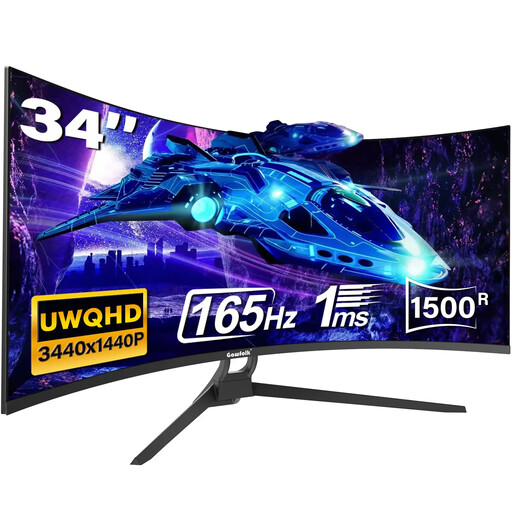
The product name specifies 3,440 × 1,440 resolution, a 165 Hz refresh rate and VESA mounting. If colour coverage or Type-C connectivity is decisive, confirm those details for this exact variant before purchase.
Aim to place the top of the screen near eye level and the display about an arm’s length away, following Health and Safety Executive guidance. Check the position at your actual standing desk height; if the supplied stand cannot achieve it, assess a compatible arm and your desk’s mounting limits.
No: a 40-inch 5K2K screen provides 2,160 vertical pixels rather than the 1,440 pixels of a 34-inch 3,440 × 1,440 model, but that extra document height is useful only if the larger screen fits your workstation. If placement is the limiting factor, check a 34-inch option instead.
No. A one-cable setup depends on the laptop’s video output, the monitor’s data and charging features, and a suitable cable. Confirm those functions for the exact laptop and monitor rather than relying on the connector name alone.
They can matter for work use: the Health and Safety Executive says the Display Screen Equipment Regulations apply to workers who use display screen equipment daily for continuous periods of an hour or more. If that describes your work, discuss how your workstation is assessed with your employer; buying a particular monitor does not by itself establish that the setup is suitable.