Who each setup suits
The choice starts with what your limited space must still allow you to see and do, not with diagonal screen size alone.
Compact-rig immersion seekers
If three monitors will not fit but you want more horizontal track and cockpit image from one screen, assess a 34-inch ultrawide. Measure the rig or desk first, and consider whether your PC can run your chosen games at its native resolution.
Mixed-use 4K racers
If the same display serves racing, desktop tasks, other games or a console, a 32-inch 16:9 4K model may suit the space and uses better. Check its physical footprint and the modes supported by the connection you intend to use.
Motion-priority competitive drivers
If smooth presentation through corners and traffic matters more to you than screen width, compare the available refresh and variable refresh rate modes with your PC or console output. The panel’s headline refresh rate alone does not establish the mode you can use.
What matters when choosing
For a touring-car rig with limited floor space, decide whether a wider view, a narrower mixed-use screen or room for three displays is the governing constraint. Then check the dimensions and connection modes of the exact models on your shortlist.
Single 34-inch ultrawide
Choose when: You want a wider horizontal image from one screen without arranging three panels and their mounts.
Allow for: More screen width than a 32-inch 16:9 format, plus model-specific connection limits and, for OLED versions, care around persistent on-screen displays.
Single 32-inch 4K monitor
Choose when: Available width is tighter or desktop, general gaming and console use weigh heavily in the decision.
Allow for: Less horizontal game image than a 21:9 ultrawide and a need to check your PC’s performance at 4K.
Triple monitors
Choose when: Side visibility takes priority and a measured, permanent rig layout accommodates all three screens.
Allow for: More room, mounting work and display connections than a single-screen installation. Sim Racing Setups identifies the broad view and substantial space requirement as the central trade-off.
| Concern |
What to check |
Who this matters to |
| Wider single-screen view |
Compare aspect ratio and native resolution, then measure screen width and stand or arm clearance. |
If I cannot fit triples, I still want to see more of the track beside the car without adding screens. Roughly 42% of consumers put that wider single-screen view first. |
| Motion and input match |
Check refresh rate at native resolution through your intended port, along with variable refresh rate compatibility. |
Through fast corners and traffic, I care most about the motion mode my gaming system can actually supply. For around 33% of consumers, that output match is the primary concern. |
| Narrower, mixed-use placement |
Compare with-stand dimensions and confirm the 4K modes available to your PC or console. |
I need one display to fit beside my racing equipment and work well for other screen-based tasks. A narrower mixed-use setup comes first for roughly 25% of consumers. |
Relevant brands to consider
These model lines illustrate different single-screen choices; the specifications and limitations belong to the named models, not every monitor from each brand.
Alienware
The AW3423DWF represents a 34.18-inch 21:9 QD-OLED ultrawide route, while the AW3225QF represents a 32-inch-class 4K curved QD-OLED route.
- Dell specifies the AW3423DWF at 3440 × 1440, with up to 165 Hz through DisplayPort.
- Dell lists a 100 Hz HDMI maximum for the AW3423DWF, so check that limit if HDMI is your intended connection.
LG UltraGear
The 34GS95QE-B is a 34-inch curved OLED ultrawide for drivers considering a 21:9 single-screen format.
- LG specifies the 34GS95QE-B at 3440 × 1440, 800R curvature and 240 Hz.
- For repeated static racing HUDs, follow the OLED model’s panel-care guidance and check its warranty terms.
AOC
The CU34G2XP/BK offers a 34-inch curved Fast VA ultrawide route rather than the OLED panel route represented by the named Alienware and LG models.
- AOC specifies the CU34G2XP/BK at 3440 × 1440 and 180 Hz, with FreeSync Premium.
- Do not assume its image characteristics match an OLED model simply because both are curved ultrawides.
ASUS ROG
The ROG Strix XG32UCG is a 31.5-inch 16:9 4K Fast IPS alternative for a one-screen rig that also serves other uses.
- ASUS specifies a 160 Hz 4K mode, a separate 320 Hz FHD mode, HDMI 2.1 and 100 × 100 mm VESA mounting.
- Its 16:9 format does not provide the same horizontal image shape as a 21:9 ultrawide; check the 71.7 cm with-stand width against your space.
Single-screen options on Joybuy
These 34-inch ultrawide monitors are options for a one-screen touring-car setup where a triple-monitor layout is impractical. Their place in your rig and the gaming modes you can use still depend on the exact model, connection and available space.
 No image available
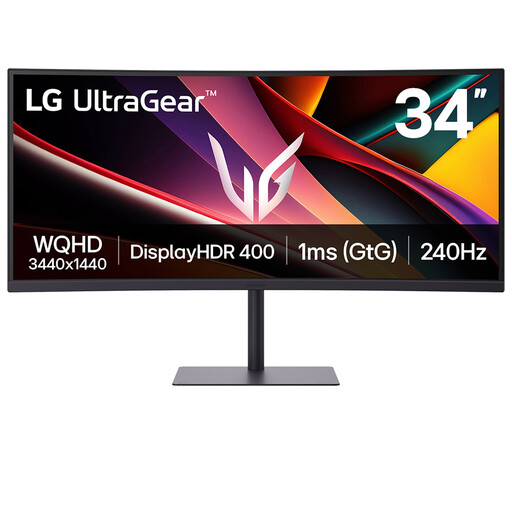
LG UltraGear 34GX900A-B 34-inch OLED WQHD
Consider this single-screen option if an OLED ultrawide is on your shortlist for racing.
The product name specifies a 34-inch WQHD OLED display and 240 Hz refresh rate. Check the mode available through your intended connection, and follow the model’s panel-care guidance for repeated static HUDs.
View on Joybuy
 No image available
LG UltraGear 34G630A-B 34-inch VA WQHD
This is a 34-inch single-screen alternative for drivers comparing ultrawide panel types.
The product name specifies a VA WQHD display and 240 Hz refresh rate. Check that your PC and chosen connection support the mode you want before treating the panel figure as an available gaming mode.
View on Joybuy
 No image available
Lenovo R34w-30 34-inch UWQHD
Consider this curved ultrawide if you want to compare a single 34-inch display with the space required for triples.
The product name identifies a UWQHD gaming monitor. Confirm its exact aspect ratio, complete with-stand dimensions and refresh mode through your intended input before deciding whether it fits the rig.
View on Joybuy
 No image available
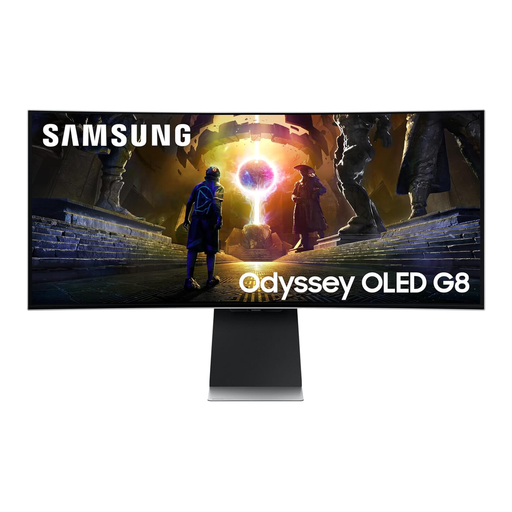
Samsung Odyssey G8 LS34DG850SUXXU 34-inch OLED
This curved ultrawide is another OLED route for a single-screen racing rig.
The product name specifies WQHD, 175 Hz and a stated 0.03 ms response time. Check variable refresh rate support and port-specific modes for your gaming device, as well as OLED-care and warranty terms for static HUD use.
View on Joybuy
 No image available
Dahua 34-inch 3440 × 1440 curved VA monitor
Consider this 21:9 single-screen option if you are comparing curved VA ultrawides for racing.
The product name specifies 200 Hz and a 1 ms MPRT rating. The listed input limits are 200 Hz through DisplayPort 1.4 and 100 Hz through HDMI 2.0; confirm the required mode, variable refresh rate support and full with-stand dimensions for your setup.
View on Joybuy
Questions before you buy
Is a 34-inch ultrawide a better fit than triples in a small racing room?
A single ultrawide is the more space-conscious route when a three-screen layout will not fit, but it does not replace the side visibility of triples. Sim Racing Setups notes both the broad view triples provide and the room they require; measure the complete screen, stand or mount, wheelbase clearance and seating position for either arrangement.
Should I choose a 3440 × 1440 ultrawide or a 32-inch 4K monitor?
Choose the 21:9 ultrawide format if a wider single-screen racing image is your priority and its physical width fits; consider a 32-inch 16:9 4K model if narrower placement and mixed desktop or console use matter more. Neither resolution tells you the frame rate your PC will achieve in a particular racing game, so check performance at the settings you intend to use.
Do I need DisplayPort rather than HDMI for racing?
Use the input that supports your required resolution and refresh mode on the exact monitor and gaming device. Dell, for example, specifies 165 Hz through DisplayPort but 100 Hz through HDMI on the Alienware AW3423DWF at 3440 × 1440; that limit should not be assumed for other models. Check the suitable cable and variable refresh rate support too.
How should I use an OLED monitor with a persistent racing HUD?
Follow the monitor maker’s panel-care instructions and avoid leaving static HUD or desktop elements displayed for prolonged periods. Microsoft Support says screen savers can help prevent prolonged static images on OLED displays; idle display sleep is another practical check. These measures are not a guarantee against image retention, so read the model’s warranty terms before buying.


