
24/7 Customer Support

Free returns

Same-day & Next-day Delivery

Quality Guaranteed

Unlock Your Welcome Offers: FREE Delivery | Up to 80% OFF | Free 30-day JoyPlus trial
Download the APP
As our devices become more integrated into our daily lives, the humble charging cable has become an essential accessory. With the widespread adoption of USB-C, from the latest iPhone 15 series to MacBooks and Android devices, finding a reliable USB C to USB C cable is more important than ever. A poor-quality cable can lead to frustratingly slow charging, data transfer errors or premature fraying and breakage.
This guide is designed to help you navigate the options. We will outline the key features to look for when making your selection and present a few recommended cables that cater to different needs, whether you require a fast charging USB C cable for your laptop or a durable, everyday option for your phone.
Before diving into specific products, it's helpful to understand what separates one cable from another. Here are a few practical points to consider.
The most significant factor for charging speed is the cable's power delivery capability, measured in watts (W). Not all USB-C cables are created equal. A standard cable might only support 15W, which is fine for older devices but slow for modern ones.
A cable's lifespan is often determined by its construction. Many standard cables use a simple plastic coating that can fray at the connector joint. A braided USB C cable, typically made from nylon, offers significantly more resistance to bending and daily wear.
Length is also a practical consideration. A standard 1-metre cable is great for portability, but a long USB C cable (1.8m or 2m) provides the flexibility to use your device comfortably while it charges from a distant wall socket.
While most people use their USB-C cables primarily for charging, data transfer speed is another important function. Most charging-focused cables support USB 2.0 speeds (up to 480 Mbps), which is adequate for syncing photos and music. However, if you frequently transfer large files like 4K videos or project backups, you may want to look for a cable that supports USB 3.1 (up to 10 Gbps) or Thunderbolt speeds for much faster transfers.
Here are our recommendations for USB C to USB C cables, selected to meet a range of common user needs.
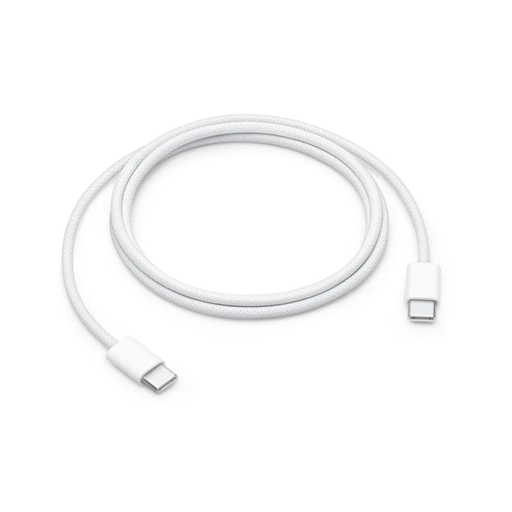
Why It Stands Out: This official Apple cable features a durable woven design, a significant upgrade in resilience compared to their older plastic-coated cables. It ensures seamless compatibility and performance within the Apple ecosystem.
Pros:
Who is it for? This cable is an ideal choice for Apple users who prioritise reliability and seamless integration. It's a dependable replacement or spare MacBook charging cable for models that require 60W or less, and a perfect partner for the iPhone 15 series.
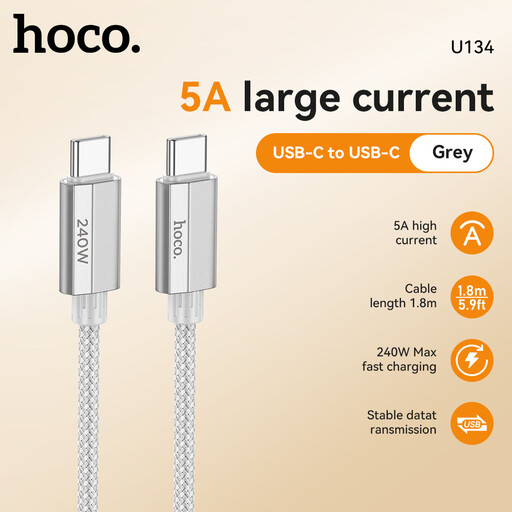
Why It Stands Out: The HOCO U134 combines a generous length with robust power handling. At 1.8 metres, it offers excellent flexibility for home or office setups where power outlets aren't conveniently located.
Pros:
Who is it for? This is a great option for anyone who needs a long USB C cable. If you often find yourself stretching a short cable to reach your desk or bedside table, the extra length of the HOCO U134 will provide much-needed convenience.
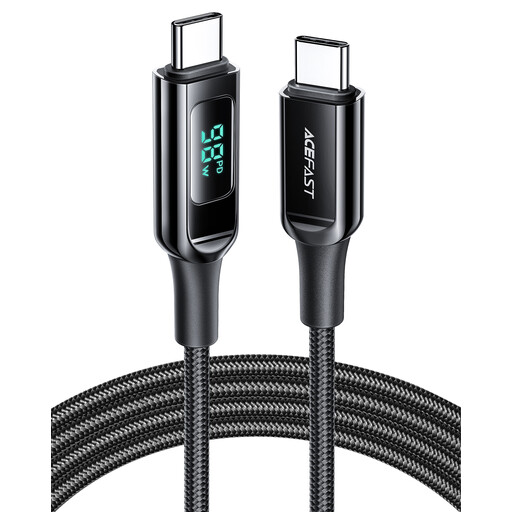
Why It Stands Out: The ACEFAST C6-03 stands apart with its built-in digital display that shows the real-time charging wattage. This, combined with its high power rating, makes it a powerful tool for tech-savvy users.
Pros:
Who is it for? This cable is perfect for professionals and tech enthusiasts who own high-performance laptops and want to verify their charging speeds. If you need a powerful MacBook charging cable and appreciate having detailed performance information, this is an excellent choice.
If these recommendations don't quite fit your needs, or if you're looking for a different length or feature set, there are many other options available.
Explore our full collection of 1m charging cables to find the right match for your devices.
1. Do all USB C to USB C cables support fast charging? No, they do not. A cable's ability to fast charge depends on its power delivery (W) rating. For a fast charging USB C cable experience, you must pair a cable with a high enough wattage rating with a compatible power adapter and device. A 100W cable will not charge a device at 100W if the power adapter can only supply 20W.
2. Can I use any USB C cable for my iPhone 15? Yes, the iPhone 15 series uses a standard USB-C port. Any compliant USB C to USB C cable will work for charging and data transfer. However, to take advantage of fast charging, you should use a cable and power adapter that support at least 20W Power Delivery.
3. What is the difference between a braided cable and a standard one? The primary difference is durability. Standard cables often use a smooth PVC or TPE plastic jacket, which can be prone to kinking and fraying near the connectors. A braided USB C cable uses a woven fabric, typically nylon, as its outer layer. This provides superior protection against bending, pulling and everyday wear, often resulting in a longer lifespan.