Single-screen immersion seekers
You want room for the road and cab view on one display rather than arranging multiple screens, and you have space for a curved 21:9 monitor.


For virtual-truck driving on one monitor, start by comparing 34-inch, 21:9 curved ultrawides if your game supports the format and the display fits your desk. A 45-inch model at the same 3440 × 1440 resolution gives you a physically larger image, not more pixel detail; a 5K2K ultrawide offers more pixels for instruments and maps but places greater demands on the PC. If 21:9 support or desk space is a constraint, check those limits before replacing a conventional widescreen.
You want room for the road and cab view on one display rather than arranging multiple screens, and you have space for a curved 21:9 monitor.
You regularly look at instruments, navigation or desktop text and are willing to check whether your PC can drive a higher-resolution display.
You care about variable-refresh compatibility or OLED picture characteristics, while recognising that prolonged static interface use calls for model-specific panel-care checks.
For virtual-truck driving on one screen, check the game’s support for your intended aspect ratio and measure the available desk space before settling on a monitor size. Then weigh instrument detail, changing frame rates and long-session practicality against your PC’s display outputs.
| Concern | What to check | Who this matters to |
|---|---|---|
| Wider single-screen view | Check 21:9 game support, native resolution and whether the monitor and stand fit your desk. | I want more room for the road and cab view without setting up a second display, provided my game supports 21:9. Around 36% of consumers put a wider single-screen view first. |
| Readable instruments | Compare size and native resolution together; check whether your PC can use a higher-resolution mode. | If I frequently read gauges and maps, I would prioritise fine detail over a bigger image at the same resolution. Roughly 29% of consumers put instrument readability first. |
| Smooth motion | Confirm adaptive-sync compatibility and the refresh mode available through your PC’s output, cable and monitor input. | Changing frame rates can distract me while driving, so I care about how the display behaves when they vary. About 21% of consumers give smooth motion their top priority. |
| Long-session practicality | Measure stand or arm clearance; for OLED, read the exact model’s panel-care and warranty terms. | I need the screen to fit alongside my driving controls, and static interface elements may stay visible for long periods. Around 14% of consumers chiefly prioritise physical fit and panel care. |
LG UK lists the 45GS95QE-B at 3440 × 1440, while Samsung UK lists the 34-inch Odyssey OLED G8 G85SD at the same resolution. The larger panel makes objects physically bigger without adding pixels.
Compare panel size with native resolution. If fine text is the priority, also consider the PC requirements of a higher-resolution option such as LG UK’s 39-inch, 5120 × 2160 39GX950B.
The refresh mode you can use depends on the whole connection. BenQ UK lists 144Hz over DisplayPort and 120Hz over HDMI for the EX3410R; variable refresh also requires compatible hardware and configuration.
Check your PC output, cable, monitor input and intended resolution together before choosing a refresh mode.
Static, high-contrast dashboards and maps can remain on screen during long drives. LG UK describes its OLED Care features as designed to reduce image-retention and burn-in risk, not eliminate it.
Read the selected model’s care instructions and warranty terms, and use its protection features as directed.
A curved ultrawide must leave room for its stand, cables and driving controls. BenQ UK lists the EX3410R at 795.7 × 269.7 mm with its base and specifies 100 × 100 mm VESA mounting.
Measure usable width and depth, then check the chosen model’s stand dimensions or your arm’s weight and mounting limits.
If the supplied stand does not fit your layout, a suitable replacement stand or monitor arm may be needed.
LG UK lists distinct curved OLED ultrawides, including the 45-inch 45GS95QE-B and 39-inch 39GX950B.
Samsung UK lists the 34-inch Odyssey OLED G8 G85SD as a 3440 × 1440 ultrawide with a 175Hz maximum refresh rate.
ASUS ROG UK specifies the PG34WCDM as a 34-inch, 3440 × 1440 curved OLED monitor with 240Hz and G-SYNC Compatible support.
BenQ UK lists the EX3410R as a 34-inch, 3440 × 1440 curved VA ultrawide.
These 34-inch options suit consumers considering a single curved ultrawide for virtual-truck driving. Compare each monitor’s stated panel type and refresh requirements with your game, PC and desk setup; the larger 45-inch and higher-resolution 5K2K choices are separate decisions.
 No image available
Consider this model if you want a 34-inch ultrawide and need to compare refresh modes by connection.
The product title specifies 3440 × 1440, 175Hz over DisplayPort and 100Hz over HDMI, with height, swivel and tilt adjustments.
Check that your PC and cable support the mode you intend to use, and confirm the screen’s curvature if that affects your viewing position.
 No image available
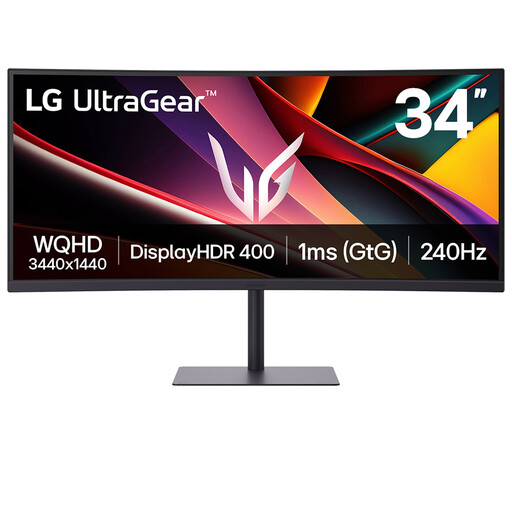
Consider this curved 34-inch option if a wide single-screen view and a high-refresh setup are your priorities.
The product title specifies a VA panel, WQHD resolution and 240Hz.
For the stated 240Hz mode, check that your graphics card supports the required DisplayPort 1.4 or HDMI 2.1 connection, and measure the space available for the monitor.
 No image available
Consider this 34-inch OLED option if you want a single ultrawide screen and can follow panel-care guidance during sessions with static dashboard elements.
The product title specifies WQHD resolution and 240Hz; the product information also identifies G-SYNC Compatible and FreeSync Premium Pro support.
Check PC and connection compatibility for your intended mode. The product warning identifies burn-in susceptibility, so review this model’s protection features and warranty terms.
 No image available
Consider this curved ultrawide if you are planning a single-screen driving setup around a DisplayPort high-refresh mode.
The product title specifies 3440 × 1440, a VA panel, 200Hz, two HDMI inputs and two DisplayPort 1.4 inputs.
Check that your PC and cable can use the intended 200Hz DisplayPort mode; confirm variable-refresh support if you need it.
 No image available
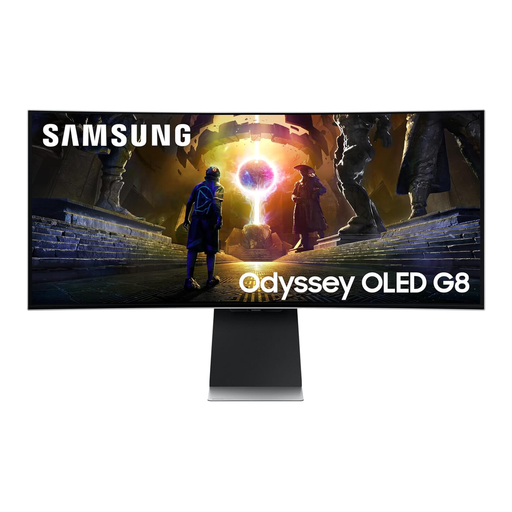
Consider this curved OLED ultrawide if you want a 34-inch single-screen format rather than a physically larger panel.
The product title specifies WQHD resolution and 175Hz; Samsung UK identifies the LS34DG850SUXXU as a 3440 × 1440 model.
Check your PC’s connection for the intended refresh mode, and read this model’s OLED care and warranty terms if dashboards or maps stay on screen for long periods.
Start with a 34-inch, 21:9, 3440 × 1440 curved ultrawide if your game supports that format and it fits your desk. Samsung UK’s Odyssey OLED G8 G85SD and BenQ UK’s EX3410R illustrate different panel choices at that size; a 45-inch model at the same resolution gives a larger physical image rather than additional pixels.
Not automatically: the refresh rate you can use depends on your PC, game settings, cable and display input. If frame rates vary, check variable-refresh compatibility as well; NVIDIA explains that G-SYNC matches monitor refresh to GPU frame rate when its hardware and setup requirements are met.
Not necessarily, but prolonged static interface use makes panel care and warranty terms important purchase checks. LG UK says its OLED Care features are designed to reduce image-retention and burn-in risk; they are not a guarantee that the risk disappears.
Keep an old monitor out of general waste. Oxfordshire County Council advises that waste electrical and electronic equipment should be recycled separately; check your local council’s arrangements for a suitable collection or drop-off option.