
24/7 Customer Support

Free returns

Same-day & Next-day Delivery

Quality Guaranteed

Unlock Your Welcome Offers: FREE Delivery | Up to 80% OFF | Free 30-day JoyPlus trial
Download the APP
Whether you are a university student juggling multiple modules or a professional managing complex client accounts, keeping your notes organised is crucial. The right A4 project book can be the difference between streamlined success and chaotic clutter. However, the market is filled with options that look promising on the shelf but fail to perform in practice. This guide will help you identify the key features that matter and avoid the common pitfalls that lead to wasted money and disorganised notes.
As a Joybuy Product Recommendation Officer, my role is to help you see past the marketing jargon and focus on what delivers genuine value. Let's break down the three most common traps to avoid when shopping for your next notebook.
To ensure you get a notebook that truly works for you, focus on these three non-negotiable specifications.
The cover is your notebook's primary protection. While a standard cardboard cover is cheap, it offers minimal durability. For a notebook that needs to withstand daily commutes, lectures and meetings, look for a polypropylene (polyprop) cover. This sturdy plastic material is not only resistant to scuffs and bending but is also wipe-clean, making it easy to maintain a professional appearance. It provides the resilience needed for a student project book or a busy office notebook with pockets.
An effective A4 multi-subject notebook is defined by its organisational features. Instead of fixed dividers, seek out models with repositionable, colour-coded dividers. This allows you to customise the size of each section based on your changing needs. Furthermore, dividers that include integrated storage pockets are incredibly useful for keeping loose handouts, receipts or sticky notes securely organised with the relevant subject matter.
The paper itself is just as important as the cover. Pay attention to the paper weight, measured in GSM (grams per square metre). A paper weight of 80gsm is a reliable standard that prevents most inks from bleeding through, ensuring both sides of the page are usable. For those who need to file or share their notes, micro-perforated pages are essential. They allow for a clean, straight tear, so sheets can be neatly added to a ring binder without any fuss.
Based on these practical criteria, here are our recommendations, matched to different user needs and priorities.
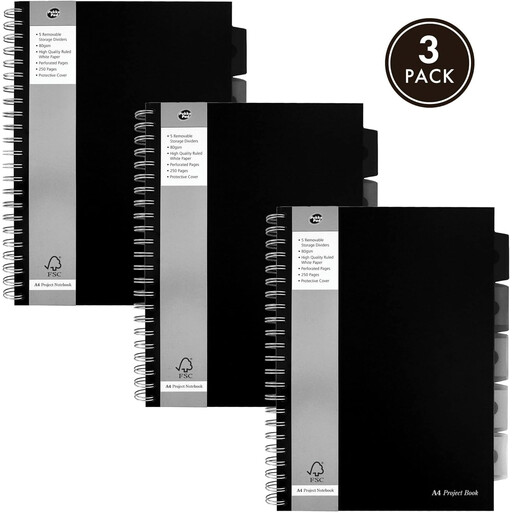
Why This Fits Their Persona: Ideal for the UK student or project manager who needs to consolidate multiple subjects or workstreams into one robust, organised system. This is a classic Pukka Pad project book built for heavy use.
Its wipe-clean polypropylene cover directly counters the "flimsy cover" trap. The five repositionable dividers with pockets solve the "fixed divider fallacy" and the micro-perforated pages eliminate the "tear-out nightmare."
A complete organisational system in a single book. The pack of three offers excellent value for an entire academic year or multiple large-scale projects.
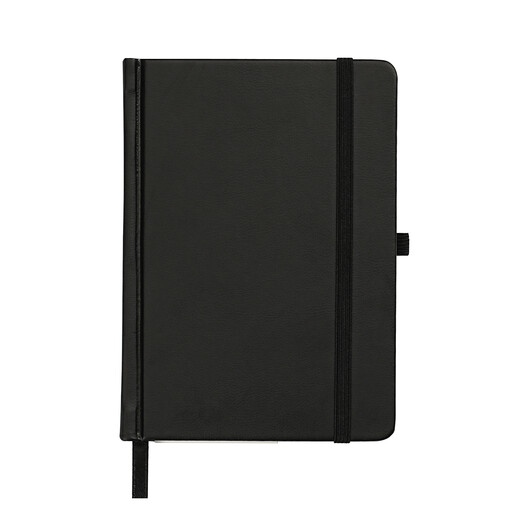
Why This Fits Their Persona: For the professional who attends frequent meetings and values portability and style. This A5 notebook is compact enough for a tote bag but durable enough for daily travel.
The sturdy fabric hardcover provides excellent protection, avoiding the "flimsy cover" trap. While not a multi-subject book, it excels in its role as a dedicated, high-quality single-subject journal.
Features high-quality 100gsm paper, which is thicker than average and great for fountain pens. The built-in bookmark and elastic closure add a layer of convenience and security.
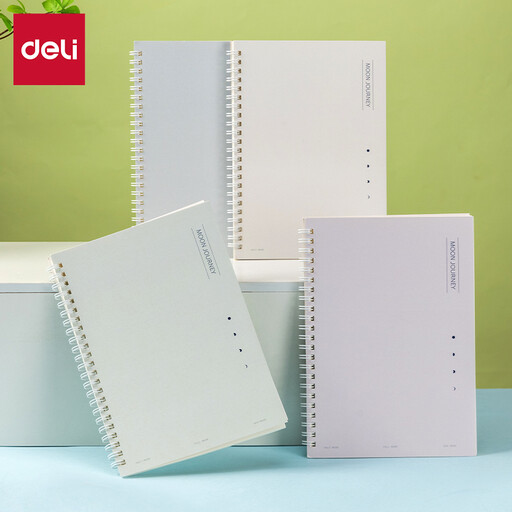
Why This Fits Their Persona: A practical and cost-effective choice for students who need to separate their subjects but are on a tight budget. Using a different coloured notebook for each module is a simple and effective organisational method.
This multi-pack sidesteps the "fixed divider" issue by providing four separate notebooks. This offers ultimate flexibility in allocating space for each subject without the higher cost of a feature-rich project book.
Exceptional value for money. The spiral binding allows each notebook to lay completely flat, providing a comfortable writing surface during long study sessions.
We have compiled a complete, real-time list of products that fully satisfy these strict selection criteria and UK safety regulations.
A regular notebook is typically a simple bound set of pages for general note-taking. An A4 project book, on the other hand, is a specialised organisational tool. It usually includes features like a durable cover, multiple sections separated by a notebook with dividers, storage pockets for loose papers and perforated pages for easy removal and filing.
For most writing instruments, including ballpoint pens, gel pens and rollerballs, 80gsm paper provides a good balance of smoothness and opacity, minimising ink bleed-through. While many fountain pen users find 80gsm paper to be adequate, those who use particularly wet inks or broad nibs may prefer a heavier paper, such as 90gsm or 100gsm, for optimal performance.
To maximise the lifespan of your project book, start by choosing one with a robust polypropylene cover, as this will resist wear and tear far better than card. Use the integrated pockets to store loose sheets rather than stuffing them between pages, which can strain the binding. Finally, be mindful of how you pack it in your bag, ensuring the spiral binding isn't crushed or bent.