
24/7 Customer Support

Free returns

Same-day & Next-day Delivery

Quality Guaranteed

Unlock Your Welcome Offers: FREE Delivery | Up to 80% OFF | Free 30-day JoyPlus trial
Download the APP
A flat battery rarely happens at a convenient time. It may follow a short winter journey, leave you stuck outside work or prevent a van, SUV or motorcycle from starting on a remote road. A car jump starter can provide independent roadside assistance without relying on another vehicle and a set of jump leads.
However, comparing portable jump starters by peak amps alone can lead to an unsuitable purchase. The useful question is not simply “How powerful is it?” but whether the unit matches your vehicle, storage habits and likely emergency needs.
A high peak-current figure may look impressive, but it does not by itself confirm compatibility with your engine. Petrol and diesel engines have different starting demands, while large engines require more reserve capacity. Always check the manufacturer’s stated limits for engine size and fuel type.
For example, a 12V jump starter rated for up to 6.0L petrol may not be suitable for a 6.0L diesel engine. A model designed for cars may also be inappropriate for a 24V commercial vehicle.
A jump starter with air compressor can be convenient, but compact pumps are intended for topping up or dealing with gradual pressure loss rather than replacing a garage compressor. Check the maximum pressure, airflow, preset modes and cooling requirements.
Some portable tyre inflators must rest after continuous operation. The air hose may also become hot, so safe handling instructions matter more than a headline PSI figure.
Lithium battery packs slowly lose charge in storage. A jump starter left in a boot for months may not be ready when needed, particularly after cold weather. Look for a clear battery display, practical charging input and storage guidance.
A jump starter power bank should be recharged according to its manual. Inspect the casing and cables periodically, and do not use a unit that is swollen, cracked, wet or unusually hot.
Most cars, SUVs, motorcycles and lawn equipment use a 12V battery system, but not every 12V jump box supports every engine size. Confirm:
A diesel jump starter generally needs a higher specification than a petrol jump starter of the same engine size. If you drive a van, large SUV or diesel vehicle, leave some margin rather than selecting a model exactly at the stated limit.
Peak amps describe the maximum current available for a short starting demand. They should be considered alongside watt-hour capacity, cable quality and the manufacturer’s compatibility guidance.
A higher-capacity battery booster pack may support more starting attempts and device charging, but it can be larger and heavier. USB-A and USB-C outputs are useful for phones, sat-navs and tablets, while faster charging inputs reduce preparation time between uses.
Choose a car battery booster with clearly explained protection features, such as:
The correct procedure is still essential. Switch off vehicle accessories, connect the red clamp to the positive terminal and the black clamp to the negative terminal or an appropriate chassis ground as directed. Start the vehicle, then disconnect the equipment promptly. Never allow the clamps to touch.
A built-in LED emergency light with steady, strobe or SOS modes can improve visibility during a night-time breakdown, although it should not be treated as a substitute for hazard lights or reflective roadside equipment.
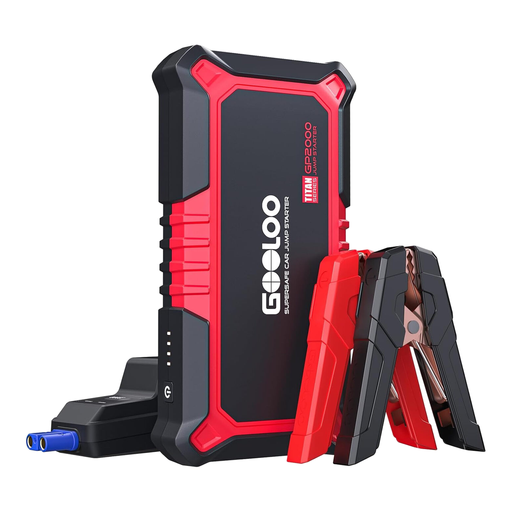
Why This Fits Their Persona: A compact option for everyday UK cars, motorcycles and smaller SUVs, with a stated limit of up to 8.0L petrol or 6.0L diesel engines.
Its smart jumper cable provides stated protection against reverse polarity, short circuits, over-current and related faults. Check the displayed vehicle limits before purchase.
2000A peak current, dual USB outputs and a 400-lumen LED torch in a stated 1.2 lb portable body.
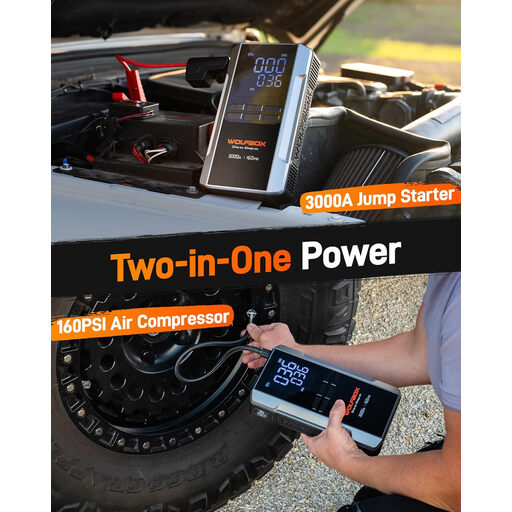
Why This Fits Their Persona: Suitable for drivers wanting one device for starting support, tyre pressure top-ups and mobile charging.
The stated 8L petrol and 6L diesel compatibility is more informative than relying on the 3000A figure alone. The compressor is rated to 160PSI.
59.2Wh capacity, 65W fast charging, built-in pump and LED light.
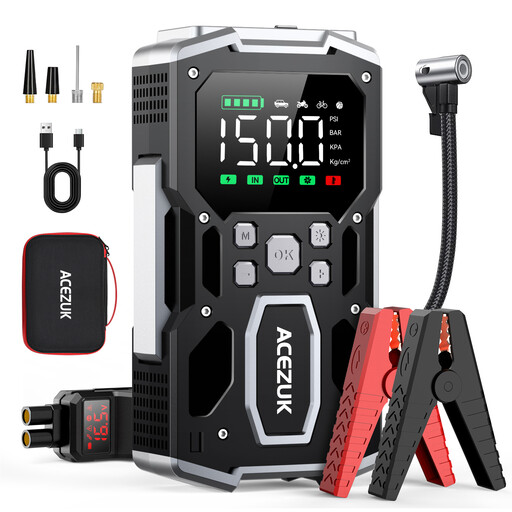
Why This Fits Their Persona: A multi-function choice for SUV owners, outdoor users and anyone who wants an inflator and high-output charger in the same kit.
The LCD shows battery and air-pressure information, while the stated 10 protection functions help make connection errors easier to identify.
7000A peak current, 150PSI compressor, USB fast charging and three LED modes.
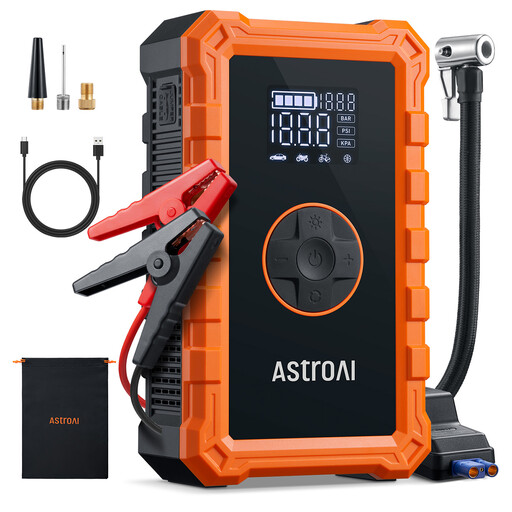
Why This Fits Their Persona: A practical fit for commuters and family drivers who want a compact emergency car battery starter with a portable tyre inflator.
Its stated 10-minute maximum continuous pump time and 10-minute rest period set clearer expectations than an isolated PSI claim.
1500A output, compatibility up to 6.0L petrol and 3.0L diesel, automatic pressure shut-off and a 2.4-inch display.
We have compiled a complete, real-time list of products that fully satisfy these strict selection criteria and UK safety regulations.
Yes, provided the product specifically lists your diesel engine size and supports a 12V system. Diesel engines may require more starting power than petrol engines, so check the stated diesel limit rather than relying on the petrol rating.
Storage life varies by battery design and temperature. Keep the unit dry and away from excessive heat, check its charge indicator periodically and recharge it according to the instructions. If it will remain unused for several months, a maintenance charge can help ensure it is ready for roadside use.
It can be useful if you regularly drive long distances, carry sports equipment or want backup tyre inflation. Compare the compressor’s airflow, pressure presets and duty cycle. If you already carry a separate portable inflator, a smaller jump box may be easier to store and use.