
24/7 Customer Support

Free returns

Same-day & Next-day Delivery

Quality Guaranteed

Unlock Your Welcome Offers: FREE Delivery | Up to 80% OFF | Free 30-day JoyPlus trial
Download the APP
A flashing tyre pressure warning light on your dashboard is an unwelcome sight, often appearing at the most inconvenient times. While the local petrol station air pump is an option, it can be costly, cumbersome and often out of order. A modern cordless tyre inflator offers a practical solution, providing peace of mind in your garage and on the road.
However, the market is flooded with devices that make bold promises. Many buyers find their new gadget is underpowered, inaccurate or fails after only a few uses. As the Joybuy Product Recommendation Officer, my role is to help you see past the marketing hype. Before you buy, be aware of these three common pitfalls that lead to wasted money and frustration.
tyre inflator with pressure gauge is a key feature, but its accuracy is paramount. Low-quality sensors can be off by 5 PSI or more. This not only defeats the purpose of precise inflation but can also be dangerous, leading to under-inflated tyres which wear unevenly or over-inflated ones that reduce grip.electric bike pump designed for the low-volume, high-pressure needs of a bicycle tyre is fundamentally different from a portable car tyre pump. Using the wrong type for your vehicle can result in extremely slow inflation, overheating and permanent damage to the inflator's motor.To ensure you get a reliable tool, focus on the technical specifications that actually matter. Here’s what to check to find a dependable rechargeable air compressor.
Nearly every inflator boasts a high-pressure capability, such as being a 150 PSI air pump. While this figure indicates the motor's strength, it doesn't tell the whole story. For an air pump for car tyres, the more critical metric is airflow, measured in Litres per Minute (L/min).
The battery is the heart of a cordless inflator. Look for the capacity listed in milliampere-hours (mAh). For topping up car tyres, a capacity of 4000mAh or more is a good benchmark. This provides enough power for multiple top-ups or to handle a significantly deflated tyre without running flat itself. Also, check for modern charging standards like USB-C, which offers more convenient and faster charging than older micro-USB ports.
A reliable inflator should feel sturdy. Pay attention to the air hose and its connection valve. A flimsy, screw-on plastic connector is prone to air leaks and cross-threading, whereas a robust metal-threaded or quick-release clamp connector is far more durable. Ensure the kit includes the right nozzle attachments for your needs, primarily Schrader valves (used on cars, motorbikes and mountain bikes) and Presta valves (common on road bikes).
Instead of a one-size-fits-all approach, we've matched some promising options to specific user needs.
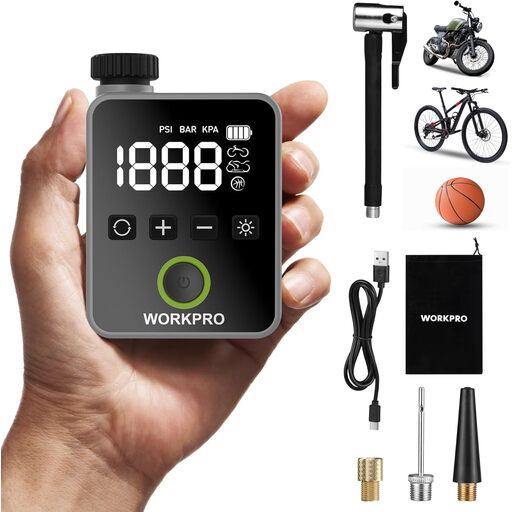
Why This Fits Their Persona: This user needs a lightweight, compact tool to stash in a backpack or pannier for rides. At just 270g, this mini inflator is built for portability without sacrificing the high pressure needed for bike and motorbike tyres.
It directly avoids the "one-size-fits-all" trap by clearly stating it is not suitable for car tyres. This honest positioning ensures buyers get a tool perfectly suited for its intended purpose.
Its primary advantage is its ultra-compact and lightweight design. The inclusion of a multi-mode LED light (steady, flash and SOS) is a practical bonus for roadside repairs in low light.
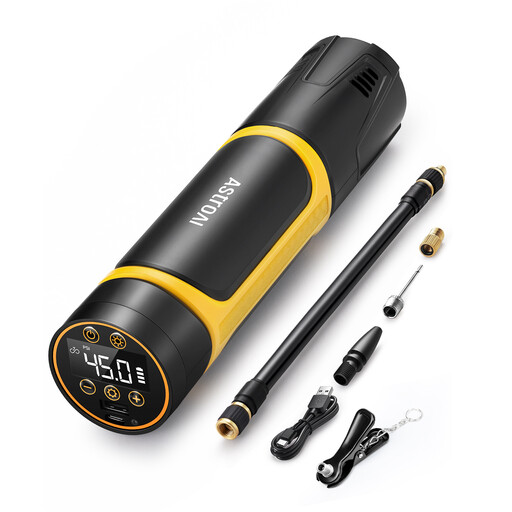
Why This Fits Their Persona: This user needs a versatile tool for the family car, the kids' bikes and the odd football. This AstroAI model is a true multi-purpose inflator, capable of handling a wide range of tasks from car tyres to bike tyres.
It tackles the inaccurate gauge problem with a clear LCD screen and an auto-shutoff feature that stops at the preset pressure. Its 4500mAh total battery capacity (3x1500mAh) provides a realistic power reserve, avoiding the empty promises of smaller units.
The 5 intelligent inflation modes (car, bike, etc.) simplify operation. A standout feature is the USB output, allowing it to double as a power bank to charge your phone in an emergency.
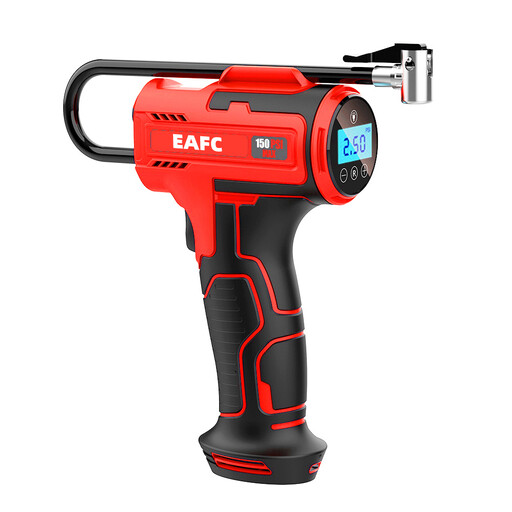
Why This Fits Their Persona: This user prioritises readiness and power. They likely drive a larger vehicle like an SUV and want a robust inflator that lives in the boot for any eventuality, from slow leaks to significant pressure loss on a long journey.
It directly counters the battery myth with a substantial 4000mAh battery (2x2000mAh cells), providing the necessary power reserve for larger volume car and SUV tyres without making unrealistic claims.
Its key advantage is its focus on vehicle inflation. The combination of a large battery, digital display with auto-shutoff and suitability for SUVs makes it a reliable emergency tool.
We have compiled a complete, real-time list of products that fully satisfy these strict selection criteria and UK safety regulations.
The lifespan of a cordless tyre inflator depends on its build quality, motor and how it's used. A well-made device should provide several years of reliable service. The lithium-ion battery is often the component with the most limited lifespan, typically degrading noticeably after 300-500 full charge cycles. To prolong its life, avoid storing it fully discharged for long periods.
While convenient, leaving your inflator in the car during extreme UK winter cold can be detrimental. Low temperatures significantly reduce a battery's efficiency and its ability to deliver power. Most manufacturers specify an operating and storage temperature range. For optimal performance and longevity, it is advisable to store the device indoors and bring it with you on journeys during the coldest months.
No, it is not strictly necessary, as most car tyres only require 30-40 PSI. However, the 150 PSI rating is an indicator of the pump's overall power and robustness. It means the motor can comfortably and quickly reach standard car pressures without straining, which can lead to better durability and a longer lifespan. This high-pressure capability also makes it versatile enough for other items like road bike tyres.