
24/7 Customer Support

Free returns

Same-day & Next-day Delivery

Quality Guaranteed

Unlock Your Welcome Offers: FREE Delivery | Up to 80% OFF | Free 30-day JoyPlus trial
Download the APP
Digital kitchen scales can make recipes more consistent, simplify meal preparation and reduce the guesswork involved in portioning ingredients. However, a low price or long feature list does not always indicate a suitable purchase. The right model depends on what you weigh, how often you use it and whether you need simple measurements or connected nutritional tracking.
A scale that measures up to 10kg may sound versatile, but high capacity is not automatically useful for small quantities. Yeast, spices and coffee often require finer readings than flour or vegetables.
For everyday cooking and baking, 1g increments are generally practical. Coffee enthusiasts and users weighing very small quantities may prefer 0.1g precision, although these models commonly have a lower maximum capacity.
Bluetooth kitchen scales can connect to an app for food logging, calorie estimates and nutrient records. This can be helpful for meal-preppers and people tracking portions, but it may be unnecessary if you only need to weigh flour or pasta.
Before buying a smart nutritional scale, check:
Glass and stainless-steel platforms are usually straightforward to wipe clean, but electronic scales should not be immersed in water. Consider the size of your usual bowls, the available worktop space and whether the controls can be reached when a large container is in place.
A compact design is useful in a UK flat or smaller kitchen, while a broader platform can provide better stability for mixing bowls.
A 5kg kitchen scale is suitable for most home cooking, baking and meal-preparation tasks. It can accommodate ingredients in a bowl while leaving useful headroom below the maximum limit.
For heavier ingredients or larger batches, a 10kg model may be more suitable. For coffee, spices or small recipe quantities, look for 0.1g precision kitchen scales. Always check the minimum weighing amount as well as the maximum capacity.
A tare function resets the display to zero after placing a bowl or adding an ingredient. This allows you to weigh several ingredients in one container, reducing washing-up and improving recipe consistency.
Scales with tare function are particularly useful for baking, where flour, sugar and liquids can be added sequentially. Confirm that the tare control is easy to operate and positioned away from areas likely to be covered by a bowl.
Useful units include grams, kilograms, ounces and pounds. Some digital food scale models also display millilitres, although liquid volume readings are based on assumptions about density and may not replace a measuring jug for every ingredient.
For everyday use, check whether the display is readable in your kitchen lighting, whether the scale switches off automatically and whether it uses AAA batteries, rechargeable power or an alternative system. A battery-free model can reduce battery purchases but may require winding before use.
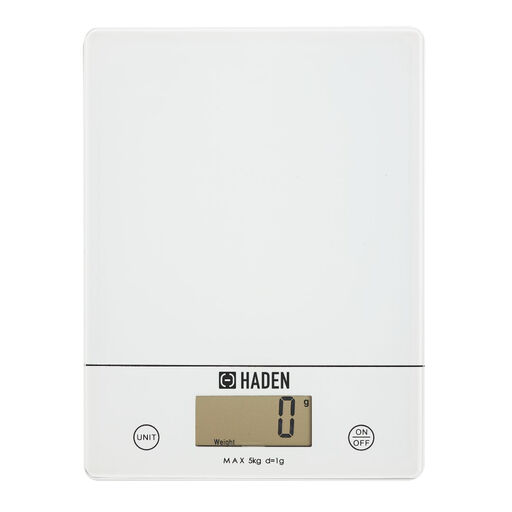
Why This Fits Their Persona: A straightforward option for UK households wanting one scale for cooking, baking and occasional portioning, without app connectivity.
Its stated 5kg capacity and 1g increments are more practical for general kitchen use than selecting a small precision scale for every task.
Tempered glass platform, touch controls, multiple units, automatic shut-off and low-battery and overload indicators.
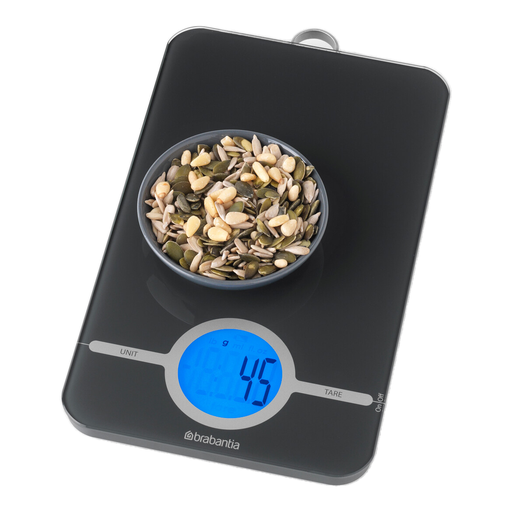
Why This Fits Their Persona: Suits regular bakers and cooks who value a polished, slim design with convenient add-and-weigh operation.
The integrated tare controls address the inconvenience of weighing each ingredient in separate bowls.
Measures up to 5kg in 1g graduations, includes a backlit LCD display, automatic power-off and a hanging hook.

Why This Fits Their Persona: Designed around pour-over preparation, making it a more suitable choice for users who want weighing and timing in one compact unit.
It provides stated 0.1g precision and a timer, rather than relying on a general cooking scale for brew timing.
2,000g capacity, 0.1g sensitivity, flow-rate function, USB-C rechargeable battery and g/oz conversion.

Why This Fits Their Persona: A practical match for households recording food intake, preparing portions or managing shared meal-planning data.
Its Bluetooth and app functions are specified for food logging, rather than adding connectivity without a clear use case.
5kg capacity, 1g increments, stainless-steel platform, multiple units and compatibility with listed health-tracking apps.
We have compiled a complete, real-time list of products that fully satisfy these strict selection criteria and UK safety regulations.
Place the scale on a flat, stable surface before switching it on. Put the empty bowl on the platform, press tare, then add ingredients gradually. Avoid placing hot pans directly on the weighing surface unless the manufacturer specifically permits it.
For consistent results:
A well-chosen digital kitchen scale should match your actual routines rather than simply offering the longest feature list. For most households, 1g increments, a 5kg capacity and a reliable tare function cover everyday cooking. Coffee users may need finer precision and timing, while meal-preppers may benefit from Bluetooth and nutritional logging.
Models offering 1g increments are generally suitable for common home-baking ingredients such as flour, sugar and butter. For very small quantities, check for 0.1g precision and the manufacturer’s stated minimum weighing amount.
Lifespan depends on battery care, cleaning and protection from moisture or overload. Wipe the surface rather than immersing the scale, store it in a dry place and avoid leaving heavy items on it when not in use.
Running costs are usually limited to replacement batteries or occasional charging electricity. Battery-free models avoid standard battery purchases, while USB-rechargeable scales can be convenient for frequent use. Check the power type before ordering so it suits your kitchen routine.