
24/7 Customer Support

Free returns

Same-day & Next-day Delivery

Quality Guaranteed

Unlock Your Welcome Offers: FREE Delivery | Up to 80% OFF | Free 30-day JoyPlus trial
Download the APP
For many of us in the UK, the line between the living room and the office has blurred. With more time spent at a desk than ever before, the aches and pains that come from an unsuitable chair are becoming all too familiar. Choosing an ergonomic office chair seems like a straightforward solution, but the market is filled with products that promise comfort and deliver disappointment.
As a Joybuy Product Recommendation Officer, my role is to help you see past the marketing jargon. Before you invest in a new home office chair, let's look at the common pitfalls that lead to buyer's remorse and how you can secure a chair that genuinely supports your health and productivity.
A chair with a high price tag and an "ergonomic" label doesn't automatically guarantee quality. Many fall short in key areas, often due to design compromises that are not obvious at first glance.
To avoid these traps, focus on the mechanical and material specifications. These are the non-negotiable elements that define a truly supportive and durable desk chair for back pain.
Look for a chair where the lumbar support is not just a static feature. A quality adjustable lumbar support chair will allow you to modify its height and, in some cases, its depth (how much it pushes forward). The most advanced systems are self-adaptive, meaning the support flexes and moves with you as you shift your posture throughout the day. This dynamic support is crucial for preventing lower back strain during long working sessions.
A chair should adapt to you, not the other way around. Beyond simple gas-lift height adjustment, here are the key features to look for:
high back computer chair will allow you to recline and lock the backrest in several positions. The tilt tension control lets you adjust how much force is needed to lean back, ensuring the chair feels stable and responsive to your movements.The materials determine a chair's longevity and comfort. A mesh ergonomic chair is often a good choice for its breathability, which prevents heat build-up and its ability to distribute weight evenly without creating pressure points. Check the frame and base material; powder-coated steel or a polished aluminium alloy is far more durable than a simple plastic base. Also, look for certifications like BIFMA (Business and Institutional Furniture Manufacturer's Association) or EN 1335, which are independent standards that verify the chair's safety, durability and structural integrity.
Based on these strict criteria, we filter products to find those that offer genuine ergonomic value. Here is a recommendation for professionals seeking a comprehensive solution.
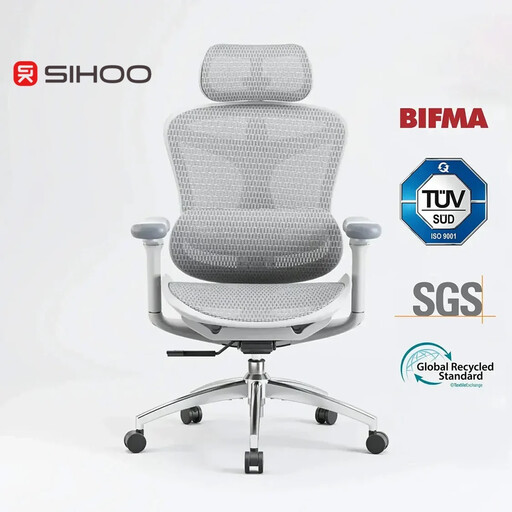
Why This Fits Their Persona: For the professional spending 8+ hours a day at their desk, this chair addresses the need for continuous, responsive support. It's built for long-term use where static chairs fail, making it a sound investment in daily comfort and health.
It features a self-adaptive lumbar support system that moves with your body, avoiding the "one-size-fits-all" issue. The full mesh construction provides firm, breathable support, steering clear of foam that degrades over time.
The intelligent weight-sensitive mechanism automatically adjusts recline tension. It also holds multiple safety certifications, including EN1335 and BIFMA, confirming its build quality.
An ergonomic chair is the foundation of a healthy workspace, but it is only one part of the equation. To complete your setup, consider the height and flexibility of your work surface. A fixed-height desk can force you into an unnatural posture, even with a good chair.
A height-adjustable mobile desk offers the versatility to work from different locations in your home, such as a sofa or bed, while maintaining a comfortable posture. The SIHOO D01 Overbed Table, for example, provides both height and tilt adjustment, allowing you to position your laptop at the correct eye level and angle wherever you choose to work. It is a practical solution for creating a flexible and ergonomic environment beyond the traditional desk. It is available in several finishes to match your home decor, including Dark Walnut, Maple and White.
We have compiled a complete, real-time list of products that fully satisfy these strict selection criteria and UK safety regulations.
The lifespan of an ergonomic chair depends heavily on its build quality and materials. A chair with a steel frame, a high-quality gas lift and durable mesh or fabric should provide reliable service for 5 to 10 years. Look for products with a multi-year warranty and certifications like BIFMA, as these indicate the manufacturer has tested the chair for long-term, intensive use.
For most users, especially those who sit for long hours, a mesh ergonomic chair offers distinct advantages. The primary benefit is breathability, which is particularly welcome during warmer months in the UK. High-quality mesh also provides firm, consistent support that distributes your weight evenly, unlike foam padding which can compress and create pressure points. However, personal preference matters, and some may prefer the initial softness of a padded seat.
Proper setup is key to unlocking the benefits of your chair. Follow this simple checklist: