For gaming and creative coursework at one desk, start with a Windows desktop specified for the most demanding course software: a ready-built system reduces assembly work, while a configurable or creator-focused desktop gives you more control over the parts chosen. Epic Games recommends 32 GB RAM and at least 8 GB graphics memory for Unreal Engine, and the Blender Foundation lists 32 GB RAM and 8 GB graphics memory among its recommended Windows specifications. Choose a laptop when you need to carry your work between locations, but check its exact configuration against your course requirements.
Who is this decision for?
The right PC depends on the software used for your projects and whether your work needs to travel with you.
Game-design students building 3D projects
If your modules use game engines and 3D tools as well as games, check the course’s required versions and project work before choosing hardware. The University of Surrey names Unreal Engine, Unity and Maya among its games-design tools; the University of Staffordshire London also names Maya, 3ds Max, Substance Suite and Unreal Engine.
Home-based gamers doing creative coursework
If the computer will stay at one desk, compare desktop configurations against your planned 3D work as well as your games. Epic Games’ Unreal Engine and the Blender Foundation’s Windows recommendations give useful RAM and graphics-memory checks, though your course projects may have different demands.
Students who need to carry their work
A laptop lets you take the same computer between home, campus and presentations. Check its memory, graphics, storage and support terms as a particular model and configuration, rather than assuming that a gaming or creator label settles the choice.
What should you check before choosing?
Begin with the course software and your largest expected projects, then decide whether a ready-built desktop, a configurable or creator-focused desktop, or a portable laptop fits the way you will work. A creator-focused label is useful only if the actual parts suit both the creative applications and the games you plan to use.
| Priority |
What to check |
Your needs |
| Course compatibility |
Confirm required application versions, operating system and plugins with your course. Epic Games’ recommended Unreal Engine hardware specifies Windows 11 and DirectX 12-compatible graphics; check other tools against their own requirements. |
I need the computer to run the software and assessment workflow my course actually uses, not just games with similar-looking graphics requirements. |
| System memory |
Compare the exact RAM configuration with your main applications. Epic Games recommends 32 GB for Unreal Engine, and the Blender Foundation recommends 32 GB for Blender on Windows; Autodesk recommends 16 GB or more for Maya 2026. |
If I expect substantial Unreal or Blender projects, I want to choose memory for that work rather than assume a game’s requirements cover it. |
| Graphics |
Check the graphics-card model and its stated memory separately. Epic Games recommends at least 8 GB graphics memory for Unreal Engine; the Blender Foundation recommends 8 GB for Blender on Windows. |
My 3D scenes and course tools matter alongside gaming, so I need to know what graphics hardware the particular PC contains. |
| Storage and expansion |
Check SSD capacity for applications, games and project files. For a configurable desktop, confirm the selected memory and storage and ask what its motherboard, case and power supply allow you to change later. |
I want space for course files and games, and I may want to adapt a desk-based PC as projects change. |
| Portability and support |
Decide whether you need to carry the computer. Read the terms for the exact system: Scan states that its 3XS desktops have three years of warranty cover, with onsite service in year one and return-to-base service in years two and three, while its 3XS laptops have a two-year warranty. |
If I regularly work on campus, carrying one laptop may be worth prioritising. If I work at one desk, I can compare desktop configurations without making portability the deciding factor. |
What mistakes should you avoid?
-
Choosing by the gaming label alone
A gaming PC’s name does not establish that its RAM and graphics memory meet your creative software’s recommendations. Epic Games recommends 32 GB RAM and at least 8 GB graphics memory for Unreal Engine; the Blender Foundation lists 32 GB RAM and 8 GB graphics memory as recommended for Blender on Windows.
Compare the exact listed configuration with the applications and project work in your course brief.
-
Treating a minimum requirement as a coursework target
Requirements differ between applications and workloads. Unity recommends at least 8 GB RAM for its Editor and notes that performance varies with project complexity, while Unreal Engine and Blender publish higher recommended-memory figures for their stated setups.
Ask your course team about the engines, software versions and scale of projects you will use, then check the relevant recommendations rather than selecting from a single minimum figure.
-
Assuming graphics memory tells the whole laptop story
System RAM and graphics memory are separate specifications. A GIGABYTE AERO X16 configuration has 8 GB graphics memory but 16 GB system RAM; that RAM is below Epic Games’ 32 GB recommendation for Unreal Engine.
If you need a laptop, check both memory figures, its storage and the exact model’s support terms before deciding whether it fits your projects.
-
Overlooking terms for a configured build
A configured desktop calls for a final check of the parts selected and the seller’s cancellation, returns and warranty terms. Support also differs by product line: Scan describes different warranty periods for its 3XS desktops and laptops.
Save the final specification and read the terms for that particular order before placing it.
Which brands and product lines are relevant?
These examples illustrate configuration and support choices; a brand or product-line name does not establish that a particular PC meets your course requirements.
PCSpecialist
PCSpecialist offers configurable gaming desktops for buyers who want a builder-assembled system with selected components.
- PCSpecialist says its gaming-PC configurator lets buyers choose the processor, graphics card, memory and storage, and advertises a three-year premium warranty.
- Check the selected parts and the warranty terms for your finished configuration; the ability to configure a PC does not make every starting build suitable for creative coursework.
Scan 3XS
Scan 3XS covers assembled desktops, workstations, gaming PCs and laptops, with support terms that depend on system type.
- Scan states that 3XS desktops have a three-year warranty: onsite service in year one, then return-to-base service in years two and three.
- Scan states that 3XS laptops have a two-year warranty. Check the terms and hardware of the particular system rather than transferring desktop terms to a laptop.
GIGABYTE AERO
The AERO X16 is a laptop example for someone who needs to take gaming and creative work between locations.
- An AERO X16 configuration specifies 16 GB DDR5 RAM, a 1 TB SSD and GeForce RTX 5070 graphics with 8 GB graphics memory.
- That listed 16 GB RAM is below Epic Games’ 32 GB recommended-memory figure for Unreal Engine; check the configuration against your own projects.
Joybuy PCs for study and gaming
These listings include ready-built gaming desktops for a desk-based setup and one laptop for work that needs to travel. Compare each exact configuration with your course software; the desktop listings are not examples of a self-build route.
 No image available
CyberPowerPC JOYB1013, Ryzen 7 9800X3D, RTX 5080 16 GB
A ready-built desktop to assess for gaming and 3D coursework at one desk. Its listed configuration includes 32 GB DDR5 RAM, a 2 TB NVMe SSD and Windows 11 Home; compare the software you will use with those specifications. Check which monitor and other peripherals you need for your setup.
View on Joybuy
 No image available
CyberPowerPC JOYB1010, Core Ultra 7 265KF, RTX 5070 12 GB
A ready-built option for gaming and creative work at a fixed desk. The named configuration has 32 GB DDR5 RAM, a 1 TB NVMe SSD and Windows 11 Home. Check whether that storage capacity and the peripherals you have suit your coursework setup.
View on Joybuy
 No image available
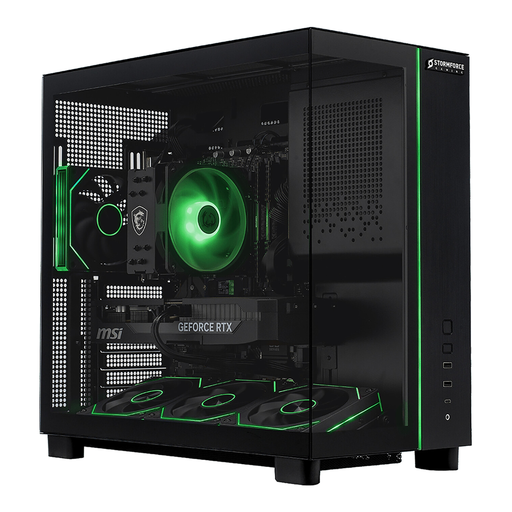
Stormforce Defiance, AMD Ryzen 7, 32 GB RAM, 2 TB SSD
This desk-based gaming desktop lists Windows 11 alongside its 32 GB RAM and 2 TB SSD. Confirm the graphics card before choosing it for a course requirement: the listing title says RTX 5070 Ti, while its descriptions say RTX 5070.
View on Joybuy
 No image available
Stormforce Cyclone, Core i7, RTX 5080, 32 GB RAM
A desktop option for gaming and creative projects in a fixed workspace, with a listed 2 TB SSD and Windows 11. Its stated 22 kg weight makes placement worth planning; check your desk space, peripherals and course software before ordering.
View on Joybuy
 No image available
Lenovo LOQ Essential 15ARP11, Ryzen 7 170, RTX 5050
A portable option when the same computer needs to go between study locations. The named configuration includes 16 GB RAM, a 1 TB SSD and a 15.6-inch 144 Hz FHD display. Its listed maximum of 16 GB system RAM is below the 32 GB recommended by Epic Games for Unreal Engine and by the Blender Foundation for Blender on Windows, so check your course workload before choosing it.
View on Joybuy
Common questions
Is 16 GB RAM enough for a game-design PC?
It depends on the applications and projects: Autodesk recommends 16 GB or more for Maya 2026, while Epic Games recommends 32 GB for Unreal Engine and the Blender Foundation recommends 32 GB for Blender on Windows. If substantial Unreal or Blender work is expected, compare PCs against those higher recommended figures and confirm your course’s own requirements.
Do I need Windows for game-design coursework?
Not for every creative application, but the operating system must suit your course’s required tools and workflow. Epic Games’ recommended Unreal Engine hardware specifies Windows 11, while Unity publishes Windows Editor requirements. Check the course’s software versions, plugins and assessment instructions before choosing another operating system.
Should I choose a gaming desktop or a creator-focused desktop?
Choose by the work each configuration must handle, not its label. A gaming desktop can serve both purposes if its parts meet your course software’s requirements; a creator-focused configuration is worth comparing when rendering, 3D assets or extensive multitasking shape your component choices. Check the actual processor, RAM, graphics memory, storage and operating system in either case.


