
24/7 Customer Support

Free returns

Same-day & Next-day Delivery

Quality Guaranteed

Unlock Your Welcome Offers: FREE Delivery | Up to 80% OFF | Free 30-day JoyPlus trial
Download the APP
Garages, sheds and workshops often become storage spaces by necessity. Garden equipment, paint tins, power tools, spare parts and seasonal boxes can quickly cover the floor, leaving little room to work. Heavy duty garage shelving units can create useful vertical storage, but comparing them by appearance alone can lead to an unsuitable purchase.
The most common buying traps are easy to miss:
A sensible purchase starts with the specifications rather than the marketing language.
A static load capacity describes the maximum weight supported when items remain stationary and are distributed correctly. It does not mean that a shelf is suitable for dropping heavy machinery onto or placing all the weight at one edge.
For example, a 5-tier steel shelving unit rated at 175 kg per tier and 875 kg in total offers a different capacity from a unit rated at 120 kg per tier and 600 kg overall. Check whether the stated figure applies to:
For everyday garage storage, keep heavier items on the lower tiers where possible. This can also help reduce the risk of the unit becoming unstable when frequently accessed.
Measure the available area, including skirting boards, pipes, doors, windows and vehicle clearance. Record the maximum:
Adjustable garage shelving is useful when your storage includes both shallow tool cases and taller containers. Some models use fixed spacing, while others allow shelf positions to be changed in set increments. A unit with shelves adjustable in 5 cm increments, for instance, gives more control over how vertical space is used.
Steel frames are generally suited to workshop storage shelves and warehouse racking applications because they provide a rigid framework. However, frame material alone does not determine suitability. Check the shelf-board material, frame thickness where stated, crossbars, feet and included fixings.
A boltless shelving unit with an interlocking design can be convenient for home assembly. It may not require a drill or spanner for the basic build, but you should still follow the instructions, wear work gloves and use the supplied anti-tip kit. Place the unit on a firm, level surface and secure it to the wall when instructed.
MDF shelves can offer a flat surface for boxes and tools, but keep them dry. For sheds or areas prone to condensation, inspect the boards regularly and avoid exposing them to standing water. If you need metal shelving for a shed, galvanised steel can be a practical option, although the surrounding environment and shelf-board material still matter.
The right choice depends on what you store and how often you access it. A homeowner organising decorations may value adjustable shelves and a compact footprint. A tradesperson may prioritise shelf capacity and easy access to tool cases. A small business may need modular storage shelving that can be reconfigured as stock changes.
The following options match different UK storage situations.
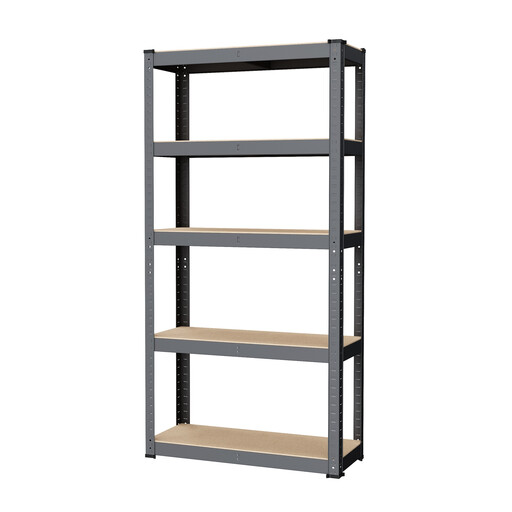
Why This Fits Their Persona: Its 75 x 30 x 150 cm footprint is suitable for homeowners who need vertical storage without filling a full garage wall. It can also be divided into two units for a different layout.
The listing separates its 650 kg total capacity from the 130 kg rating for each tier, making comparison clearer than relying on one headline number.
Steel frame, adjustable shelves, boltless interlocking assembly and an included anti-tip kit.
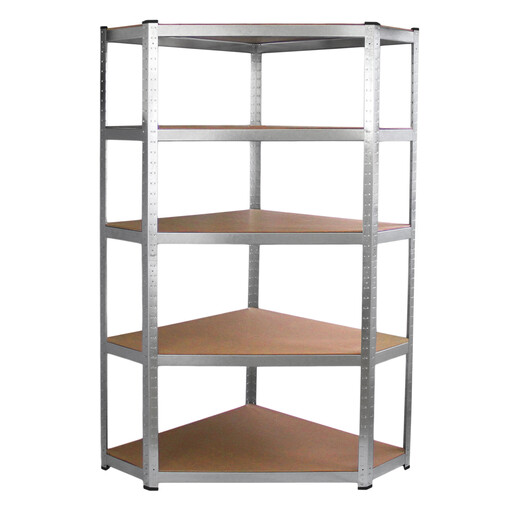
Why This Fits Their Persona: This corner configuration suits organised garages, workshops and small businesses seeking to use an otherwise awkward corner for storage.
Its 30 cm depth is stated clearly, helping buyers assess walkway clearance instead of assuming all heavy duty storage shelves have the same profile.
Galvanised steel frame, five 5 mm MDF shelves, feet and corner protectors, with boltless assembly.
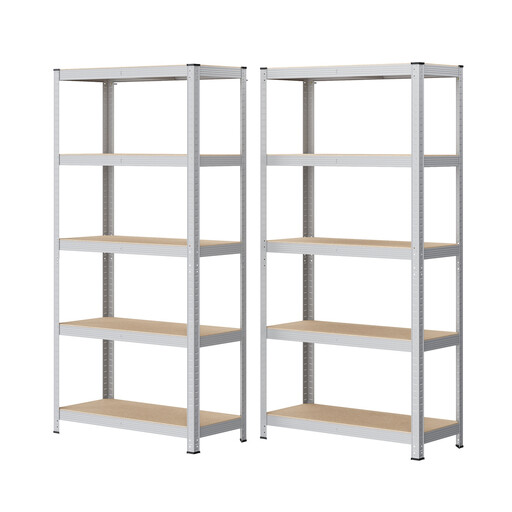
Why This Fits Their Persona: Tradespeople and workshop users can create two storage zones, or split the units between a garage and shed. Each unit measures 90 x 40 x 180 cm.
The listing states a 175 kg per-tier and 875 kg per-unit capacity, so buyers can compare usable shelf loading rather than only the pack size.
Two units, adjustable shelves, reinforced steel construction, boltless assembly and two anti-tip kits.
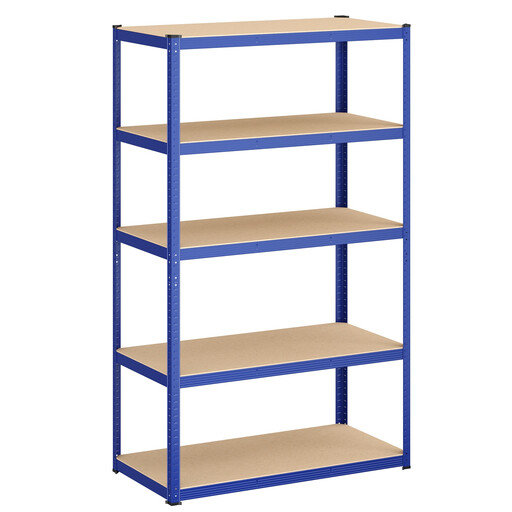
Why This Fits Their Persona: At 120 cm wide, 60 cm deep and 200 cm high, this unit provides substantial capacity for larger garages, workshops and stock rooms with generous floor space.
The 750 kg total rating is paired with a 150 kg per-tier rating, while the large dimensions are stated for proper space planning.
Five adjustable tiers, powder-coated steel frame, MDF shelves, split-unit configuration and included anti-tip kit.
Before assembling tool-free assembly shelving, check that the floor is flat and clear. Interlocking sections need to be fully seated; partially engaged supports can affect stability. Two-person assembly is sensible for taller units, particularly when positioning the upper frame.
Follow these practical precautions:
Shelving does not usually consume electricity, so ongoing running costs are negligible. The more relevant long-term considerations are moisture, overloading, impact damage and whether the configuration continues to suit your storage needs.
We have compiled a complete, real-time list of products that fully satisfy these strict selection criteria and UK safety regulations.
They can be, provided the dimensions fit and the environment is suitable. Check whether the frame is galvanised or coated, keep MDF shelves dry and use a stable, level base. Avoid placing shelving where rainwater or condensation can collect.
Boltless shelving can be suitable when correctly assembled and used within its stated static load ratings. The absence of bolts does not remove the need to seat every connector properly, distribute weight evenly and use anti-tip hardware where supplied.
Lifespan depends on loading, moisture, assembly quality and everyday impacts. Keeping shelves dry, avoiding overloading and checking connectors periodically can help maintain stability. Replace damaged boards or bent frame components rather than continuing to use them under heavy loads.