
24/7 Customer Support

Free returns

Same-day & Next-day Delivery

Quality Guaranteed

Unlock Your Welcome Offers: FREE Delivery | Up to 80% OFF | Free 30-day JoyPlus trial
Download the APP
A flat battery is more than an inconvenience; for owners of large SUVs, vans or trucks, it can bring your entire day to a halt. While a heavy duty jump starter seems like a simple solution, the market is filled with devices that over-promise and under-deliver. A dead battery on a cold morning is bad enough without discovering the emergency tool you bought is not up to the job.
As a Joybuy Product Recommendation Officer, my role is to help you see past the marketing clutter. Many UK drivers invest in a car battery booster only to be let down by common purchasing pitfalls. Before you buy, be aware of these frequent traps:
To choose a reliable portable jump starter, you need to understand the specifications that genuinely impact performance. Here are the core parameters to analyse.
When you see a product advertised as an 8000A jump starter, that number refers to the Peak Amps. This is the maximum electrical current the unit can discharge in an instant. However, the more important metric is the Starting Current (sometimes called Cranking Amps). This is the sustained power the booster can deliver for several seconds to turn over a cold or large engine. For a portable jump starter for trucks or vehicles with high-displacement engines, a higher starting current (e.g., 600A or more) is non-negotiable.
The battery capacity, measured in milliamp-hours (mAh), determines how much energy the jump starter power bank holds. A higher capacity means more starting attempts on a single charge or the ability to revive a completely dead battery. For large petrol engines (over 6.0L) and diesel engines (over 4.0L), look for capacities of 16,000mAh or higher to ensure you have enough power, especially during winter when batteries are less efficient.
Modern jump starters should come with "smart clamps" that contain a control box. This isn't just a gimmick; it houses the circuitry for critical safety features. At a minimum, look for:
Instead of a one-size-fits-all approach, we've matched our recommendations to specific user needs. This ensures you get a tool that is fit for your purpose.
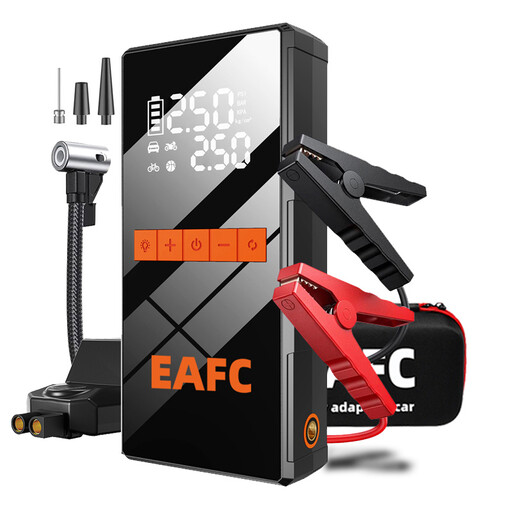
Why This Fits Their Persona: This is for the practical driver of a standard car or small SUV who values utility. The integrated air compressor and power bank function make it a versatile tool for road trips and general car maintenance, not just emergencies.
It has clear and realistic engine compatibility ratings (up to 4.0L petrol/2.0L diesel), avoiding the trap of over-promising power it cannot deliver.
The 4-in-1 design combines a jump starter, 150 PSI air compressor, power bank and LED torch, offering excellent value and saving boot space.
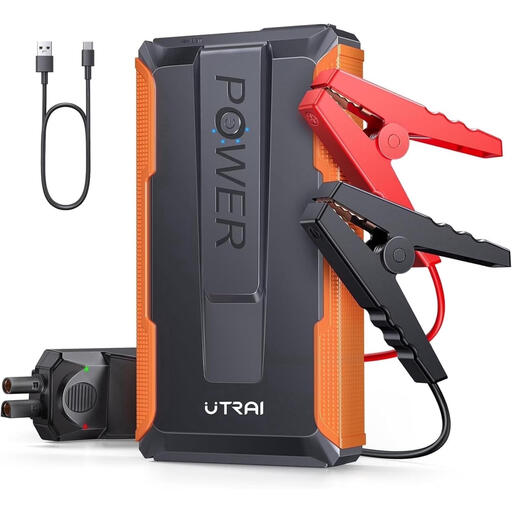
Why This Fits Their Persona: Ideal for owners of mid-to-large sized family cars, SUVs and light commercial vans in the UK. It provides a solid balance of power for engines up to 7.5L petrol/5.5L diesel without the bulk of a professional-grade unit.
It includes a full suite of safety features via its smart clamp, including audible alarms and LED indicators for incorrect connections, preventing user error and vehicle damage.
Features a Quick Charge 3.0 USB port, turning it into a genuinely fast-charging power bank for your devices. It also has a manual "Boost" button for starting completely flat batteries.
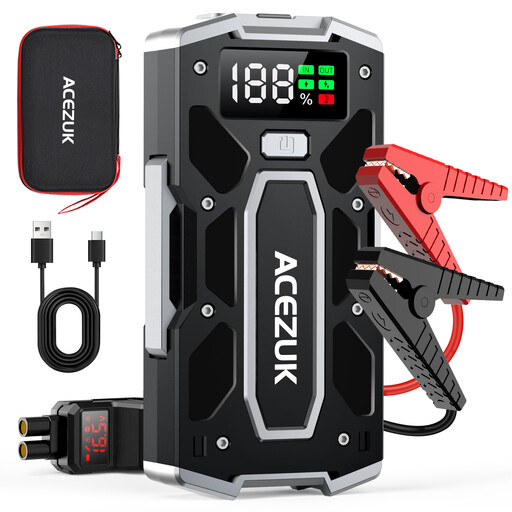
Why This Fits Their Persona: This is a true heavy duty jump starter for those with demanding needs: truck drivers, boat owners, mechanics and anyone with a large diesel engine up to 8.0L. Its high power output is designed for reliable starting of high-displacement vehicles.
Unlike units with vague claims, this model's 8000A peak power is backed by its stated ability to handle up to 10.0L petrol and 8.0L diesel engines, aligning its power rating with genuine heavy-duty capability.
The large LCD screen provides clear, real-time information on battery level and status. When looking at an ACEZUK M02 review, users often highlight this clarity and the sheer power as its main benefits.
We have compiled a complete, real-time list of products that fully satisfy these strict selection criteria and UK safety regulations.
Most manufacturers recommend recharging your jump starter every 3 to 6 months to ensure it's ready when you need it. A quality lithium-ion unit will hold its charge well, but self-discharge is inevitable over time. Storing it in extreme temperatures (very hot or cold) can also affect battery life. It's good practice to check its charge level before a long journey.
Yes, you can. Modern smart clamps are designed to deliver only the power the vehicle's battery requires. A powerful jump starter will not "overload" a smaller car's battery or electrical system, as the car's starter motor will only draw the current it needs. The safety features are there to prevent issues, making it safe to use a more powerful unit on a smaller vehicle.
A jump starter provides a large, immediate burst of power to start a vehicle with a flat battery. It is a portable, emergency tool. A battery charger, on the other hand, is designed to slowly recharge a battery over several hours. It plugs into a mains socket and is used for battery maintenance and recovery, not for immediate starting. Many jump starters can also function as a jump starter power bank to charge devices, but their primary function is not to slowly recharge a car battery.