
24/7 Customer Support

Free returns

Same-day & Next-day Delivery

Quality Guaranteed

Unlock Your Welcome Offers: FREE Delivery | Up to 80% OFF | Free 30-day JoyPlus trial
Download the APP
A flat battery can turn a routine commute, family trip or weekend outing into a roadside delay. A car jump starter offers a self-contained alternative to waiting for another vehicle, provided you select a model that matches your engine and keep it charged.
However, product listings can make comparison difficult. Large peak-current figures, high-pressure compressor ratings and broad vehicle compatibility statements do not always tell the full story. Before buying a portable car battery booster, check the specifications that affect real-world use.
A large peak-current number may look impressive, but it is not a complete indication of starting capability. Peak current is a short-duration figure, while starting demand varies according to engine size, temperature, battery condition and cable quality.
A suitable 12V jump starter should clearly state the petrol and diesel engine capacity it is designed to support. Avoid relying solely on phrases such as “for all vehicles” unless the listing provides specific compatibility information.
A jump starter with air compressor can be useful for topping up a tyre or inflating a bicycle tyre, but its pressure rating does not necessarily indicate how quickly it will inflate a car tyre. Check whether it includes an automatic shut-off, a readable display, suitable valve nozzles and an air hose long enough for your vehicle.
You should still use the vehicle manufacturer’s recommended tyre pressures, normally found in the handbook, fuel flap or door frame. A compressor is not a substitute for checking a tyre for puncture damage.
Even a high-capacity jump starter power bank may be unusable if it has been left in a glovebox for months without recharging. Lithium battery packs gradually lose charge in storage, and low temperatures can affect available output.
Look for a clear battery-level display and follow the supplied charging and storage instructions. Keep the unit secure, dry and away from excessive heat. It should be accessible without becoming a loose object in the passenger compartment.
Most portable vehicle boosters are intended for 12V systems, covering many cars, SUVs, motorcycles, vans and some leisure equipment. Confirm that the listed petrol or diesel engine limit is suitable for your vehicle. Diesel engines generally require greater starting assistance than smaller petrol engines because of their compression and glow-plug systems.
A booster designed for a smaller engine may not be the right choice for a large diesel SUV, pick-up or commercial vehicle. It is also important to confirm polarity and terminal connection instructions before use. A car jump starter should not be connected to a system unless the manual confirms compatibility.
Prioritise practical safety features, including:
Safety features do not remove the need to read the manual. Switch off the vehicle, keep metal objects away from the terminals and remove the clamps promptly after the engine starts, following the manufacturer’s instructions.
A vehicle battery booster may also work as a USB power bank, an LED torch jump starter or a portable tyre inflator. These features can be useful during breakdowns, camping trips and outdoor activities, but they should not distract from the core starting specification.
A display showing charge level is particularly practical because it helps prevent taking a depleted unit on a long journey. If you regularly travel at night, an SOS or strobe light may improve visibility when signalling for assistance. A storage case can also keep clamps, cables and nozzles together.
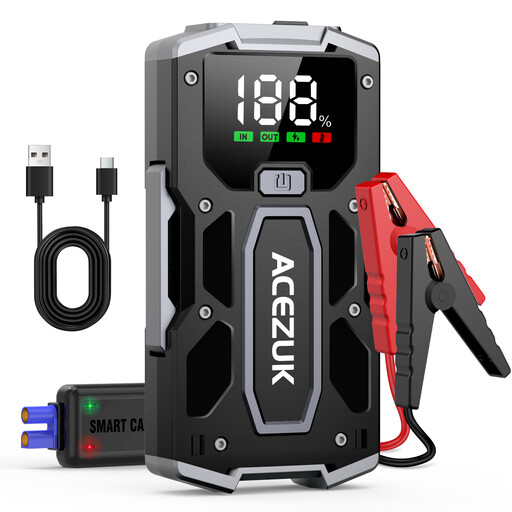
Why This Fits Their Persona: A practical option for everyday UK motorists who want a compact emergency starter with power-bank and lighting functions for occasional use.
The LCD display shows remaining battery level and temperature warnings, helping you identify when recharging is needed instead of discovering an empty unit during an emergency.
Rated for petrol engines up to 7.0L and diesel engines up to 5.5L; includes USB outputs and a multi-mode LED light.
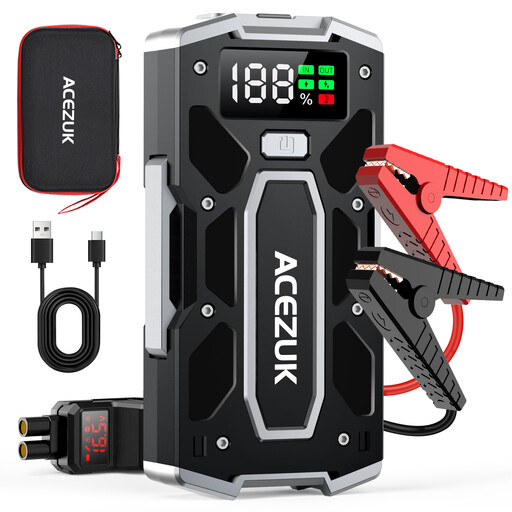
Why This Fits Their Persona: Suitable for drivers who want a higher-capacity unit for cars, SUVs, motorcycles, boats or garden machinery, with clear operating information.
The LCD screen displays battery level, input/output status and temperature alerts, while the clamp provides audible and visual connection warnings.
Rated for up to 10.0L petrol and 8.0L diesel engines; offers USB charging and a four-mode LED torch.
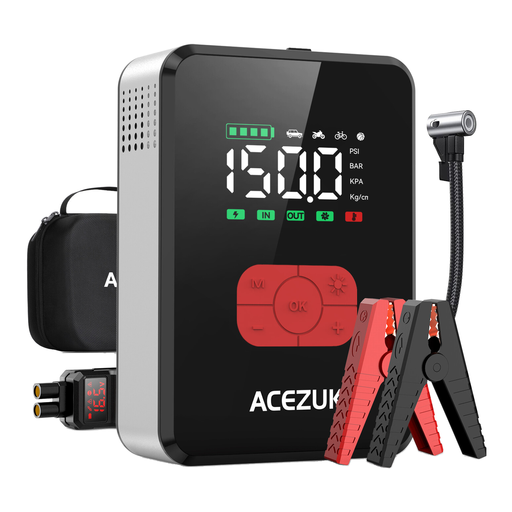
Why This Fits Their Persona: A multi-purpose choice for motorists, outdoor users and owners of several vehicles who want starting assistance and inflation equipment in one case.
Its compressor includes a display, automatic shut-off and four preset modes, making pressure selection more controlled than relying on a basic pressure-only pump.
Provides a stated 7,000A peak current and 150 PSI compressor; rated for petrol vehicles and diesel vehicles up to 12L.
Before an emergency, charge the unit fully and check the clamps, cable and casing for visible damage. Read the instructions for your specific model because connection sequences can differ.
A typical process is:
Do not use a jump starter near leaking fuel, damaged batteries or visible electrical faults. If the vehicle does not start after reasonable attempts, seek roadside assistance rather than repeatedly forcing the starter.
We have compiled a complete, real-time list of products that fully satisfy these strict selection criteria and UK safety regulations.
Some models are designed for both, but the supported engine capacities can differ. Check the manufacturer’s stated petrol and diesel limits rather than assuming that a high peak-current figure covers every vehicle.
The practical storage period depends on the battery design, temperature and how often it is used. Check the charge indicator regularly and recharge according to the manual. Avoid leaving it permanently in a hot vehicle, as high temperatures can affect battery condition.
It can be useful if you want one roadside kit for battery assistance, occasional tyre inflation, USB charging and lighting. If you only need a portable tyre inflator, a dedicated compressor may be smaller and more focused. For broader emergency coverage, a combined unit can reduce the number of items stored in the boot.