
24/7 Customer Support

Free returns

Same-day & Next-day Delivery

Quality Guaranteed

Unlock Your Welcome Offers: FREE Delivery | Up to 80% OFF | Free 30-day JoyPlus trial
Download the APP
A portable rechargeable fan can make a crowded train, warm office or outdoor event more comfortable, but compact cooling devices are not all designed for the same conditions. A pocket fan that works well at a desk may feel inadequate outdoors, while a high-speed handheld fan may be louder and heavier than expected.
The practical way to compare a handheld fan, mini portable fan or personal cooling fan is to look beyond headline motor speeds. Battery capacity, usable runtime, noise, charging requirements and how the fan is worn or held usually have a greater effect on everyday satisfaction.
RPM, wind speed and blade count can indicate how a fan is designed, but they do not tell the whole story. A very powerful airflow may be useful at a concert or campsite, yet uncomfortable at close range or distracting in a quiet office. Look for several speed settings rather than relying on one maximum figure.
Manufacturers usually quote the longest runtime at the lowest setting. A fan advertised for 20 or more hours may run considerably less at high speed. Compare the stated range, charging time and battery capacity together. A USB rechargeable fan with a 2,000mAh battery may be lighter, while a 5,000mAh model generally offers more reserve but adds weight.
A fan can be technically capable but inconvenient if it activates inside a bag, lacks a stand or needs constant hand-holding. Safety locks, lanyards, foldable bodies and hands-free options matter for commuters, travellers and gym users. For children, check the manufacturer’s instructions carefully; a portable fan is an electrical appliance, not a toy.
Battery capacity is measured in mAh, but runtime also depends on motor power and speed. For example:
Use only the specified or a suitable certified charger. Do not use a fan if its battery becomes unusually hot, swollen or damaged.
A quiet portable fan should offer a low setting suitable for an office, bedroom or public transport. High-speed turbo modes are more appropriate for open-air use, but may produce more audible motor and airflow noise. Some product specifications quote noise at a particular distance, so treat figures as a guide rather than a guarantee for every environment.
Five speeds allow finer adjustment than two or three. A scroll control or clearly marked speed buttons can also be easier to operate when walking or wearing gloves.
Choose the format around your routine:
For UK purchases, check the product listing for appropriate manufacturer information, safety instructions, charging details and a UK Responsible Person where applicable. Keep fans away from water, heavy rain, heat and loose hair. Never insert fingers or objects into an operating grille, and do not use a high-speed fan close to the eyes or face.
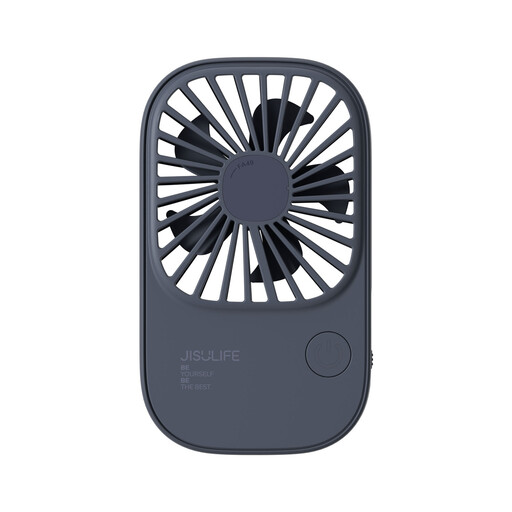
Why This Fits Their Persona: Its 104g ultra-slim format suits commuters, students and first-time buyers who want a pocket fan for daily travel without carrying a larger battery-operated fan.
Three speed settings provide more choice than a single fixed output, while the safety lock helps prevent accidental activation in a bag.
2,000mAh battery, USB-C charging, rear stand and lanyard; stated runtime is up to 14 hours on low speed.
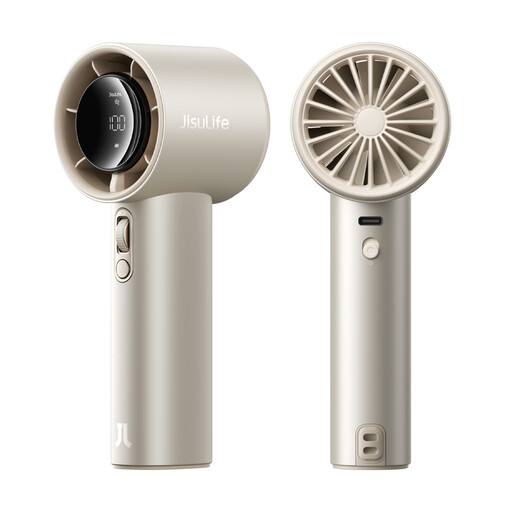
Why This Fits Their Persona: Suitable for shoppers who value detailed control, a metal-look finish and visible battery information for commuting, travel or events.
The LED display shows wind speed and battery level, reducing uncertainty around sudden shutdowns. Its scroll control offers adjustment across 100 levels.
5,000mAh battery, stated 1.5–2-hour charging time with compatible 18W input, LED display and 280g weight.
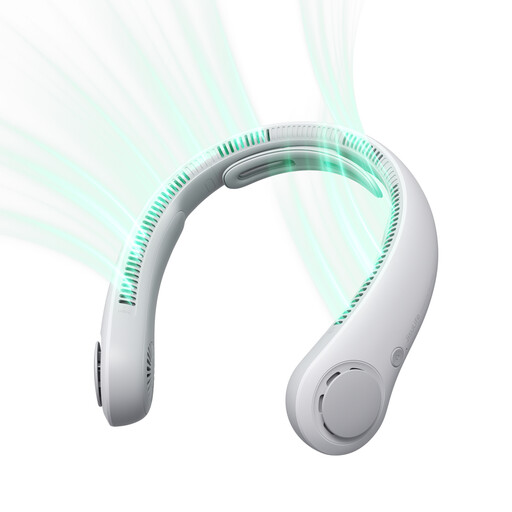
Why This Fits Their Persona: A hands-free choice for outdoor workers, gym users, concertgoers and travellers who need airflow while keeping both hands available.
The neckbrace design avoids continuous hand-holding, while five speeds help balance airflow and noise in different settings.
Bladeless format, 5,000mAh battery, USB-C charging and stated 2.5–16.5-hour operating range; weight is approximately 282g.
We have compiled a complete, real-time list of products that fully satisfy these strict selection criteria and UK safety regulations.
Charging time varies by battery size and input. Compact 2,000mAh models may take around three hours, while 5,000mAh fans commonly take three to five hours. Fast-charging models can be quicker when paired with a compatible adapter. Check the product specification rather than assuming every USB-C charger provides the same speed.
Small personal fans are often suitable for travel, but they contain lithium-ion batteries. Airline policies can differ, particularly for spare batteries and checked luggage. Keep the fan in your hand luggage where permitted, prevent accidental activation and check your airline’s current baggage guidance before flying.
A USB rechargeable fan generally uses relatively little electricity compared with larger mains-powered cooling appliances, but consumption depends on charging frequency, battery size and speed. Charging from a laptop, power bank or USB adapter is convenient, although using the highest setting continuously will shorten runtime and require more frequent recharging.