
24/7 Customer Support

Free returns

Same-day & Next-day Delivery

Quality Guaranteed

Unlock Your Welcome Offers: FREE Delivery | Up to 80% OFF | Free 30-day JoyPlus trial
Download the APP
Maintaining correct tyre pressure is one of the simplest yet most overlooked aspects of vehicle ownership. It impacts fuel efficiency, handling and, most importantly, your safety on the road. While the air pumps at petrol stations are an option, they can be inconvenient, costly and often out of order. A portable tyre inflator is a practical solution, giving you the freedom to check and top up your tyres anywhere, anytime.
However, the market is flooded with options, and it's easy to fall for marketing hype. Many drivers end up with a device that fails when they need it most. As the Joybuy Product Recommendation Officer, my role is to help you cut through the clutter and identify the features that truly matter. Before you buy, be aware of these common pitfalls.
The "Cordless Convenience" Trap: A cordless tyre inflator sounds ideal, but many cheaper models are fitted with small, low-capacity batteries. They might claim to inflate "tyres," but this often refers to bicycle tyres. When faced with a partially deflated car tyre, these units can run out of power before the job is done, leaving you stranded. The promise of convenience becomes a source of frustration.
The "Maximum PSI" Myth: Brands often advertise a high maximum pressure (e.g., 150 PSI) as a key feature. For a standard UK car, which typically requires 30-40 PSI, this number is largely irrelevant. The critical metric is airflow, measured in Litres Per Minute (L/min). A pump with a high PSI but low airflow will take an frustratingly long time to inflate a tyre. A slow pump is not just an inconvenience; it can be a safety issue on the side of a busy road.
Inaccurate Gauges and Missing Safety Features: A tyre pump with a pressure gauge is standard, but the accuracy can vary wildly on affordable models. An inaccurate gauge can lead to dangerous over- or under-inflation. Furthermore, a crucial feature is auto shut-off, which stops the pump once a preset pressure is reached. Without it, you are forced to constantly monitor the process, risking inaccurate inflation.
To ensure you get a reliable tool, focus on these non-negotiable specifications.
Your first decision is how the device is powered. There is no single "right" answer; it depends on your needs.
Ignore the maximum PSI and look for the airflow rating (L/min). For car tyres, an airflow of 20 L/min or higher provides a reasonable inflation speed. Anything lower will feel sluggish, especially on larger SUV or van tyres.
Equally important is the duty cycle. This is the maximum continuous running time recommended by the manufacturer before the unit needs to cool down. A cheap mini air compressor might have a duty cycle of only 5-8 minutes, after which it must rest for 10-15 minutes to prevent overheating and permanent damage. More robust models can run for longer, which is essential if you need to inflate multiple tyres.
For accuracy and ease of use, a digital tyre inflator is a significant upgrade over older analogue models. A clear digital screen allows you to see the current pressure and set your target pressure precisely.
The auto shut-off function is a must-have safety and convenience feature. Simply set your vehicle's recommended PSI, turn the pump on and it will automatically stop when the target is reached. This prevents dangerous over-inflation and allows you to attend to other things while it works.
Based on these practical criteria, we've matched a few standout products to different user needs.
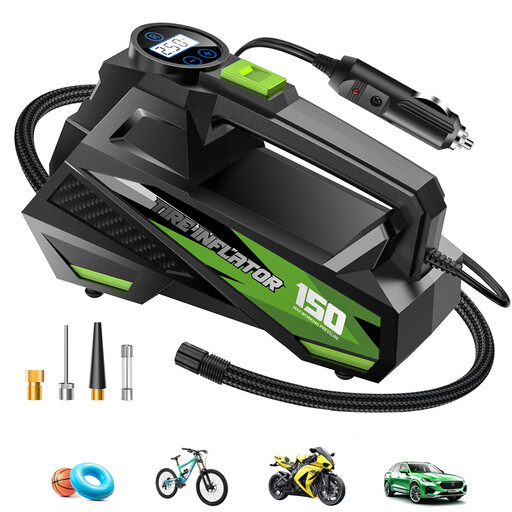
Why This Fits Their Persona: This user wants a simple, reliable tool that lives in the boot for emergencies or routine top-ups. They aren't concerned with fancy features, just that it works every time.
It sidesteps the "cordless convenience" trap by drawing reliable power from the car's 12V socket. You never have to worry about a dead battery in an emergency.
Its primary benefit is its simplicity and reliability. The extended power cord provides ample reach for all four tyres without needing to reposition the unit.

Why This Fits Their Persona: This user values high-performance gadgets that make life easier. They want a powerful, fast and multi-functional tool for their car that also serves other purposes.
It counters the weak battery pitfall with a large 7500mAh battery, providing enough power for multiple car tyre inflations. The digital gauge and auto-shutoff feature also avoid the accuracy trap.
Its strong airflow (35L/Min) ensures fast inflation, while the large battery doubles as a power bank to charge devices, making it a versatile emergency tool.
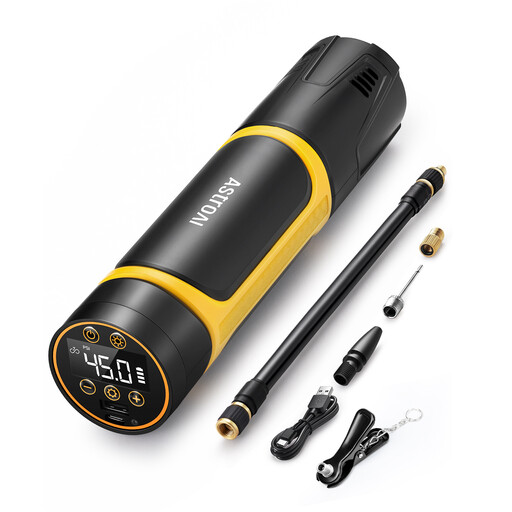
Why This Fits Their Persona: This person owns a car, a motorcycle and a bicycle. They need one compact, portable tool that can handle the different valve types and pressure requirements of all their vehicles.
It avoids the trap of being a one-trick pony. With 5 intelligent modes (car, bike, etc.) and included adapters for both Presta and Schrader valves, it's genuinely designed for multi-vehicle use.
Its key advantage is versatility. The preset modes and included nozzles remove the guesswork, making it easy to switch between inflating a high-pressure road bike tyre and a car tyre.
We have compiled a complete, real-time list of products that fully satisfy these strict selection criteria and UK safety regulations.
The lifespan of a portable air compressor for car tyres depends on its build quality and how it's used. A key factor is adhering to the duty cycle. Continuously running a pump beyond its recommended time will cause it to overheat, which can damage the motor and piston. A well-maintained inflator from a reputable brand, used according to instructions, should provide many years of reliable service. Always allow the unit to cool down between tyres.
Yes, but you must choose the right one. A basic mini air compressor designed for bicycles will struggle. For an SUV, you need a cordless model with a high-capacity battery (look for 6000mAh or more) and a strong airflow rating (25 L/min or higher). These more powerful units are specifically designed to handle the larger volume of SUV and van tyres. Always check the product specifications to ensure it is suitable for your vehicle type.
It is not recommended to leave a 12V tyre inflator plugged in when not in use. While it won't draw power when switched off, it's best practice to unplug accessories from the 12V socket to prevent any potential slow drain on your car's battery. For safety, only plug the inflator in when you are ready to use it and always run your vehicle's engine during operation to avoid draining the battery.